
Fact-checked by the Smart Insurance 101 editorial team
The Verdict
Dwelling coverage is worth getting right if your home’s replacement cost exceeds $200,000, which describes most U.S. homeowners. Set your limit to 100% of estimated rebuild cost, not market value or purchase price. It is not adequate if you base it on what you paid for the home, skip annual reviews, or skip an extended replacement cost endorsement in a high-risk area.
The single factor that swings your dwelling coverage amount decision is replacement cost, not what your home is worth on Zillow. According to Insurify’s 2025 analysis, the national average dwelling limit used in sample policy calculations is $300,000, but that number means nothing if it does not match what it would actually cost to rebuild your specific home from the ground up today. Get this wrong, and a covered loss can leave you holding the bill for the gap.
With construction costs still elevated after years of supply chain disruption and rising labor expenses, a quick glance at your declarations page is no longer enough.
| Factor | Reasons to Increase Your Dwelling Coverage | Reasons to Keep Coverage Lower |
|---|---|---|
| Replacement Cost Reality | Rebuild costs exclude land value and commonly exceed market price, especially in high-labor markets | If your home is modest, new construction, and costs were recently documented, the base estimate may be accurate |
| Underinsurance Risk | 18% of homeowners say they are underinsured; coinsurance penalties can reduce claim payouts below your actual loss | If you have already obtained a certified appraisal in the last 12 months, over-coverage adds unnecessary premium cost |
| Policy Linkage | Other coverages, including other structures (10%) and personal property (50-70%), scale off your dwelling limit | Raising the dwelling limit raises all linked sub-limits and your premium proportionally; only do it when needed |
| Inflation Exposure | Construction costs rose sharply from 2021-2025; policies without inflation guard or extended replacement cost can fall behind quickly | If your policy includes a guaranteed replacement cost endorsement, there is no cap risk regardless of limit changes |
| Renovations | Kitchen remodels, additions, and upgrades increase your rebuild cost; failing to update your limit creates immediate shortfalls | No recent improvements and no changes to home size mean your original estimate likely still holds |
| Lender Requirements | Most mortgage servicers require at least 100% of replacement cost as a condition of your loan | If your home is paid off, minimum state-required coverage may technically suffice, though it is rarely advisable |
Key Takeaways
- Your dwelling coverage limit should equal 100% of your home’s estimated rebuild cost, calculated per square foot using local construction costs, not the purchase price or assessed value.
- If your limit falls below 80% of replacement cost, many insurers apply a coinsurance penalty that reduces your claim payout proportionally, even if the loss is covered.
- After any renovation costing more than $10,000, update your dwelling limit to reflect the added rebuild value before your next renewal.
- Add an extended replacement cost endorsement of at least 25% above your base limit if you live in a region with volatile construction costs or recent wildfire or hurricane exposure.
- Review your dwelling coverage at least once per year; construction costs in many U.S. markets have risen by double digits since 2021, and a limit that was accurate then may now be short.
- Your other structures limit is automatically set at 10% of your dwelling amount and personal property at 50-70%, so undercovering the dwelling undercuts those protections too.
- A certified replacement cost appraisal, which typically costs between $300 and $500, can verify whether your insurer’s estimate is accurate and may be worth it for older or custom homes.
What Does Dwelling Coverage Actually Pay For?
Dwelling coverage pays to repair or rebuild the physical structure of your home and anything permanently attached to it after a covered loss. That includes the foundation, roof, exterior and interior walls, built-in appliances, plumbing, electrical systems, HVAC, and attached features like a garage or deck. The Washington State Office of the Insurance Commissioner describes it plainly: dwelling coverage provides for the repair or replacement of the damaged portion of your home and attached structures due to a covered loss, and most homeowner policies provide replacement coverage up to the limits within the policy.
Standard HO-3 policies cover your dwelling on an open-perils basis, meaning anything not explicitly excluded is covered. Common covered perils include fire, lightning, windstorm, hail, burst pipes, and theft damage. Common exclusions include flood (requires a separate NFIP or private flood policy), earthquake, normal wear and tear, and any maintenance-related deterioration. Your land value is never part of the calculation. If your home sits on a lot worth $80,000, that amount should be subtracted from your total property value before estimating what coverage you need.
Detached structures, like a freestanding garage or a shed, fall under the separate “other structures” coverage, which defaults to 10% of your dwelling limit. For a full picture of how dwelling protection fits within your overall homeowners policy, the Homeowners Insurance Guide: A Beginner’s Overview on this site breaks down each coverage component in detail.
Replacement Cost vs. Market Value: An Expensive Difference to Get Wrong
Setting your dwelling limit to your home’s market value is one of the most common and costly mistakes homeowners make. Market value includes land and reflects neighborhood demand; rebuild cost does not include land and reflects current labor rates, materials, and local code requirements. In many U.S. markets, rebuild cost runs significantly higher than sale price, especially in rural areas where land is cheap but skilled labor and materials are expensive to transport.
Here is a concrete example using verified figures. If your home has 2,000 square feet and local construction costs run $175 per square foot, your rebuild cost is approximately $350,000. According to Forbes’ 2025 homeowners insurance cost data, the average annual premium for a policy with $350,000 in dwelling coverage is $2,720, or about $227 per month. If you set your limit at only $280,000 (80% of that rebuild cost), you save a small amount on premium but expose yourself to a coinsurance penalty on any major claim. For a $100,000 fire loss, a policy at 80% of required coverage might only pay $80,000 after the penalty calculation, leaving you short $20,000 out of pocket.
Policies that base limits on purchase price often start underfunded from day one. A home bought in 2019 for $310,000 could cost $400,000 or more to rebuild in 2025 given cumulative construction inflation. This gap is where real financial exposure lives.
It is also worth noting how mortgage lenders treat this issue. Servicers like Chase and Wells Fargo typically require dwelling coverage equal to 100% of replacement cost as a loan condition, which means your lender has a stake in your limit being accurate. If your coverage lapses or falls short, the lender can force-place a policy at your expense, often at a significantly higher premium than what you would have chosen yourself.

How to Calculate the Right Dwelling Coverage Amount
Start with square footage and local per-square-foot construction costs. Multiply the two and you have a rough rebuild estimate. Local construction costs vary significantly: a 1,500-square-foot home might cost $130 per square foot to rebuild in rural Arkansas and $280 per square foot in coastal California. Your state’s department of insurance, your insurer’s online estimator, or a licensed public adjuster can all give you a starting figure.
From there, adjust upward for custom millwork, high-end finishes, a finished basement, energy-efficient features, or any major renovation completed in the last five years. The Indiana Department of Insurance recommends that homeowners know their home’s replacement value, review coverage regularly, and adjust limits according to building costs at the time of review. Annual review is standard practice, not optional guidance.
If you want a precise number, a certified appraisal from a licensed residential appraiser (not a real estate agent) gives you the most defensible figure. These typically run $300 to $500. For a home with custom features or one that was significantly renovated, that cost is minimal compared to the coverage gap it can close. You can also ask your insurer to recalculate using their proprietary replacement cost estimator tools, many of which use data from CoreLogic (formerly Marshall & Swift/CoreLogic). Do not simply accept the figure printed on your existing declarations page without verifying when it was last updated.
Some homeowners also cross-check estimates using tools from insurers like State Farm, Nationwide, or USAA, all of which publish replacement cost calculators for policyholders. These are reasonable starting points, though they vary in methodology and may use national averages that do not fully reflect hyperlocal labor costs.
Why So Many Homeowners End Up Underinsured
According to a 2025 survey by Kin Insurance, 18% of American homeowners self-report being underinsured on their home insurance. The actual rate is probably higher, since many homeowners do not know what their rebuild cost is in the first place. Meanwhile, a Policygenius study found that 56% of homeowners had not reviewed their home insurance policy in the prior year.
Construction cost inflation from 2021 through 2025 hit the residential market hard. Supply chain bottlenecks, elevated lumber prices, and increased demand from storm-related rebuilds across the Gulf Coast, Southeast, and Western U.S. pushed per-square-foot costs up by double digits in many regions. A dwelling limit calibrated accurately in 2020 may now be short by 20-30%, even if the homeowner never touched the house.
Post-disaster demand surges make this worse. After a major hurricane or wildfire, contractors flood the affected area and labor costs spike, sometimes by 40-60% above normal, for months or years. A policy written at pre-disaster construction rates will not cover post-disaster rebuild costs unless it includes an extended replacement cost or guaranteed replacement cost endorsement. This is the gap most standard policies leave open, and it does not show up on your declarations page in any obvious way.
The Federal Reserve’s tracking of producer price indexes for construction materials confirms that residential building costs remain elevated above pre-pandemic baselines. The CFPB has also flagged homeowner underinsurance as a consumer protection concern, particularly for lower-income borrowers who may not realize their coverage is insufficient until a claim is filed. The broader forces pushing premiums up are worth understanding too; the Insurance Premiums Are Exploding article on this site covers the macroeconomic drivers in detail.
Endorsements That Close the Gap Your Base Policy Leaves Open
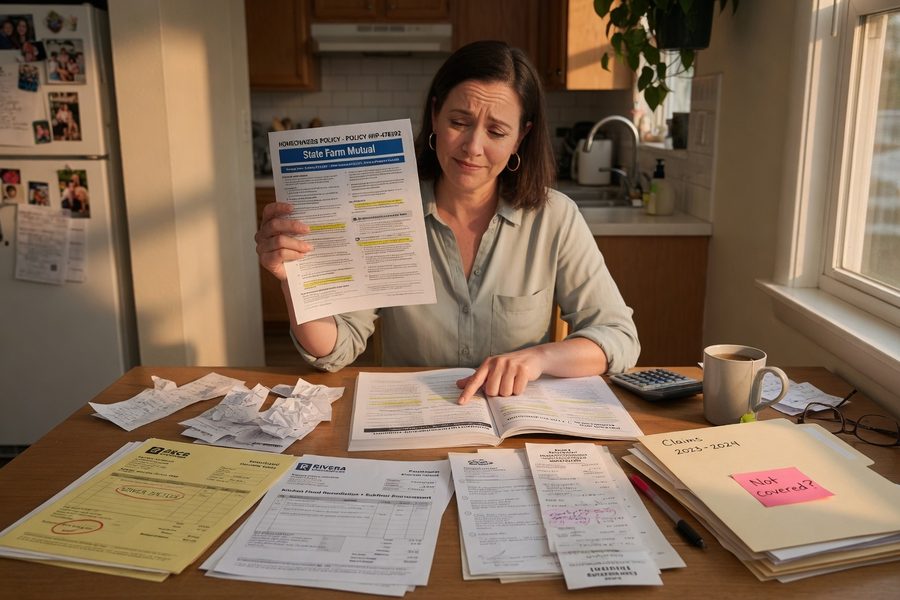
Two endorsements directly address underinsurance risk, and every homeowner should know the difference between them. An extended replacement cost endorsement raises your insurer’s maximum payout to 125% or 150% of your stated dwelling limit. If you set your limit at $350,000 and add a 25% extended replacement cost endorsement, your insurer will pay up to $437,500 on a total loss. This buffer absorbs moderate cost overruns without requiring you to reset your base limit every year.
Guaranteed replacement cost coverage has no cap: the insurer pays whatever it costs to rebuild your home to its pre-loss condition, regardless of your stated limit. This is the strongest protection available, but not all insurers offer it, and premiums are higher. For homes in wildfire-prone zones in California, Colorado, or Oregon, or in hurricane corridors along the Atlantic and Gulf Coasts, guaranteed replacement cost is worth the extra cost unless your base limit is verified annually by a professional appraisal.
A third endorsement worth knowing is ordinance or law coverage. When local building codes have been updated since your home was constructed, a rebuild may legally require upgraded electrical panels, additional fireproofing, or seismic retrofits. Without this endorsement, those code-driven costs can fall outside your claim settlement. For homes built before 1990, this gap can easily reach $15,000 to $50,000 on a major loss.
One honest caveat: even with guaranteed replacement cost in place, disputes over what qualifies as “pre-loss condition” do arise. Insurers like Allstate and Liberty Mutual define this differently in their policy language, and the settlement process can involve negotiation. Reading the endorsement terms carefully, not just the marketing summary, is worth the time. If you want to understand how coverage decisions like these fit into a broader cost-management strategy, the tips in How to Save Money on Your Homeowners Insurance are worth reading alongside this one.
Who Should and Who Should Not Prioritize Higher Dwelling Coverage
Good candidates
Most homeowners fall into this category, but these profiles have the clearest case for setting limits above the minimum and adding an endorsement.
- Homeowners in high-construction-cost states (California, New York, Massachusetts, Hawaii) where rebuild costs per square foot regularly exceed $200
- Anyone who completed a major renovation in the last five years without updating their dwelling limit
- Homeowners in wildfire, hurricane, or flood-adjacent zones where post-disaster contractor costs spike well above normal
- Owners of homes built before 1990, where ordinance or law coverage can prevent five-figure gaps from updated code requirements
- Homeowners with a mortgage, since lenders typically require coverage equal to 100% of replacement cost anyway
Who should skip higher limits
A few situations make a lower or static dwelling limit a defensible choice.
- Homeowners who obtained a certified replacement cost appraisal within the last 12 months and whose limit already matches the result
- Owners of new construction in low-labor-cost markets where the builder’s cost documentation is recent and complete
- Homeowners with a guaranteed replacement cost endorsement already in place, where the base limit is less critical because there is no cap on the payout
- Owners of vacation or secondary properties with minimal custom features and no recent renovations, where standard replacement cost estimates are straightforward to verify
Frequently Asked Questions
How do I calculate how much dwelling coverage I need?
Multiply your home’s square footage by the local per-square-foot construction cost for your area. A 2,000-square-foot home in a market where construction runs $175 per square foot needs roughly $350,000 in dwelling coverage. Adjust upward for custom finishes, recent renovations, or high-cost labor markets, and verify the number with your insurer’s replacement cost estimator or a certified appraisal.
Is dwelling coverage based on market value or replacement cost?
Replacement cost is the correct basis. Market value includes your land and reflects buyer demand, neither of which affects what it costs to rebuild the physical structure. In many markets, rebuild costs run higher than market value, so using market value as your limit almost always results in underinsurance.
What happens if my dwelling coverage is too low?
If your limit falls below 80-100% of your home’s actual replacement cost, most standard policies apply a coinsurance clause that reduces your claim payout proportionally. On a $100,000 covered loss, being insured to only 80% of required replacement cost can cut your settlement to $80,000, leaving you $20,000 short even though the loss itself was fully covered. Underinsurance does not show up until you file a major claim.
Does dwelling coverage include my personal belongings?
No. Dwelling coverage applies only to the physical structure and permanently attached components. Personal property, furniture, electronics, and clothing fall under a separate personal property coverage section, which typically defaults to 50-70% of your dwelling limit. Increasing your dwelling limit does proportionally raise your personal property sub-limit, which is one reason getting the dwelling amount right matters for your entire policy.
How often should I update my dwelling coverage amount?
At minimum, once per year at renewal, and immediately after any renovation costing more than $10,000. Construction costs in many U.S. markets have risen significantly since 2021, so a limit set three or four years ago may now be materially short. The Indiana Department of Insurance specifically recommends annual reviews as standard practice. For additional guidance on reviewing your overall homeowners insurance, see Important Homeowners’ Insurance Policies You Should Know.
Does a homeowners insurance policy automatically adjust for inflation?
Some policies include an inflation guard endorsement that automatically increases your dwelling limit by a set percentage, often 4-8% annually, at renewal. That may not be enough in years when construction costs spike by double digits. Automatic adjustments are a reasonable baseline, but they are not a substitute for manually verifying your limit against current local rebuild costs every year.
Sources
- Indiana Department of Insurance, Property Insurance Consumer Services
- Washington State Office of the Insurance Commissioner, Homeowner Insurance Guide (2025)
- Kin Insurance, 2025 Underinsurance Survey
- Insurify, Average Cost of Homeowners Insurance (2025)
- Forbes, Average Cost of Homeowners Insurance (2025)