Fact-checked by the Smart Insurance 101 editorial team
The Verdict
Freelancer health insurance over 40 is affordable without a group plan if your household income falls below $60,000 per year, making you eligible for ACA premium tax credits that can cut a $619/month premium to under $200. It is not cost-effective if your net income regularly exceeds $80,000 and you overlook the self-employed premium deduction, which alone can offset hundreds of dollars each month.
What does a 44-year-old graphic designer do when the agency job ends and the group health plan disappears with it? That is the real question behind freelancer health insurance over 40, and the answer turns almost entirely on one variable: your net self-employment income. Get that number right, and subsidies can make coverage genuinely manageable. Get it wrong, and you either overpay by hundreds each month or face a repayment bill from the IRS at tax time. Either way, the stakes are real and the margin for error is narrow once you hit your forties.
This matters more in 2026 than it did five years ago. Treasury Department data compiled by healthinsurance.org shows that 4.2 million small business owners and self-employed workers now rely on ACA Marketplace coverage, a number that keeps climbing as independent contracting becomes more common across creative industries. The tools exist to build affordable coverage without an employer. The trick is knowing which tools to use in which order.
| Factor | Reasons to Use Individual/ACA Coverage | Reasons to Look Elsewhere |
|---|---|---|
| Premium cost | Tax credits can reduce a $619/month plan to under $200 for qualifying incomes | Unsubsidized silver plans average $476–$619/month for a 40-year-old, steep if you earn too much to qualify |
| Pre-existing conditions | ACA plans cannot deny coverage or raise premiums for health history | Short-term plans, which are cheaper, can and do exclude pre-existing conditions |
| Tax deductibility | Self-employed premium deduction reduces adjusted gross income above the line via IRS Form 7206 | Deduction phases out if your net profit drops to zero, common in lean freelance years |
| Network access | Silver and Gold plans include broad specialist networks; PPO options exist in most states | HMO-only markets in some states limit specialist access without referrals |
| Enrollment flexibility | Losing employer coverage triggers a Special Enrollment Period; PEOs like Opolis offer year-round access | Missing open enrollment without a qualifying event means waiting months for coverage |
| Coverage gaps (designer-specific) | Major medical plans cover repetitive strain treatments, mental health, and vision referrals | Standalone dental and vision require separate plans at additional cost; rarely bundled in Marketplace plans |
Key Takeaways
- Your estimated net self-employment income (from Schedule C) falls between 100% and 400% of the federal poverty level, making you eligible for ACA premium tax credits
- You are willing to use an HDHP with a deductible of $1,650 or higher (2026 IRS minimum) in exchange for HSA-eligible tax savings
- You lost employer-sponsored coverage within the past 60 days, qualifying you for a Special Enrollment Period on HealthCare.gov
- Your monthly design income fluctuates, but your annual net profit is reliably above $1 (required to claim the self-employed health insurance deduction)
- You have checked both on-exchange and off-exchange PPO options in your state, especially if your projected income exceeds $60,240 (400% FPL for a single adult in most states)
- You have factored in supplemental coverage for dental, vision, and disability, particularly relevant if repetitive-strain or screen-related conditions are a concern in your design work
- You have considered a PEO arrangement such as Opolis or Freelancers Union if year-round enrollment flexibility matters more than maximizing subsidies
Why Does Freelance Health Insurance Get Harder After 40?
Age is the most direct cost driver in individual health insurance, and the math is not gentle. Under ACA rating rules, insurers can charge a 40-year-old up to 3 times what they charge a 21-year-old for the same plan. By the time you reach 50, that ratio widens further. The result: a designer who left a group plan at 42 faces significantly higher premiums than younger colleagues shopping the same Marketplace, even for identical coverage tiers.
Income volatility compounds the problem. Project-based design work produces lumpy 1099 income: a strong Q1 from a brand launch, a slow Q3 between contracts. HealthCare.gov’s guidance on self-employed income reporting requires you to estimate the current year’s net profit, not last year’s, when applying for subsidies. That means a slow quarter early in the year can lead you to underestimate income, and a strong close can trigger subsidy repayment at tax time. Freelancers who do not update their income estimate mid-year are the most common victims of this trap.
There is also the pre-existing condition concern that many designers over 40 quietly carry: a history of carpal tunnel, repetitive strain injury, or early-stage vision deterioration from years of screen work. On a group plan, those conditions are invisible to the insurer. On an individual ACA plan, they are also protected, the ACA prohibits medical underwriting. But on short-term or limited-benefit plans, which some brokers push as “cheaper alternatives,” they can become grounds for denial. That distinction matters, and it is worth knowing before you shop.
What Does Coverage Actually Cost for a 40-Plus Designer in 2026?
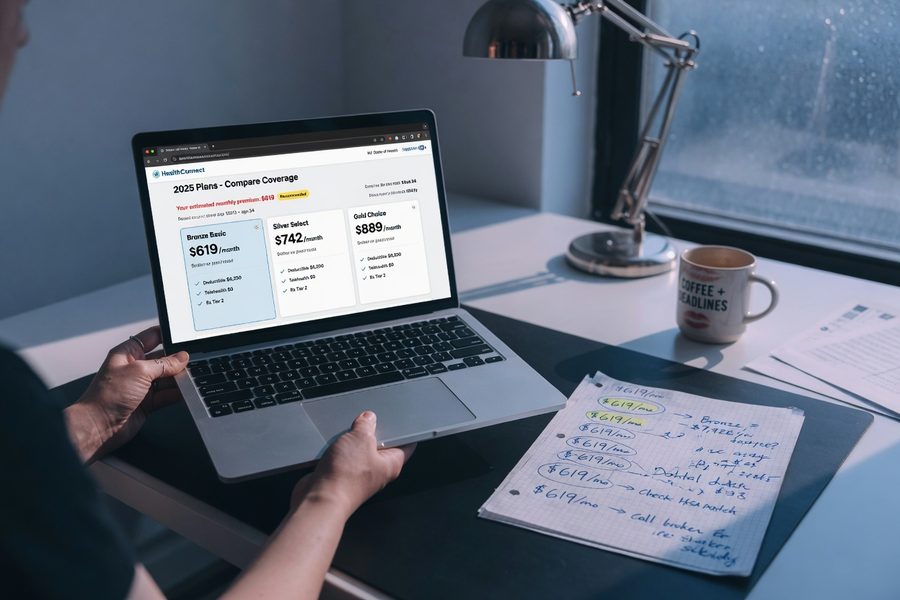
Unsubsidized, a 40-year-old purchasing a silver plan through the ACA Marketplace pays an average of $619 per month, according to healthinsurance.org’s 2025 Marketplace analysis, that is $7,428 per year before a single claim. State and carrier variations are wide. A Kaiser Permanente HMO averages around $540/month for a self-employed 40-year-old; an Oscar PPO runs closer to $585/month. Choose a gold plan for lower out-of-pocket costs and you add another $100 to $150 per month.
Subsidies change the picture dramatically. A single designer earning $45,000 in net self-employment income in 2026 would qualify for premium tax credits that could reduce that $619/month premium to somewhere between $150 and $250, depending on the state and plan selected. At $55,000 net income, the credit shrinks but remains meaningful. Above roughly $60,240 (the 400% federal poverty level threshold for a single adult), enhanced subsidies still apply under current law, though at a reduced rate.
Here is the arithmetic spelled out. If a designer earning $50,000 net pays $200/month in subsidized premiums instead of the full $619/month, the annual savings are $5,028. Add the self-employed health insurance deduction on that $200 monthly premium ($2,400/year), and the net cost drops further depending on their effective tax rate. That combination, subsidy plus deduction, is the core of what makes the ACA workable for mid-career freelancers who do the math properly. For a broader look at the best health insurance plans for self-employed workers in 2026, the Marketplace remains the starting point for most solo designers.
ACA Marketplace vs. PEO Group Plans: Which Route Makes More Sense?
For most freelance designers over 40, the ACA Marketplace is the right first stop, but it is not the only one. HealthCare.gov confirms that self-employed individuals with no employees enroll through the individual Marketplace and are not eligible for SHOP (small group) plans. That creates a legitimate gap: no group rates, no employer contribution, and the standard open enrollment window constraint.
PEOs (Professional Employer Organizations) like Opolis and membership-based organizations like Freelancers Union step into that gap. Both offer access to group-style plans, Opolis through Cigna networks, Freelancers Union through partnerships with regional carriers, with year-round enrollment that sidesteps the ACA open enrollment calendar. For a designer who picks up a major contract in August and wants coverage before September, that flexibility has real value.
The trade-off is cost transparency. PEO plans typically carry administrative fees layered on top of premiums, and those fees are not always easy to compare against a straight Marketplace premium. If you qualify for substantial ACA subsidies based on your income, the subsidized Marketplace plan will almost always be cheaper. If your income is above the subsidy threshold, a PEO group rate may match or beat the unsubsidized Marketplace price. Run both numbers before committing. Understanding the difference between HMO and PPO plan structures matters here too, since PEO offerings often default to HMO networks that may not include your current specialists.
Can a High-Deductible Plan With an HSA Actually Save Money for a Designer Over 40?
Done right, an HDHP-plus-HSA combination can reduce a 40-year-old designer’s total health spending, but it requires discipline and a relatively healthy year to pay off. The HDHP carries a lower monthly premium than a silver or gold plan, and contributions to the linked Health Savings Account are fully deductible above the line under IRS Topic 502, regardless of whether you itemize. In 2026, the HSA contribution limit for self-only coverage sits at $4,300 (IRS-indexed figure), meaning a designer who maxes out their HSA shields that amount from federal income tax entirely.
The risk is the deductible itself. An HDHP deductible of $2,000 or more means you pay full price for most services until you hit that threshold. For a designer managing a chronic condition, carpal tunnel, migraines, or early arthritis, a high-deductible plan can cost more in a bad year than a lower-deductible silver plan with predictable copays. The break-even calculation depends heavily on how often you actually use care. Pair the HDHP with a Direct Primary Care (DPC) membership, which typically runs $70 to $150 per month for unlimited primary care visits, and you cover the routine-visit gap without burning through your deductible. That hybrid approach (HDHP + HSA + DPC) is one of the more practical structures available to solo creatives who want to control costs without exposing themselves to catastrophic risk.
To understand how the deductible interacts with your total yearly exposure, read through the difference between your deductible and out-of-pocket maximum before selecting a plan, those two numbers together define your worst-case financial scenario for any given year.
Who Should and Who Should Not
Good candidates
These are the freelance designers most likely to find an affordable, functional solution without a group plan.
- A 42-year-old designer earning $48,000 net per year, eligible for ACA premium tax credits that bring a silver plan below $250/month, with no chronic conditions requiring frequent specialist visits
- A 46-year-old who just left an agency and has a 60-day Special Enrollment Period window, the Marketplace is the fastest and most cost-effective path right now
- A 50-year-old designer with variable income who can project conservatively, claim the self-employed premium deduction, and contribute to an HSA in strong-income years to offset future costs
- A freelancer earning $65,000 or more who cannot get subsidies but wants a PPO for specialist flexibility, off-exchange plans in most states offer comparable networks to group coverage at competitive rates
Who should skip it and look at alternatives
The individual Marketplace is not the right primary solution for everyone.
- A designer with highly unpredictable income (anywhere from $20,000 to $100,000 in a single year) who cannot reliably estimate annual earnings, the subsidy repayment risk at tax time may outweigh the savings
- A 48-year-old who needs year-round enrollment flexibility and whose income exceeds the subsidy threshold, a PEO like Opolis may offer better group rates with fewer timing constraints
- A freelancer who rarely sees a doctor and is tempted by short-term health plans, those plans are genuinely dangerous for anyone over 40 with any health history, since they can exclude pre-existing conditions and cap benefits
- A designer planning to bring on even one W-2 employee in the next 12 months, at that point, SHOP plans and small group coverage options open up and should be evaluated separately
Related reading: How a 33.
Frequently Asked Questions
Is freelancer health insurance over 40 actually affordable without employer help?
Yes, for most designers earning under $60,000 net per year. ACA premium tax credits can reduce a $619/month unsubsidized premium to under $250/month, and the self-employed health insurance deduction further reduces your taxable income. The combination makes individual coverage genuinely competitive with what many employer plans cost in employee contributions.
What happens if my freelance income swings wildly from month to month, will I owe subsidies back?
Potentially, yes. The IRS reconciles your advance premium tax credits against your actual annual income when you file. If you earned significantly more than estimated, you may owe some or all of the credits back. The fix is to update your income estimate on HealthCare.gov mid-year whenever a major contract lands, that adjustment reduces the repayment risk without requiring you to drop or change plans.
Can I deduct health insurance premiums if I had a low-income year with little net profit?
The self-employed health insurance deduction is limited to your net profit from the business under which the plan is established. If your Schedule C shows a loss or zero net income, you cannot take the deduction for that year. You may still be eligible for the itemized medical expense deduction if total medical costs exceed 7.5% of your adjusted gross income, but that threshold is harder to clear.
Do ACA Marketplace plans cover repetitive strain injuries and vision problems common in design work?
Major medical ACA plans cover treatment for repetitive strain injuries, physical therapy, and specialist referrals under standard benefits. Routine vision exams and glasses, however, are not included in most Marketplace plans, those require a separate vision plan. For designers with ongoing screen-related eye strain, adding a standalone vision policy from a carrier like VSP or EyeMed runs $15 to $30/month and is worth the cost.
Is a short-term health plan a reasonable stopgap while I figure out my freelance income?
Short-term plans are a genuine risk for designers over 40, not a safe stopgap. They can exclude pre-existing conditions, cap benefits well below what a serious claim would cost, and do not satisfy ACA minimum essential coverage standards. If you missed open enrollment, check whether a qualifying life event triggers a Special Enrollment Period first. The National Association for the Self-Employed recommends the individual Marketplace as the primary route for solo workers, short-term plans are a last resort, not a strategy.
One more area worth reviewing as your freelance practice grows: if clients or contracts put you in situations where professional liability is a concern, understanding liability insurance for small business owners can help you identify gaps in your broader coverage picture beyond health insurance alone.
Sources
- HealthCare.gov, Health Coverage for Self-Employed Individuals
- HealthCare.gov, Reporting Self-Employment Income for Marketplace Coverage
- Internal Revenue Service, About Form 7206, Self-Employed Health Insurance Deduction
- Kaiser Family Foundation, About Half of Adults With ACA Marketplace Coverage Are Small Business Owners, Employees, or Self-Employed (2025)
- healthinsurance.org, Self-Employed Health Insurance: Costs, Options, and Tax Savings (2025)
- National Association for the Self-Employed, Navigating Insurance for the Self-Employed (2024)