Fact-checked by the Smart Insurance 101 editorial team
Quick Answer
A standard HO-3 homeowners policy covers tree damage to your home’s structure when a covered peril, wind, lightning, or ice, caused the fall. Your own policy pays first regardless of whose tree it was, minus your deductible. Tree removal is only covered if the tree hit a covered structure, and limits are typically $500–$1,000 per tree, far below actual removal costs. Flood- and earthquake-related tree falls require separate policies.
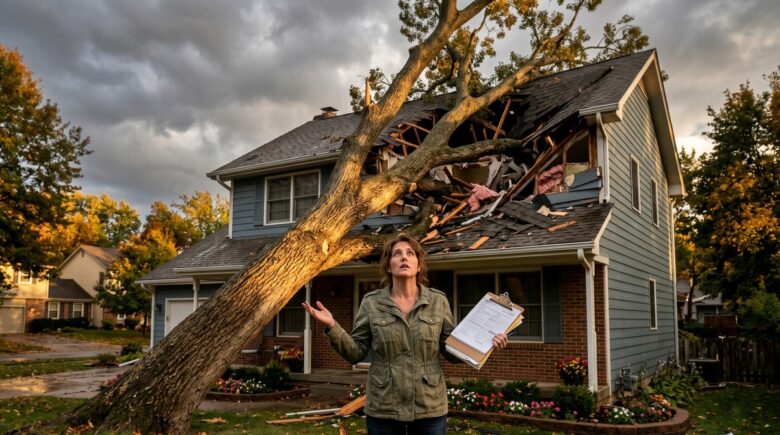
A massive oak splits your roof at 3 a.m. The thunderous crack, the groan of wood, the shattering of glass, and then the first coherent thought that surfaces: what is this going to cost me? Understanding how tree falls on house insurance actually works can mean the difference between a fully covered repair and a five-figure out-of-pocket nightmare. Most homeowners have no idea what their policy actually covers until disaster strikes.
Falling trees are far more common than most people realize. According to the NOAA Storm Events Database, severe thunderstorms, the leading cause of tree failures, affect millions of U.S. homes every year. The Insurance Information Institute reports that wind and hail damage combined account for roughly 45% of all homeowners insurance claims. The average claim for tree-related structural damage runs between $5,000 and $10,000, but major incidents involving full roof collapses can easily exceed $50,000. What’s worse, many homeowners discover mid-claim that large portions of the damage, or the tree removal itself, aren’t covered the way they assumed.
This guide cuts through the confusion. You’ll learn exactly which scenarios trigger coverage, which ones don’t, how deductibles and dwelling limits affect your payout, what to do in the first 24 hours after impact, and how to fight back if your insurer underpays or denies your claim. Whose tree it was, yours, your neighbor’s, or a tree that simply gave up on a calm afternoon, matters less than you think. You’ll walk away knowing precisely where you stand.
Key Takeaways
- Most standard homeowners policies (HO-3) cover tree damage to your dwelling when the fall is caused by a covered peril such as wind, lightning, or ice, typically reimbursing 80–100% of repair costs minus your deductible.
- Tree removal is only covered if the tree hit a covered structure; average removal coverage is capped at $500–$1,000 per tree, far below the $1,500–$3,000 average removal cost.
- When a neighbor’s tree falls on your property, your own policy pays first, you can only pursue your neighbor if they were negligent (e.g., the tree was visibly dead or diseased).
- Flood-related tree falls and earthquake-related damage are specifically excluded from standard HO-3 policies and require separate endorsements costing $300–$800 per year.
- Filing a tree-damage claim can raise your premium by 9–20% at renewal, and two claims within three years can trigger non-renewal in some states.
- Documenting damage within the first 48 hours, with timestamped photos, a written inventory, and a licensed contractor estimate, can speed up the claims process by 30–45 days compared to undocumented claims.
In This Guide
- What Homeowners Insurance Actually Covers
- Covered Perils: When the Claim Gets Approved
- What Is Not Covered: The Gaps That Cost Homeowners
- When Your Neighbor’s Tree Falls on Your House
- Tree Removal Coverage: The Most Misunderstood Benefit
- Deductibles, Coverage Limits, and the Actual Payout
- How to File a Tree Damage Claim Step by Step
- Handling Claim Denials and Underpayment
- Reducing Your Risk Before a Tree Falls
- Policy Review: What to Look for Right Now
What Homeowners Insurance Actually Covers
A standard HO-3 homeowners policy, the most common form in the United States, covers your home’s structure under an open-perils basis. That means it covers all causes of damage except those specifically excluded. Understanding this framework is the first step to knowing how tree damage will be handled.
The Four Coverage Components That Apply to Tree Damage
Dwelling coverage (Coverage A) pays for damage to the physical structure of your home, walls, roof, foundation, and attached structures like a garage. This is the primary coverage triggered when a tree crushes your roof. Most policies set this at the estimated rebuild cost of your home, not its market value.
Other structures coverage (Coverage B) applies to detached garages, fences, sheds, and outbuildings. It’s typically set at 10% of your dwelling coverage. So if your home is insured for $350,000, you have $35,000 for other structures, which can be eaten up quickly if a tree demolishes a detached garage.
Additional living expenses (Coverage D), also called loss of use coverage, reimburses hotel bills, restaurant meals, and other costs if your home is uninhabitable during repairs. Most policies cap this at 20–30% of dwelling coverage for up to 12–24 months. For a $350,000 dwelling policy, that’s up to $105,000 in living expense coverage.
Personal property coverage (Coverage C) covers belongings damaged by the falling tree, furniture crushed by a collapsed ceiling, electronics destroyed by water intrusion through the damaged roof. Standard limits are 50–70% of dwelling coverage, though many policies pay actual cash value (ACV) rather than replacement cost value (RCV).
According to the Insurance Information Institute, wind damage is the single most common cause of homeowners insurance claims in the U.S., representing approximately 25% of all claims filed each year.
HO-3 vs. HO-5: Does Your Policy Type Matter?
An HO-5 comprehensive policy covers your personal property on an open-perils basis as well, not just named perils. This matters when a falling tree damages belongings, because an HO-3 might deny a personal property claim if the cause isn’t on its named-perils list. HO-5 policies cost roughly 7–15% more than comparable HO-3 policies but provide stronger protection. Homeowners with significant personal property often find the upgrade worth it.
One honest caveat: even an HO-5 won’t rescue you from a low dwelling limit or a steep wind deductible. Policy type matters less than whether your coverage amounts reflect your home’s actual rebuild cost. Both HO-3 and HO-5 policies share the same flood and earthquake exclusions, so neither protects you from those scenarios without separate coverage.
| Coverage Component | Typical Limit | Applies to Tree Damage? |
|---|---|---|
| Dwelling (Coverage A) | Full rebuild cost | Yes, roof, walls, structure |
| Other Structures (Coverage B) | 10% of Coverage A | Yes, garages, fences, sheds |
| Personal Property (Coverage C) | 50–70% of Coverage A | Yes, damaged belongings |
| Loss of Use (Coverage D) | 20–30% of Coverage A | Yes, if home is uninhabitable |
| Tree Removal | $500–$1,000 per tree | Only if tree hit a structure |
Covered Perils: When the Claim Gets Approved
Not every falling tree triggers a valid insurance claim. The cause of the tree’s fall, the covered peril, determines whether your insurer will pay. This is one of the most critical and misunderstood aspects of tree falls on house insurance.
Weather Events That Trigger Coverage
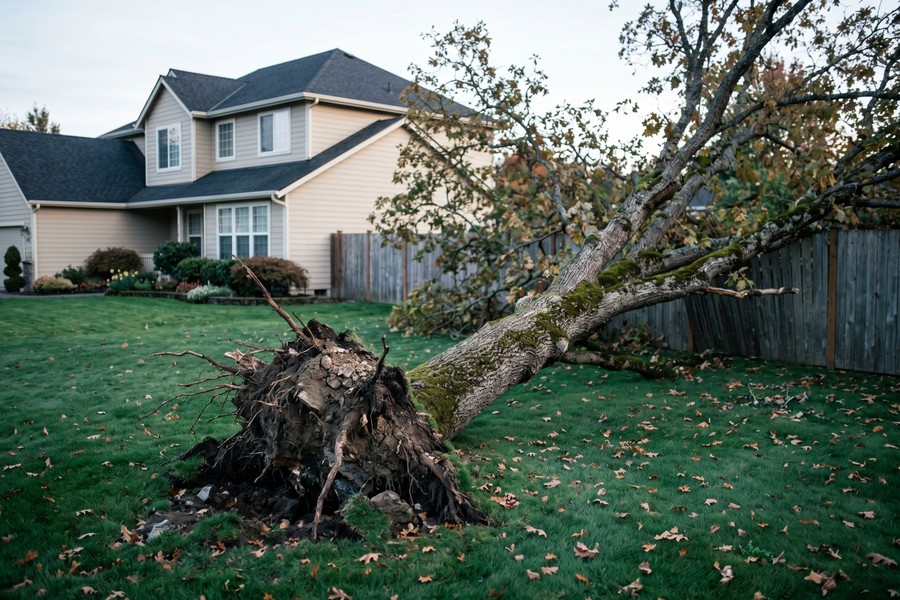
Windstorms are the most common trigger. When sustained winds or gusts cause a tree to uproot or snap, virtually every standard HO-3 policy will cover the resulting structural damage. The wind doesn’t need to be a named hurricane, ordinary severe thunderstorm winds above 40–50 mph qualify in most policy language.
Lightning strikes that kill or split a tree, causing it to fall on your home, are clearly covered. Lightning is a named peril on every standard homeowners policy in the country. Coverage also extends to fires started by lightning-struck trees that spread to your home.
Ice and snow accumulation are covered perils under most policies. When ice storms weigh down branches or cause entire trees to split and fall, the resulting dwelling damage is payable. Some policies in northern states add a windchill or freeze endorsement for added clarity.
The average homeowners insurance claim for wind and hail damage in 2022 was $13,451, according to the Insurance Information Institute, a 10.9% increase from the prior year.
Less Obvious Covered Scenarios
A tree that falls due to vandalism, for instance, someone deliberately cutting it down onto your property, is covered under most HO-3 policies because vandalism is a named peril. You’ll need a police report to support the claim.
A vehicle crash into a tree on your property that causes it to fall on your home creates a different dynamic. The vehicle owner’s auto liability insurance is the primary payer. Your homeowners policy may step in as secondary coverage if that liability coverage is insufficient, depending on policy language.
| Cause of Tree Fall | Covered? | Coverage Type |
|---|---|---|
| Windstorm / Hurricane | Yes | Dwelling, Other Structures |
| Lightning Strike | Yes | Dwelling, Personal Property |
| Ice / Snow Weight | Yes | Dwelling, Other Structures |
| Vandalism | Yes | Dwelling |
| Flooding / Storm Surge | No | Requires flood policy (NFIP) |
| Earthquake | No | Requires earthquake endorsement |
| Healthy tree, no storm | No | Excluded, no covered peril |
| Neglected / dead tree (yours) | No | Excluded, negligence |
What Is Not Covered: The Gaps That Cost Homeowners
The exclusions in tree-damage claims are where homeowners get blindsided. Knowing these gaps in advance lets you either buy supplemental coverage or take preventive action.
Negligence and Maintenance Exclusions
When an insurer determines that a tree was visibly dead, diseased, or previously reported as a hazard before it fell, they may deny the claim entirely under the negligence or maintenance exclusion. This is especially common when arborists or neighbors have documented concerns about a tree’s condition. Courts have generally upheld these denials when clear evidence of neglect exists.
The key word is “visible.” A tree that appeared healthy from the outside but had internal rot, which is common, generally cannot trigger the maintenance exclusion. Getting an arborist’s written assessment before and after a loss can make or break this kind of dispute.
If a neighbor has sent you a written complaint about a hazardous tree on your property and you fail to address it, that letter could be used by an insurer to deny a future claim on grounds of documented negligence. Never ignore written tree complaints.
Flood and Earthquake Exclusions
A tree that falls because floodwater undermined its roots produces flood damage, not covered by a standard homeowners policy. You’d need a separate National Flood Insurance Program (NFIP) policy or private flood insurance, which FEMA administers through the NFIP. Average NFIP premiums run $700–$1,000 per year for most single-family homes.
Similarly, when an earthquake destabilizes soil and causes trees to topple onto your home, standard policies won’t cover it. Earthquake endorsements are available in most states for $300–$800 per year, and are strongly recommended in seismic zones.
Trees That Fall Without Hitting a Structure
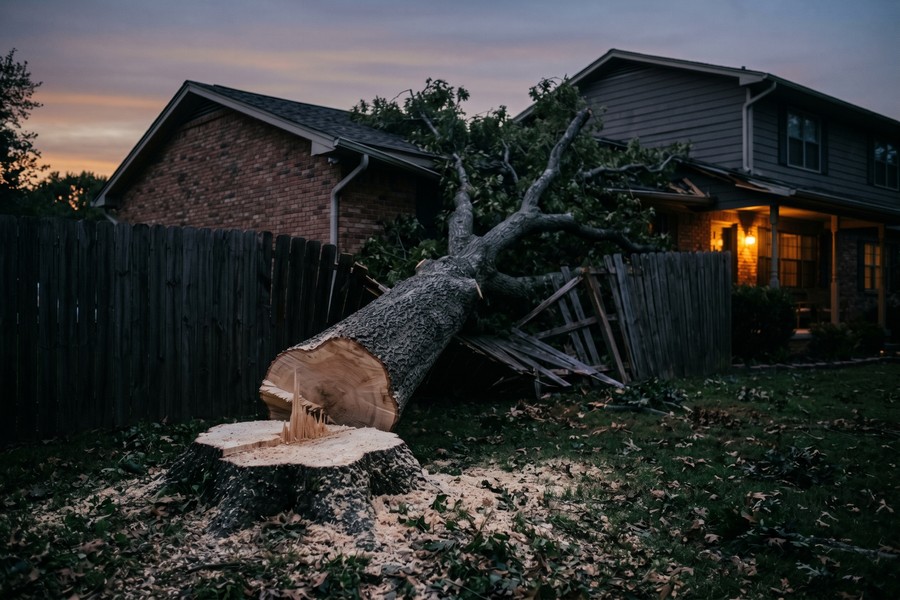
This surprises many homeowners: a tree that falls in your yard but doesn’t hit your house, garage, fence, or another covered structure will generally not be covered for removal. A 60-foot oak lying in your backyard is entirely your financial responsibility if it didn’t damage anything. Removal costs in that scenario average $1,000–$2,500 out of pocket.
When Your Neighbor’s Tree Falls on Your House
One of the most common and contentious tree-damage scenarios involves a tree from a neighboring property. The rules here often defy common sense, and leave many homeowners paying for damage they feel their neighbor caused.
The General Rule: Your Policy Pays First
In most cases, when a neighbor’s tree falls on your house, your homeowners insurance is the primary payer, not your neighbor’s. This applies regardless of whose tree it was, as long as a covered peril caused the fall. Your insurer will cover your dwelling repairs minus your deductible, and you’ll deal with the claim process as if the tree were yours.
This surprises most homeowners. The logic is that your dwelling coverage protects your structure from damage caused by covered perils, the origin of the hazard is secondary. You are responsible for insuring your own home.
“In the vast majority of cases, when a tree falls across property lines, it is the damaged homeowner’s own policy that responds first. The tree’s ownership is largely irrelevant unless negligence can be proven.”
When You Can Pursue Your Neighbor
Holding your neighbor financially liable requires proving negligence. This typically means demonstrating three things: the tree was visibly dead, diseased, or structurally compromised before it fell; the neighbor knew or should have known about the hazard; and they failed to take reasonable action to address it.
Evidence that supports negligence claims includes prior written complaints to the neighbor, photos of the tree’s condition, municipal code violation notices, or an arborist’s written report issued before the incident. Without this evidence, a negligence claim is difficult to sustain in court.
When negligence is established, your insurer may pursue subrogation, recovering the claim amount from your neighbor’s liability policy on your behalf. You could also file directly in small claims court for deductible recovery if damages fall under your state’s small claims limit (typically $5,000–$10,000).
The Subrogation Process Explained
Subrogation is the legal right of your insurer to “step into your shoes” and recover money from a liable third party after paying your claim. When your insurer recovers funds through subrogation, they must reimburse your deductible proportionally. This process can take 6–18 months and isn’t guaranteed, but it’s a legitimate avenue when negligence is clear.
According to a survey by the Insurance Research Council, only about 38% of homeowners with tree damage claims knew that their own policy, not their neighbor’s, would respond first when a neighbor’s tree caused the damage.
Tree Removal Coverage: The Most Misunderstood Benefit
Tree removal coverage is perhaps the single most misunderstood element of tree falls on house insurance. Homeowners routinely assume they’re covered for removal regardless of circumstances, and that assumption is almost always wrong.
When Removal Is Covered
Coverage for debris removal, including tree removal, is triggered only when the tree has damaged a covered structure. The typical coverage limit is $500–$1,000 per tree, with a policy aggregate of $1,000–$1,500. Some insurers offer endorsements to raise this limit to $5,000 or more, usually for an additional $20–$50 per year in premium.
That cap matters enormously in practice. The national average cost to remove a large tree (over 60 feet) that has fallen on a structure is $1,500–$3,000, according to Angi’s 2023 cost data. For complex removals involving roof penetration or proximity to power lines, costs can reach $5,000–$8,000. The policy’s $500–$1,000 limit leaves a significant gap.
The average cost to remove a fallen tree from a residential property is $1,871, according to Angi’s 2023 national average, nearly double what most standard homeowners policies cover for tree removal.
When Removal Is Not Covered
A tree that falls in your yard but misses every structure is almost certainly not covered for removal under your policy. This includes trees that fall against an excluded fence, trees that land across a driveway, and trees that fall in open lawn areas. A few high-end policies include “fallen tree debris removal” as a separate endorsement regardless of structural contact, worth asking your agent about if you have large, mature trees.
A tree that is merely leaning dangerously and hasn’t fallen yet receives no coverage under any standard policy. Preventive tree removal is a property maintenance expense, typically $500–$2,500 per tree depending on size and location.
Deductibles, Coverage Limits, and the Actual Payout
Understanding the mechanics of how your insurer calculates your check is essential to avoiding an unpleasant surprise. The interplay of deductibles, coverage limits, and payout methods can dramatically affect what you actually receive.
Standard vs. Wind/Hail Deductibles
Many homeowners don’t realize they have two deductibles: a standard deductible (typically $500–$2,500) and a separate wind/hail deductible that applies specifically to weather-related damage. Wind/hail deductibles are often calculated as a percentage of dwelling coverage, commonly 1%–5%. On a $400,000 home, a 2% wind deductible means you pay $8,000 out of pocket before coverage kicks in.
These percentage-based wind deductibles became standard in coastal states after Hurricane Andrew in 1992 but have since spread inland as weather-related claims have increased. Homeowners in the Midwest, South, or any area prone to severe thunderstorms should check their declarations page carefully for a wind deductible clause.
Replacement Cost Value vs. Actual Cash Value
Replacement cost value (RCV) policies pay what it costs to rebuild or replace damaged property at today’s prices, with no depreciation deduction. Actual cash value (ACV) policies deduct depreciation, so a 15-year-old roof destroyed by a fallen tree might be worth only 40–50% of its replacement cost, leaving you with a fraction of the repair bill covered.
The difference can be enormous. A falling tree that destroys a roof costing $18,000 to replace might yield only $8,000–$10,000 under an ACV policy after depreciation. Upgrading to RCV coverage costs roughly 10–15% more in annual premium but can save tens of thousands in a major claim.
| Scenario | ACV Payout | RCV Payout |
|---|---|---|
| $18,000 roof replacement (15-yr roof) | $8,100–$9,000 | $18,000 |
| $12,000 structural wall repair | $9,600–$10,800 | $12,000 |
| $5,000 personal property damage | $2,000–$3,500 | $5,000 |
| $3,000 hotel costs (2 months) | $3,000 (no depreciation) | $3,000 |
Your policy declarations page will specify either “Replacement Cost” or “Actual Cash Value” under each coverage section. For more context on how coverage choices affect your overall costs, see our guide on homeowners insurance basics for new policyholders.
How to File a Tree Damage Claim Step by Step
The actions you take in the first 24–72 hours after a tree falls on your home have an outsized impact on how your claim is processed and how much you receive. A disorganized claim takes longer, pays less, and creates more disputes.
Immediate Actions: Safety and Documentation
Your first priority is safety. A tree that has breached your roof or walls may have compromised the structure. Evacuate, call 911 if anyone is injured, and turn off utilities at the main panel if there’s any risk of electrical damage or gas line rupture. Do not re-enter until a structural professional clears the building.
Once the immediate danger has passed, begin documentation immediately. Use your phone to take timestamped photos and videos of every angle, the tree itself, the point of impact, all visible structural damage, damaged personal property, and any pre-existing conditions for comparison. This visual record is your most powerful asset in a claim.
Enable location and timestamp metadata on your phone’s camera before photographing any damage. This creates an irrefutable digital record that adjusters and courts accept as evidence. Back up photos to cloud storage immediately, don’t risk losing them if your phone is also damaged.
Temporary Repairs and Emergency Mitigation
Your policy requires you to take reasonable steps to prevent further damage, this is the “duty to mitigate” clause. Hire a roofing contractor or handyman to place tarps over breached areas. Boarding up broken windows and doors is also expected. Keep all receipts, these costs are reimbursable under your policy’s debris removal or dwelling coverage, typically up to 5% of your dwelling limit.
Do not make permanent repairs until your adjuster has inspected the damage. Completing unauthorized permanent repairs before the adjuster’s visit can complicate your claim and potentially reduce your payout.
Working with the Adjuster
After filing your claim, your insurer will send an insurance adjuster, either a staff adjuster or an independent adjuster, to assess the damage. Be present during the inspection. Point out all damage, including areas that may not be immediately visible. Ask the adjuster to document every item you show them.
Get an independent estimate from a licensed contractor before or shortly after the adjuster’s visit. A gap of 20% or more between the adjuster’s estimate and your contractor’s number is a red flag, you have grounds to negotiate or escalate. For broader guidance on reviewing your current coverage, our article on saving money on homeowners insurance walks through policy review strategies in detail.
The National Association of Public Insurance Adjusters (NAPIA) estimates that homeowners who hire a public adjuster on a complex tree-damage claim typically recover 20–40% more in claim settlements than those who handle the process alone. The fee, usually 10–15% of the settlement, often pays for itself. Public adjusters are not always worth hiring for smaller, straightforward claims; on a $4,000 repair with a clear adjuster estimate, the fee can outpace any additional recovery.
Handling Claim Denials and Underpayment
Getting your claim denied or receiving a check far below your repair costs is more common than most homeowners expect. Knowing how to respond, and how quickly, is essential.
Common Reasons for Denial
The most frequent denial reasons in tree-damage claims include: the cause of fall wasn’t a covered peril; the tree was determined to be dead or diseased prior to the event; the policy lapsed due to non-payment; or the damage was classified as a maintenance issue rather than a sudden loss. Each of these denials is challengeable with the right evidence.
Request a written denial letter specifying the exact policy language cited. This is your roadmap for the appeal. Vague or overly broad application of exclusions is a common insurer tactic that doesn’t always hold up when challenged directly.
Your Appeal and Escalation Options
Start with a formal written appeal to your insurer, attaching your contractor estimate, photos, arborist reports, and any weather service documentation (such as NOAA storm reports confirming wind events in your area on the date of loss). Insurers are required to respond to appeals within specific timeframes, typically 15–45 days depending on your state.
When the internal appeal fails, file a complaint with your state’s Department of Insurance. Most state DOI websites have online complaint portals. Regulators take underpayment and bad-faith denial seriously, and filing a complaint alone often prompts reconsideration. The National Association of Insurance Commissioners (NAIC) maintains a state regulator directory at naic.org. You can also contact your state’s insurance commissioner directly, state-level insurance regulation operates independently of federal agencies like the CFPB, which generally covers financial products rather than property insurance.
As a last resort, consider hiring a public adjuster (through NAPIA) or a policyholder attorney. Both typically work on contingency, 10–15% of the final settlement, and can threaten or pursue bad-faith insurance litigation, which carries penalty provisions in most states.
In 2022, state insurance departments across the U.S. resolved over 160,000 consumer complaints against homeowners insurers, with property damage claims (including weather events) representing the largest single complaint category, according to the NAIC.
Reducing Your Risk Before a Tree Falls
The best tree-damage claim is one you never have to file. Proactive tree maintenance protects your insurance coverage and can reduce your premium over time.
Regular Tree Inspections and Maintenance
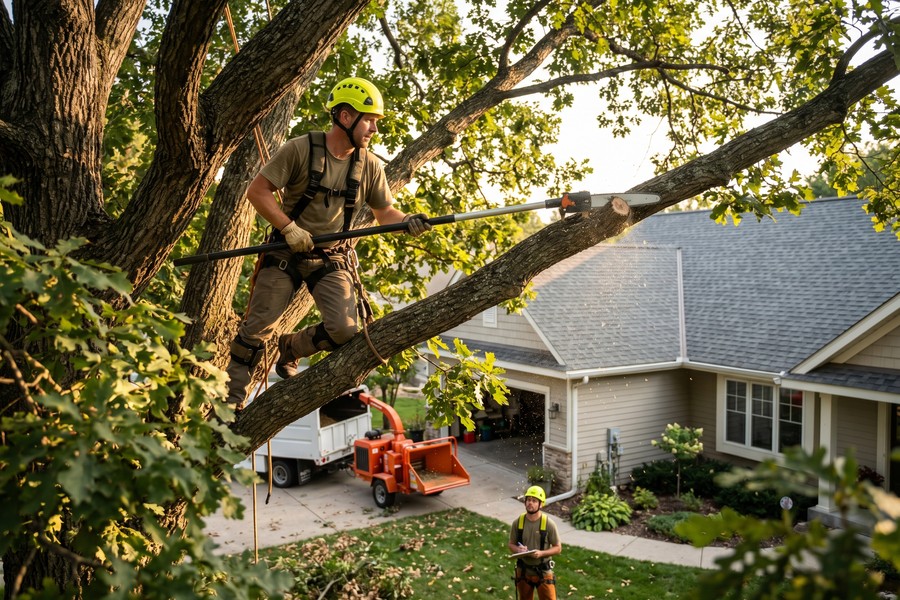
A certified arborist can identify structural weaknesses, root rot, fungal infections, and co-dominant stems, all conditions that dramatically increase failure risk during storms. The International Society of Arboriculture (ISA) recommends inspections every 3–5 years for mature trees, and annually for trees over 30 years old or within falling distance of structures. An arborist inspection typically costs $100–$300 per tree.
Proactive pruning of dead or weakened branches costs $200–$800 per tree depending on size. This is substantially cheaper than a $500–$2,500 deductible plus the inconvenience of a major claim. Documenting your maintenance history, receipts, arborist reports, also strengthens your position if a future claim is ever challenged on negligence grounds.
Insurance Discounts for Risk Mitigation
Some insurers offer premium discounts of 5–10% for documented tree maintenance programs, particularly in high-wind-risk ZIP codes. Ask your agent specifically whether your insurer has a “loss prevention” or “proactive maintenance” credit. Even without a formal discount, a clean claims history (five or more years without a claim) typically qualifies you for a 10–20% loyalty discount at renewal.
For a broader view of strategies that can lower your overall homeowners costs, including tree-related risk management, our piece on getting the best home insurance coverage while saving money covers this in detail.
Policy Review: What to Look for Right Now
A review of your homeowners policy in the last 12 months is overdue for most people, and a tree-damage scenario is the perfect reason to do it today. Details buried in your declarations page and policy language can mean five-figure differences in coverage.
Five Critical Things to Check on Your Policy
First, confirm your dwelling coverage limit reflects current rebuild costs, not what you paid for your home. Construction costs have risen 30–40% since 2020 in most U.S. markets. Underinsurance is a widespread problem: a 2023 CoreLogic study found that 12% of U.S. homes are underinsured by 26% or more.
Second, identify your wind/hail deductible. A percentage-based deductible (1%–5%) translates to real dollars, calculate that amount and confirm you have it accessible. Third, check whether your policy covers replacement cost or actual cash value for both dwelling and personal property, and consider upgrading to RCV if you have ACV. Fourth, verify your tree removal sublimit, at $500, an endorsement to raise it costs almost nothing. Fifth, confirm your loss of use limit would actually cover your area’s hotel costs for the likely duration of major repairs.
Call your insurance agent and specifically ask: “What would happen if a large tree fell on my roof tonight, walk me through exactly what’s covered and what’s not.” Their answer will reveal coverage gaps far more quickly than reading the policy yourself.
Shopping Your Policy When Gaps Exist
Low tree removal limits, ACV depreciation, or a high wind deductible are all legitimate reasons to get competitive quotes. The homeowners insurance market is competitive, and switching carriers can often improve coverage while maintaining or reducing your premium. Premium increases of 20–40% at renewal are now common in storm-prone states, making proactive shopping more important than ever. Our article on why insurance premiums are exploding provides important context for what’s driving those increases.
When evaluating policies side by side, don’t focus solely on the premium. Compare deductibles, coverage limits, endorsement availability, and the insurer’s claims-handling reputation. AM Best financial strength ratings and J.D. Power claims satisfaction scores are reliable starting points for vetting insurers. Carriers like Amica Mutual, USAA (for military families), and Erie Insurance consistently rank near the top of J.D. Power’s home insurance satisfaction studies, though availability varies by state.
Most homeowners don’t look at their policy until they have a claim. By then, it’s too late to change it. Reviewing your coverage annually, especially after a storm season, is the most impactful thing you can do for your financial protection.
A 2023 CoreLogic analysis found that 12% of U.S. single-family homes are underinsured by 26% or more, meaning a total loss would leave the average affected homeowner short by $65,000–$130,000 after their insurer’s payout.
Real-World Example: The Rodriguez Family’s $47,000 Tree Claim in Nashville
In April 2023, a severe thunderstorm with 65-mph gusts uprooted a 70-foot white oak in Mark and Jennifer Rodriguez’s backyard in Nashville, Tennessee. The tree landed squarely across the back half of their home, destroying 40% of the roof, collapsing one bedroom wall, and penetrating the attic insulation and HVAC system. The couple had lived in the home for 11 years and hadn’t reviewed their policy since 2018.
Their HO-3 policy had a $1,500 standard deductible and a 1% wind deductible on their $310,000 dwelling coverage, meaning $3,100 was their effective out-of-pocket cost for the wind event. Their first concern was coverage type: fortunately, their policy covered dwelling repairs at replacement cost value. Contractor estimates came in at $44,500 for structural repairs, $2,800 for HVAC, and $3,200 for tree removal. Their tree removal coverage was capped at $1,000, leaving $2,200 of removal cost uncovered. Their insurer’s first adjuster estimate came in at $38,700, nearly $6,000 below the contractor quotes.
Jennifer hired a public adjuster after finding a 19% gap between the insurer’s estimate and contractors’ bids. The public adjuster documented three areas the staff adjuster missed: secondary water intrusion damage behind the collapsed wall ($3,400), depreciation applied incorrectly to the roofing underlayment ($1,100), and a line-item omission for temporary structural shoring ($1,600). After a three-week negotiation, the insurer revised the payout upward to $44,200–$5,500 more than the original offer. The public adjuster’s 12% fee ($5,304) was almost exactly covered by the additional recovery.
Total claim settlement: $44,200. Out-of-pocket costs: $3,100 deductible + $2,200 uncovered tree removal + $5,304 public adjuster fee = $10,604. Before the incident, the Rodriguezes had no idea their tree removal sublimit was only $1,000. After the claim closed, they added a $5,000 tree removal endorsement to their policy for an additional $38 per year in premium, a lesson they wish they’d learned before the storm hit.
Your Action Plan
-
Pull your current policy declarations page today
Find your dwelling coverage limit, wind/hail deductible (check whether it’s flat dollar or percentage), personal property coverage type (RCV vs. ACV), tree removal sublimit, and loss of use limit. Write these numbers down and compare them to your home’s current rebuild cost using a local contractor or online rebuild estimator.
-
Get an arborist inspection for any mature trees near your home
Hire a certified arborist (look for ISA certification) to assess any tree within falling distance of your home, garage, or other structures. Get a written report. When the arborist recommends removal, act on it promptly, the documentation protects you legally and from future claim denials.
-
Call your agent and ask the “tree falls tonight” question
Ask your agent to walk you through exactly what would be covered if a large tree fell on your home tonight. Push for specific dollar amounts, not generalities. Ask about wind deductible triggers, ACV vs. RCV on your roof specifically, and tree removal limits. Document their answers in writing (a follow-up email is sufficient).
-
Consider a tree removal endorsement if your sublimit is under $2,500
At $500–$1,000 in current coverage, a debris removal or tree removal endorsement is worth requesting. Most cost $20–$50 per year to raise the limit to $5,000. The return on investment from even one large tree removal event is enormous.
-
Create a home inventory and document current property condition
Walk through your home with your phone and record a video inventory of all rooms, personal property, and the exterior, including the condition of trees. Store the video in cloud storage. Update it annually. This inventory is critical for personal property claims and eliminates disputes about pre-existing conditions.
-
Know your immediate response protocol before an event
Save your insurer’s claims number in your phone. Know the location of your policy number. Identify a local 24-hour tarping or emergency contractor in advance, not after a storm when everyone is booked for weeks. Having a contractor relationship established before an event speeds up your temporary mitigation and claim timeline significantly.
-
If a tree does fall, document before making any permanent repairs
Take timestamped photos from every angle. Make only temporary repairs (tarps, boarding) until your adjuster visits. Get at least two independent contractor estimates. When the adjuster’s estimate runs 15% or more below your contractors’ bids, consider hiring a public adjuster through NAPIA to negotiate on your behalf.
-
Review your policy annually, especially after premium renewals
Insurers sometimes quietly reduce sublimits, add new exclusions, or switch from RCV to ACV at renewal without homeowners noticing. Read your renewal declarations page line by line, compare it to last year’s, and call your agent about any changes. For additional strategies, see our guide on important homeowners insurance policies you should know.
Related reading: Colorado Homeowner Secures Homeowners Insurance After Tree Collapse Claim.
Frequently Asked Questions
Does homeowners insurance cover a tree that falls on my house if there was no storm?
It depends on the cause. Coverage applies when the tree fell due to a covered peril (wind, lightning, ice), even if the storm seems minor by local standards. A tree that fell on a calm day with no identifiable weather event is a gray area: your insurer may investigate whether neglect or an undiscovered structural defect caused the failure. An arborist’s post-fall report documenting no prior signs of disease or decay strengthens your case significantly.
Will my insurance go up after I file a tree damage claim?
Yes, typically. A single weather-related claim can increase your premium by 9–20% at renewal, depending on the insurer and state. Two claims within three to five years can result in non-renewal in some markets. This doesn’t mean you shouldn’t file, major structural damage is exactly what insurance is for, but for smaller claims under $3,000–$5,000, consider whether paying out of pocket preserves your clean claims history and long-term premium stability. Our coverage on why insurance premiums are rising provides additional context on how claims affect pricing.
Who pays if my tree falls on my neighbor’s house?
Your neighbor’s homeowners insurance pays first, not yours, unless they can prove your tree was a known hazard that you neglected. A negligence claim requires demonstrating that the tree was visibly dead or diseased, that you had documented notice of the hazard, and that you failed to act. Arborist records and a history of proper maintenance are your best protection against liability claims. Your homeowners liability coverage (typically $100,000–$300,000) would respond if negligence is ultimately proven.
Does homeowners insurance cover tree removal if the tree didn’t hit anything?
Generally, no. Standard HO-3 policies only cover tree removal costs when the tree has damaged a covered structure. A tree lying harmlessly in your yard, even one that fell during a covered storm, typically won’t be covered for removal. Some high-end policies and endorsements include “fallen tree debris removal” regardless of structural contact, but that must be explicitly stated in your policy. Check your debris removal provisions specifically.
What if my car is in my driveway and a tree falls on it?
Your homeowners insurance does not cover vehicle damage. Vehicle damage from a falling tree is covered by your comprehensive auto insurance, not your homeowners policy. Comprehensive coverage handles acts of nature and falling objects. Without comprehensive coverage on your vehicle, you have no insurance recourse for tree damage to your car. This is one reason comprehensive coverage is strongly recommended even for paid-off vehicles in tree-dense or storm-prone areas.
How long does a tree damage claim typically take to settle?
Simple claims, where damage is limited to one area, documentation is thorough, and the adjuster’s estimate aligns with contractor bids, can settle in 2–4 weeks. Complex claims involving structural assessment disputes, contractor scheduling delays, or supplemental damage discovery can take 3–6 months. Claims that go to appraisal or litigation can exceed 12 months. Homeowners with thorough documentation from the first 48 hours consistently see faster resolutions than those who begin organizing paperwork weeks after the event.
Is there a time limit for filing a tree damage claim?
Yes. Most homeowners policies require you to file claims “promptly” or within a specified window, typically 30–60 days from the date of loss. Some states set minimum notice periods by regulation. Waiting too long risks claim denial on procedural grounds, even if the underlying damage is otherwise covered. File as soon as you’ve secured the property and completed initial documentation, you can always supplement the claim with additional information later.
Can I be denied coverage for tree falls on house insurance if my home is older?
Age alone is rarely an explicit exclusion, but insurers may apply maintenance exclusions more aggressively for older homes where wear and deterioration are expected. A 30-year-old roof destroyed by a falling tree may trigger an ACV depreciation calculation that significantly reduces your payout. Some insurers also use roof age (typically over 20 years) as grounds for offering ACV instead of RCV on roofing. Upgrading a dated roof before it fails is both a safety measure and an insurance strategy, some carriers offer better coverage terms for newer roofing materials.
What documentation should I gather after a tree falls on my house?
Gather timestamped photos and video of all damage angles; weather service data confirming the storm event (NOAA Storm Events is free and downloadable); two or more licensed contractor written estimates; receipts for all emergency and temporary repair costs; an arborist condition report if available; and any prior maintenance records for the tree. When the tree came from a neighbor’s yard, also collect any written communications about the tree’s condition. This documentation package puts you in the strongest possible position for both initial claims and any disputes.
Does tree falls on house insurance apply to rental properties?
Standard homeowners insurance (HO-3) applies to owner-occupied properties. Owners of rental properties need a landlord policy (DP-3) or rental dwelling policy, which operates on similar principles but is structured for non-owner-occupied properties. Tree damage to covered structures on a rental property is handled comparably to an HO-3 claim, but tenant belongings damaged by the tree are not covered by the landlord’s policy, tenants need their own renters insurance. Tenants who sustain property damage from a falling tree should file under Coverage C of their renters policy.
Does filing a tree damage claim affect my FICO Score or credit?
Filing a homeowners insurance claim does not directly affect your FICO Score or credit profile, insurers report claims to their own industry databases (such as the CLUE report maintained by LexisNexis), not to the three major credit bureaus. However, if a claim leads to non-renewal and you go without coverage, lenders holding a mortgage on your property may force-place insurance, which is significantly more expensive and could affect your ability to meet mortgage obligations. Maintain continuous coverage to avoid that scenario.
What happens if my insurer goes bankrupt after I file a claim?
Each state operates a guaranty association that covers claims up to a set limit, typically $300,000–$500,000 for property damage, when a licensed insurer becomes insolvent. The NAIC maintains information on state guaranty funds, and most states’ Departments of Insurance publish specific coverage limits online. Choosing a carrier with a strong AM Best financial strength rating (A- or better) significantly reduces the likelihood of encountering this scenario, though it is not a guarantee.
Sources
- Insurance Information Institute, Homeowners and Renters Insurance Facts and Statistics
- NOAA National Centers for Environmental Information, Storm Events Database
- FEMA, National Flood Insurance Program Overview
- National Association of Insurance Commissioners, State Insurance Department Directory
- Insurance Information Institute, How to Make a Home Inventory
- NAIC, Consumer Alert: Property Insurance Basics
- AM Best, Insurance Company Financial Strength Ratings
- Insurance Information Institute, What Is Covered by Standard Homeowners Insurance


