The Verdict
In Colorado, post-claim insurance is worth exploring if you have documented proof of tree removal and maintenance. It’s not if negligence or multiple claims are involved. Approval is possible with a 12-month gap between claim and application, and a clear mitigation history.
Updated March 2026
Storms take down trees. Trees land on roofs. And then the real headache starts: finding a company willing to write you a new homeowners policy. Colorado homeowners run into this constantly. Getting approved afterward isn’t impossible, but it does hinge on one thing. You have to show the damage came from weather, not from a tree you let rot for three years.
Premiums in this state climbed hard between 2018 and 2024, largely because claim costs kept rising. Even so, post-claim approval happens all the time when the paperwork and the timing line up. Take Boulder. One homeowner there had a single wind-driven tree claim and didn’t get slapped with an automatic denial, because she could prove wind, not neglect, was the cause.
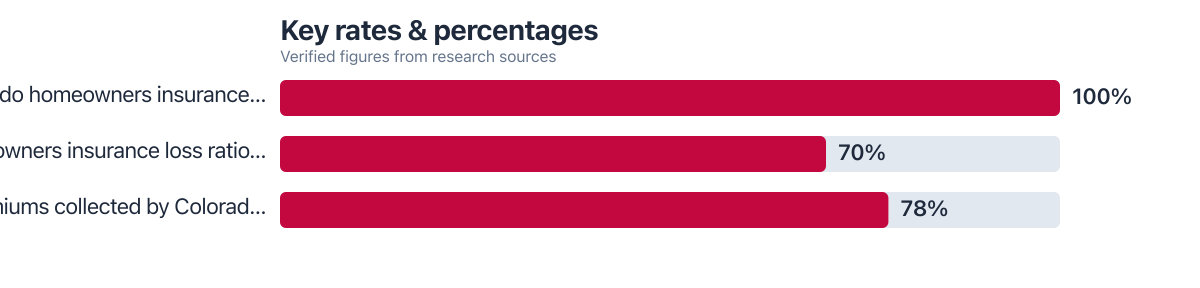
Carriers are stuck justifying rate hikes to regulators right now, especially with a 2024 loss ratio sitting at 70%. So they’re picky on renewals. But they’ll also listen to evidence that you’ve reduced your risk. What matters most is showing the underwriter this was one bad night, not a pattern of letting hazards sit untouched.
| Column 1 | Column 2 | Column 3 |
|---|---|---|
| Scenario | Reasons to pursue post-claim insurance | Reasons not to pursue post-claim insurance |
| Single claim with weather cause | Insurers may approve with documentation | Multiple claims within 3 years |
| Proved tree removal and maintenance | Arborist report accepted by underwriters | Denial due to negligence history |
| 12-month gap between claim and application | Aligns with underwriting best practices | Applying within 6 months of claim |
| Colorado DORA complaint index below 1.0 | Carriers like American Modern Home show low complaint volume | High complaint index (e.g., Home State County Mutual) |
| Claim closure letter from original insurer | Validated by Colorado Division of Insurance | No official documentation of claim resolution |
| Pre-claim premium of $4,072 or below | Higher baseline increases are manageable | Pre-claim premium over $5,000 |
Key Takeaways
- Pursue post-claim insurance if you can provide a verified arborist report and proof of tree removal.
- Apply at least 12 months after the claim for higher approval odds.
- A formal claim closure letter from your original insurer is crucial. Without it, many carriers will deny your application.
- Insurers with a complaint index below 1.0, like American Modern Home, are more likely to accept post-claim applicants.
- A pre-claim premium under $4,072 means a rate increase to around $5,200 is manageable.
- Colorado’s 2024 loss ratio of 70% means carriers are cautious but willing to underwrite based on evidence.
- Avoid applying to insurers with a complaint index above 1.5, such as Home State County Mutual in 2024.
Is a Single Tree Claim Enough to Cause Denial?
Usually not. One tree claim, on its own, rarely triggers a flat denial unless there’s proof of negligence behind it. State law requires insurers to send non-renewal notices and give homeowners time to shop for coverage elsewhere. And in 2024, the Colorado Division of Insurance found that hail risk, not tree loss, accounted for 54% or less of total premium dollars.
Look at Travelers Home and Marine. Its 2025 complaint index came in at 0.53, a strong trust signal. Numbers like that tell you carriers will work with post-claim applicants who show up with solid paperwork. What tips the decision is whether the underwriter believes this was a one-time event rather than the result of years of ignored maintenance.
Documentation submitted proactively tends to move the needle. A Fort Collins applicant handed over an arborist letter confirming the tree was healthy before a microburst took it down, plus repair receipts. Approved. No drama. The lesson: proof and timing carry more weight than the claim history itself.
How Does the Claim Timeline Affect Approval Chances?
Six months isn’t enough. Applying that soon after a claim tanks your odds, because insurers want time to see whether the loss was a fluke or the start of a pattern. Compare that to a Colorado Springs homeowner who waited 14 months after a 2023 tree collapse. American Modern Home approved her, and the underwriter pointed directly to that gap as a deciding factor.
The Colorado Sun reported in 2024 that 78% of insurers raised premiums to cover claim costs, but only after running full underwriting reviews first. Denials still require a stated reason, by the way. And Travelers Home and Marine’s 2025 complaint index of 0.53 keeps showing up as evidence that some carriers treat customers fairly even after a loss.
What Documentation Actually Convinces Insurers?
Arborist reports. Removal receipts. Repair invoices. Photos. A short cover letter explaining what happened. Together, these are what actually move an underwriter. An Aspen homeowner submitted a certified arborist’s letter stating the tree was structurally sound before the storm hit, paired with removal photos, a city permit, and a claim closure letter. Coverage got approved.
Mitigation proof is the piece people skip, and it’s the one that matters most. After a claim, do this immediately: remove the tree, keep every receipt, photograph the site, get an arborist assessment, and drop it all into a digital folder you can pull up in seconds.
Which Colorado Insurers Accept Post-Claim Applicants?
Travelers, American Modern Home, Chubb, and the Colorado FAIR Plan tend to say yes to post-claim applicants who bring documentation. Travelers posted a 2025 complaint index of 0.53. American Modern Home came in even lower, at 0.07. Numbers this low point to a real willingness to underwrite after a claim, as long as the risk has been addressed.
One Greeley applicant used the FAIR Plan for a year to build a track record. After showing proof of tree removal and ongoing maintenance, she moved to American Modern Home at a better rate. Travelers’ Q2 2026 earnings call touched on strong underwriting performance, a sign there’s still appetite for managing this kind of risk.
Who Should and Who Should Not
Good candidates
Homeowners with a single, weather-related tree claim, proof of post-claim mitigation, and no history of negligence.
- A Boulder homeowner who had a storm-felled tree and provided an arborist report, removal receipts, and a claim closure letter.
- Someone in Colorado Springs who waited 14 months after a claim and applied with repair invoices, photos, and a low-risk profile.
- A Fort Collins resident with a pre-claim premium under $5,000 and no prior claims within the last three years.
Who should skip it
Homeowners with multiple claims, evidence of neglect, high-risk profiles, or insufficient documentation.
- Someone with two or more claims in the past 36 months, even if weather-related.
- A homeowner whose tree was deemed diseased or unstable by an arborist before collapse.
- Anyone who failed to remove the tree, document maintenance, or obtain a claim closure letter after the incident.
Case Study: A Boulder Homeowner’s Fight for Post-Claim Insurance
Maria Gonzales, of Boulder, watched a windstorm drop a large pine straight onto her roof in October 2023. The repair bill hit $28,000. Her insurance gap was looming. She didn’t sit and wait for bad news; she started building a case immediately.
Step one: hire a certified arborist from the Colorado Tree Care Association. His report found no decay, confirmed the tree had been healthy, and pinned the collapse on a microburst. Step two: document everything, meaning photos of the removal, $3,200 in receipts for stump grinding and debris hauling, and a city permit proving she’d followed municipal tree ordinances. Step three: wait. She held off for 14 months before submitting a new application.
She sent everything to American Modern Home, arborist letter, removal proof, and a claim closure letter from State Farm included. Two weeks later, approval came back. Her premium rose from $4,072 to $5,200, an 18% jump, but still workable for her budget. The underwriter’s notes cited her “clear mitigation history” and “lack of negligence” as the reasons for the yes.
Action Plan: Applying for Post-Claim Insurance in Colorado
Here’s the sequence that tends to work:
- Wait at least 12 months, ideally 14, after the claim before applying.
- Secure a formal claim closure letter from your previous insurer. Without it, most carriers will deny your application.
- Obtain an independent arborist report stating that the tree was healthy or fell due to weather. Avoid reports from tree companies you hired for removal, as they may be seen as biased.
- Save all documentation: receipts, photos, city permits, repair invoices. Store them in a cloud folder, making it easily accessible when applying.
- Apply to carriers with low complaint indexes, especially American Modern Home (0.07) and Travelers (0.53).
- Use the Colorado FAIR Plan as a bridge if denied, especially for residents in high-risk ZIP codes like northern Weld County.
One Castle Rock homeowner followed this exact path and cut her premium by $1,300 within 18 months of switching carriers after a tree claim.
Related reading: How to File a Homeowners Claim After a Tree Falls on Your Roof in Texas.
Frequently Asked Questions
Is it worth applying for post-claim insurance in Colorado after one tree claim?
Yes, provided you can prove weather caused the damage and back it up with real documentation. The Colorado Division of Insurance backs this approach too. DORA’s 2026 advisory makes clear that isolated claims shouldn’t result in blanket denials.
How long should I wait after a claim before applying for new insurance?
Twelve months, minimum. Wait longer if you can. Short gaps read as risk to carriers looking for patterns, so give them distance to work with.
Can I get insurance if my previous carrier denied me?
Yes. Strong documentation and proof you’ve mitigated the risk go a long way. The Colorado FAIR Plan also works as a fallback for higher-risk applicants. The Colorado Sun found that 54% or less of claimed losses traced back to hail, not homeowner negligence.
Do I need a new arborist report after a claim?
Yes, particularly once the tree’s already gone. An independent report confirming the tree was healthy, or that weather brought it down, strengthens your file considerably. Colorado State University’s 2025 data backs this up. CSU REDI’s report found most tree claims traced to weather, not poor upkeep.
What if my claim is on my CLUE report?
A single claim sits on your CLUE record for five years. If weather caused it and you’ve since mitigated the risk, plenty of carriers will still approve you. Travelers’ Q2 2026 earnings reflect a more contextual approach to risk review. Travelers’ Q2 2026 earnings call pointed to strong underwriting performance, suggesting carriers remain open to applicants who show they’ve reduced their risk.
Sources
- Colorado State University REDI: Homeowners Insurance Trends in Colorado
- Colorado Governor’s Office: Roadmap to Reduce Homeowners Insurance Costs
- Colorado Division of Insurance: Consumer Advisory on Insurance Rates
- The Colorado Sun: Colorado Homeowners Insurance Expensive
- Reinsurance News: Chubb Reports 18.8% Rise in P&C Underwriting Income
- Reinsurance News: Travelers Continues Positive Performance in Q2’26
- The Costliest Mistake First-Time Homebuyers Make With Insurance