Reviewed by the Smart Insurance 101 Editorial Team
Our Take
For most delivery drivers doing gig work part-time, a rideshare or delivery endorsement added to a personal policy is the right starting move, it closes the personal-policy exclusion gap for roughly $5–$46 more per month and works well for single-platform drivers. The case for a standalone commercial policy is the case for full-time drivers, multi-platform drivers running DoorDash and Uber Eats simultaneously, or anyone carrying high-value cargo. Endorsements do not stack cleanly across multiple active apps, and that gap is where most claim denials happen.
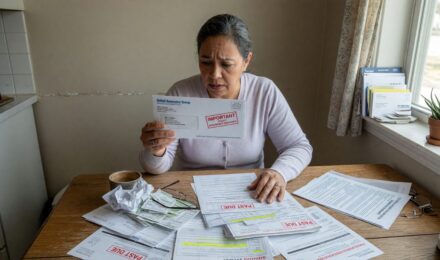
Personal auto insurance was never designed for the gig economy. The Federal Trade Commission has warned directly that most personal auto policies exclude business use of a vehicle, meaning a single delivery run can void an otherwise valid claim., roughly 7 million Americans work as gig delivery drivers according to Bureau of Labor Statistics occupational estimates, and most of them are underinsured without knowing it.
This article is for delivery drivers, DoorDash, Uber Eats, Amazon Flex, Instacart, and anyone earning income behind the wheel. What makes the coverage recommendation work is understanding which phase of a delivery shift you are in at the moment of an accident. What makes it fail is assuming one endorsement covers everything.
Key Takeaways
- Personal auto policies explicitly exclude delivery use. The North Carolina Department of Insurance states that personal policies do not cover a vehicle used for a delivery network platform, and failing to disclose this use leads to claim denials.
- Platform liability in Period 1, app on, waiting for an order, is limited to roughly $50,000/$100,000/$25,000, a documented low-limit window that leaves drivers exposed before any delivery begins.
- Adding rideshare or delivery coverage to a personal policy costs $5 to $46 more per month, according to Business Insider’s 2024 insurance analysis, a manageable cost for part-time drivers.
- Full commercial auto insurance costs approximately $147 per month for delivery drivers per Business Insider, nearly double a typical personal policy baseline of $179/month ($2,150 annually) but with broader limits and no phase gaps.
- In my experience reviewing reader coverage questions, drivers running two apps simultaneously face the single most dangerous gap: endorsements are written for one platform, and neither platform’s policy clearly covers the moment a driver accepts a second order mid-shift.
Why Standard Auto Policies Fail Delivery Drivers
Here’s the thing: personal auto insurance policies contain a business-use exclusion that is specifically designed to void coverage the moment your car becomes an income-generating tool. It does not matter whether the trip looks like ordinary driving. If you have the app open and you are transporting goods for pay, your insurer has contractual grounds to deny the claim.
The North Carolina Department of Insurance is explicit on this point: personal auto policies do not cover a vehicle while it is being used for a delivery network platform, and drivers must disclose this use to their insurer to ensure proper coverage and avoid claim denials. Texas mirrors this position. The Texas Department of Insurance states that using a vehicle for delivery work may impact premiums and requires additional coverage, and that drivers should contact their agent before taking their first order.
What “Delivery” Actually Triggers
The business-use exclusion does not activate only during the active drop-off. It activates the moment you open the app. That is the point most drivers miss. An accident in a parking lot while you have DoorDash open but have not yet accepted an order still falls into the gray zone where your personal policy says no and the platform’s liability may be minimal. This is what regulators call Period 1, and it is where coverage stacks most dangerously thin.
What I see in practice: Readers frequently believe their claim will be fine because the accident happened “before they picked anything up.” That reasoning does not hold. The app being open is the trigger insurers use to invoke the business-use exclusion. Disclosure to your insurer before you start gig work is not optional, it is the only way to preserve your coverage.
Failing to disclose delivery use at policy inception is also a material misrepresentation. That gives an insurer not just the right to deny a single claim, but grounds to rescind the policy entirely. For a deeper look at how auto coverage is structured from the ground up, our guide on everything you need to know about car insurance covers the baseline mechanics.
The Three Phases of a Delivery Shift, and Where Each One Leaves You
Platform coverage follows a three-phase model, and understanding the liability limits at each phase is the foundation of building any sound delivery driver auto insurance stack.
- Period 1 (App on, waiting for an order): Platform liability is typically $50,000 per person / $100,000 per accident / $25,000 property damage. This is contingent coverage, it only applies if your personal policy has already denied the claim.
- Period 2 (Accepted order, en route to pickup): Most platforms step up to $1 million in liability. Some also provide contingent collision and comprehensive coverage, but only if you carry those coverages on your personal policy first.
- Period 3 (Active delivery, goods in car): The $1 million liability typically continues. However, cargo, meaning the food or packages in your vehicle, is almost never covered by platform policies.
The Period 1 gap is real and documented. Kentucky’s insurance regulation 601 KAR 1:113 addressed this directly, requiring platforms to provide first-dollar coverage in Period 1 if the driver’s personal policy denies the claim. That is state-level policy acknowledging the gap exists. Most states have not gone that far.
Multi-App Drivers Face a Compounded Problem
Here’s the thing most coverage guides skip entirely: a driver who accepts a DoorDash order while an Uber Eats order is still active occupies an ambiguous zone that neither platform’s policy cleanly covers. Each platform’s contingent policy is written for their app’s activity. When two are running simultaneously, both platforms may argue the other’s coverage applies first. The endorsement on your personal policy may specify a single platform or simply say “delivery use”, but claim adjusters will scrutinize which app generated the active assignment at the time of the accident.
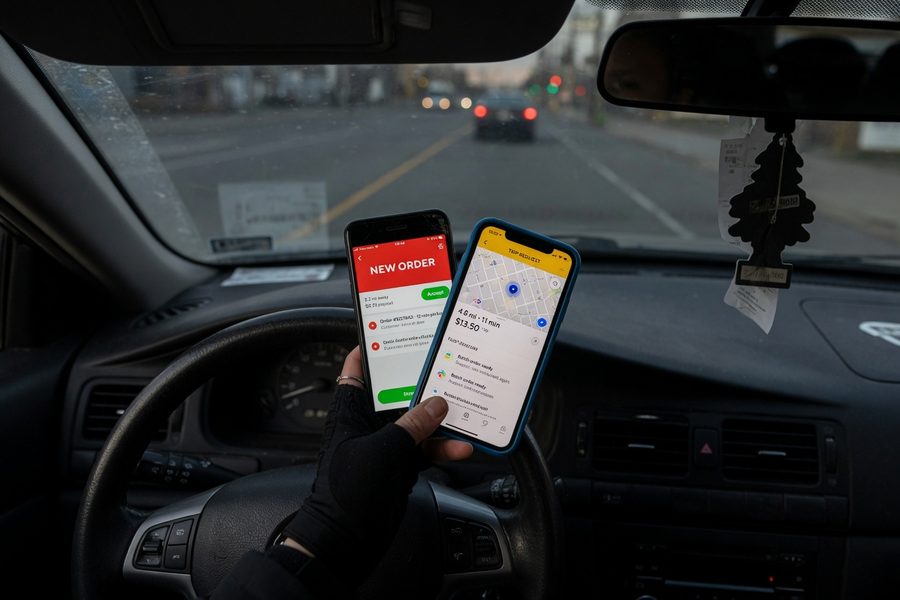
Where this gets tricky: I’ve seen readers assume their delivery endorsement covers all apps automatically. Most do not. Progressive’s TNC endorsement, for example, specifies covered network companies by name. If you add a second platform later and do not update the endorsement, you have created a coverage hole without realizing it.
Delivery Endorsements vs. Commercial Auto: The Real Cost Comparison
For part-time drivers, the endorsement route wins on cost, unless you are full-time, carry cargo risk, or run multiple apps.
Adding a delivery or rideshare endorsement to a personal policy runs $5 to $46 per month more, per Business Insider’s 2024 data. That is $60 to $552 annually. A standalone commercial auto policy averages $147 per month for delivery drivers, roughly $1,764 per year. Using the Rideshare Guy’s 2025 baseline of $2,150 per year for full personal coverage, a driver adding the maximum endorsement cost ($552) pays about $2,702 annually. A commercial policy replaces the personal policy at $1,764, but that figure does not include personal driving coverage, so many full-time drivers end up carrying both, which changes the math.
| Coverage Option | Approximate Annual Cost | Best For | Key Limitation |
|---|---|---|---|
| Personal Policy Only | $2,150 | No delivery use | Zero delivery coverage; claim denial risk |
| Personal + Delivery Endorsement (low) | $2,210 | Part-time, single-platform driver | Platform-specific; may not cover all phases |
| Personal + Delivery Endorsement (high) | $2,702 | Part-time, moderate mileage | Still excludes cargo; multi-app risk |
| Commercial Auto Policy | $1,764 (delivery only) | Full-time driver, multi-app, cargo risk | May not cover personal driving; higher upfront cost |
| Personal + Commercial Stack | $3,914+ | Full-time + personal vehicle use | Most expensive; requires careful coordination |
Progressive, GEICO, and Farmers each offer delivery-specific add-ons, though availability varies by state. Progressive’s rideshare endorsement is among the most widely available. GEICO offers a rideshare endorsement in most states but has historically been slower to add delivery-specific language. Farmers offers a “Rideshare Insurance” product that extends personal coverage into Period 1 in select states. None of these products are identical, and none automatically cover cargo damage. For drivers thinking about reducing auto insurance costs while maintaining delivery coverage, endorsements are almost always the first move to explore.
Avoiding the Hidden Gaps: Cargo, Uninsured Motorists, and Disclosure
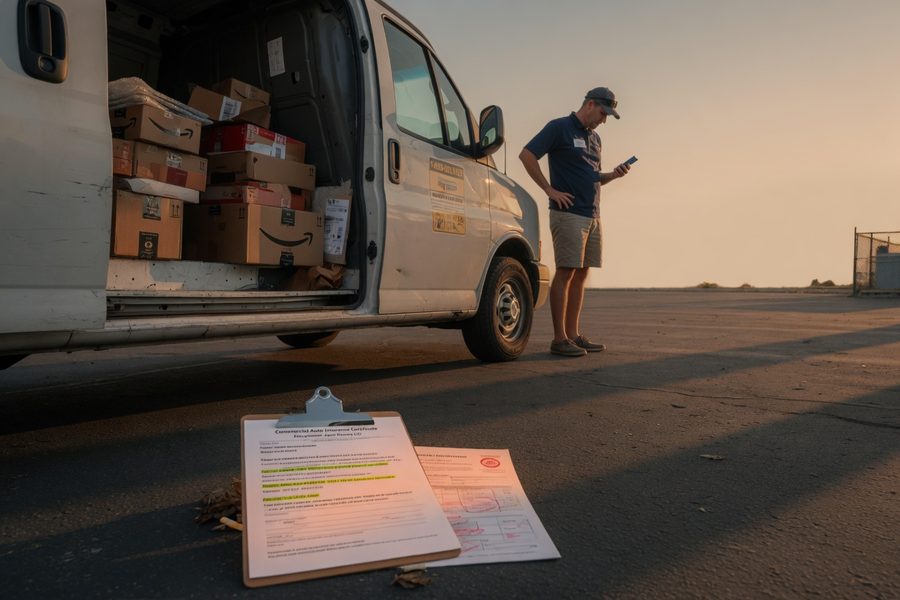
Cargo coverage is the gap almost nobody talks about. Neither personal policies nor platform liability coverage protects the goods in your car during a delivery. A $200 restaurant order or a $400 Amazon package damaged in a rear-end collision is your financial problem unless you carry separate inland marine or commercial cargo coverage. For food delivery drivers, the dollar amounts are usually small enough that self-insuring is a defensible choice. For package delivery drivers under Amazon Flex or similar contracts carrying electronics, that calculus changes.
Uninsured motorist coverage is the other sleeper issue. If an uninsured driver hits you during Period 2 or Period 3, your platform’s $1M liability does not pay you, it only covers claims against you. Your own uninsured motorist coverage is what pays for your injuries and vehicle damage. Confirm that your personal policy’s UM/UIM coverage does not contain a business-use exclusion of its own, because some policies include one.
What clients often miss: Disclosure at policy renewal, not just inception, matters. If you started gig work mid-policy term and your insurer discovers it after a claim, they can argue you withheld a material change. Call your agent within 30 days of starting delivery work, not at the next renewal.
The Washington State Office of the Insurance Commissioner recommends that drivers talk to their agent or broker before participating in gig or delivery activities, precisely because most personal policies sold in that state do not cover gig-related losses. The National Association of Insurance Commissioners reinforces that auto insurance is regulated at the state level, which means coverage requirements, platform obligations, and endorsement availability all vary. If you are not certain what your state requires, your state insurance department’s consumer directory (linked from the NAIC site) is the right starting point.
One practical note: if you are self-employed as a delivery driver, your broader financial protection picture matters beyond just the car. Our guide on health insurance plans for self-employed workers in 2026 is worth reading alongside this one, since a serious accident can generate medical costs that dwarf the property damage. And if you want a broader view of how liability exposure can escalate, why lawsuits are quietly getting more expensive is relevant context for any driver carrying commercial-level exposure.
Where This Recommendation Falls Short
The endorsement-first recommendation has a real drawback: it is built for simplicity, and the gig economy is not simple. Here is the honest version of where this approach fails.
First, endorsements are not uniform. The catch is that Progressive’s delivery endorsement in Ohio is not the same product as Farmers’ rideshare add-on in California. One may cover Period 1, the other may not. One may name specific platforms, the other may use broader language. Drivers who comparison-shop only on price and skip the policy language review are taking a risk that does not show up until a claim is filed.
Second, the endorsement route does not work for full-time delivery drivers. If you are driving 30-plus hours a week across two or three apps, a personal policy with an add-on is structurally undersized. Commercial auto policies carry higher liability limits, are not contingent on platform coverage, and are underwritten with your actual mileage in mind. The higher cost of commercial coverage, roughly $147 per month, is genuinely justified at full-time volume. The risk is that drivers resist the cost increase and stay on an endorsement that was designed for occasional use.
Third, the tradeoff on cargo coverage is real. This article recommends endorsements as a starting point, but endorsements do not cover the goods you are transporting. For most food delivery drivers, this is an acceptable exposure. For package delivery drivers, especially those handling high-value goods under Amazon Flex, the right answer is separate cargo coverage. Estimating that cost requires a quote from a commercial insurer, and most drivers do not pursue it.
Finally, multi-app drivers should not follow the endorsement recommendation at all without first confirming that the endorsement language covers all platforms they use. If it does not, and if their state lacks first-dollar platform obligations like Kentucky’s, they are effectively uninsured during the most active parts of their shift. That group should go straight to commercial auto and not optimize for lower premiums. For a broader look at how to approach comparing policy options, the step-by-step car insurance quote comparison guide is a useful tool for working through multiple insurer options side by side.
How We Sourced This
This article draws from verified institutional sources including the Federal Trade Commission, North Carolina Department of Insurance, Washington State Office of the Insurance Commissioner, Texas Department of Insurance, and the National Association of Insurance Commissioners, all accessed in May–June 2026. Cost figures come from Business Insider’s 2024 delivery driver insurance analysis and The Rideshare Guy’s 2025 delivery insurance overview; both URLs are cited inline. Platform liability phase limits (Period 1/2/3) are drawn from publicly available platform disclosure documents and corroborated by state regulatory guidance. Kentucky regulation 601 KAR 1:113 is cited as a specific state-level mandate. Articles published after June 2026 were excluded from this research. All arithmetic in the cost comparison table uses the source figures exactly as published, no figures were rounded or adjusted.
Related reading: How a Colorado Driver Avoided a 45% Auto Insurance Hike After a DUI.
Frequently Asked Questions
Does my personal auto insurance cover me while I deliver for DoorDash or Uber Eats?
No. Standard personal auto policies contain business-use exclusions that apply the moment you use your vehicle for compensated delivery work. The FTC, Texas Department of Insurance, and multiple state regulators have confirmed this directly. You need either a delivery endorsement or a commercial policy to avoid claim denial.
What is the cheapest way to get covered as a part-time delivery driver?
Adding a delivery or rideshare endorsement to your existing personal policy is the lowest-cost option, typically adding $5 to $46 per month. Call your insurer and ask specifically whether the endorsement covers the platform you use and all three delivery phases, app-on waiting, en route, and active delivery. Get the answer in writing.
Do I need separate insurance if I drive for multiple apps at the same time?
Running two apps simultaneously creates a coverage gap that most endorsements do not address. Each platform’s contingent policy covers its own assigned deliveries, and endorsements are often written for a named platform. If you regularly stack apps, a commercial auto policy that covers delivery use broadly, regardless of platform, is the more defensible choice.
Are the goods I am delivering covered if they are damaged in an accident?
Almost never, under either a personal policy or platform liability coverage. Platform policies cover your liability to third parties, not cargo damage. Separate inland marine or commercial cargo coverage is required if you want protection for the goods themselves, and for food delivery at typical order values, most drivers reasonably choose to self-insure this risk.
What happens if I never disclosed my delivery work to my insurer and I get into an accident?
Your insurer has grounds to deny the claim and, in some cases, to rescind the policy retroactively on the basis of material misrepresentation. Disclose delivery use to your agent as soon as you start, not at the next renewal. If your current insurer will not offer a delivery endorsement, that is useful information: it means you need a different carrier, not that you can skip the coverage.
Sources
- Federal Trade Commission, Driving for Extra Cash? Check Your Car Insurance First
- North Carolina Department of Insurance, Driving for a Transportation Network or Delivery Network Company
- Washington State Office of the Insurance Commissioner, Gig Workers and Delivery Drivers
- National Association of Insurance Commissioners, Auto Insurance Consumer Resource
- Texas Department of Insurance, Delivering Packages: What to Know About Auto Insurance
- Business Insider, Delivery Driver Car Insurance: Costs and Coverage Options (2024)
- The Rideshare Guy, How Delivery Insurance Works and Options for Drivers (2025)
- Bureau of Labor Statistics, Occupational Employment Statistics: Light Truck Drivers