
Fact-checked by the Smart Insurance 101 editorial team
Quick Answer
Adding a teen driver raises annual premiums by $1,500–$3,500 on average. Families who combine a good student discount, driver’s education, a telematics program, and smart vehicle assignment typically cut that added cost by 30–50%, bringing the net increase down to $900–$1,400 per year. Shop at least five carriers before making the change, pricing for teen drivers varies by up to 60% across major insurers.
Opening a car insurance renewal notice after adding a teenager to your policy delivers a specific kind of sticker shock. Adding teen driver insurance can inflate your annual premium by $1,500 to $3,500, sometimes more, in a single billing cycle. That’s not a rounding error. It’s a second car payment appearing out of nowhere, every single month.
The numbers behind this rate shock are staggering. According to the Insurance Institute for Highway Safety, drivers aged 16–19 are nearly three times more likely to be involved in a fatal crash per mile driven than drivers aged 20 and older. Insurers price that risk aggressively. Industry data consistently shows that adding a 16-year-old male to a policy increases premiums by an average of 130–160%, while adding a 16-year-old female raises rates by roughly 80–100%. These aren’t outliers, they’re the industry baseline.
This guide provides a data-backed breakdown of exactly how teen driver premiums are calculated, which discounts actually move the needle, how to use vehicle choice and policy structure to your advantage, and the specific steps that can cut your added cost by $500 to $1,500 per year without sacrificing coverage.
Key Takeaways
- Adding a teen driver raises average annual premiums by $1,500–$3,500, with male teens typically costing 130–160% more than adult drivers.
- Good student discounts can reduce a teen’s portion of the premium by 8–25%, saving families $200–$500 per year at major insurers.
- Telematics (usage-based) programs like Snapshot or DriveWise can yield discounts of 10–40% for teens who demonstrate safe driving over a 6-month monitoring period.
- Assigning a teen to an older, lower-value vehicle rather than a new SUV can reduce comprehensive and collision costs by $300–$700 annually.
- Driver’s education completion is recognized by most major insurers and typically reduces teen premiums by 5–15% immediately upon adding the driver.
- Shopping competing quotes before adding a teen, not after, can save $400–$900 per year, as carrier pricing for young drivers varies by up to 60%.
In This Guide
- Why Teen Driver Premiums Spike So Dramatically
- When and How to Add a Teen Driver to Your Policy
- Discounts That Actually Work for Teen Drivers
- Telematics and Usage-Based Programs: The Teen Driver’s Secret Weapon
- Vehicle Assignment Strategy: How Car Choice Affects the Bill
- Coverage Structure: What to Keep, What to Trim
- Shopping Carriers: Why Teen Pricing Varies Wildly
- Graduated Licensing Laws and Their Insurance Impact
- Building a Long-Term Rate Reduction Strategy
Why Teen Driver Premiums Spike So Dramatically
Insurance is a pricing exercise based on statistical risk. The data on teenage drivers is unambiguous and severe. The Centers for Disease Control and Prevention reports that motor vehicle crashes are the leading cause of death for U.S. teenagers, accounting for roughly 2,400 teen deaths per year.
Insurers don’t just look at fatality rates. They analyze claim frequency, claim severity, distracted driving citations, and the cost of property damage caused by young drivers. All of those metrics point in the same direction: teens file claims more often and those claims cost more per incident.
The Actuarial Math Behind Rate Increases
Underwriters assign each driver a risk factor multiplier based on age, gender, driving history, and geography. A 45-year-old with a clean record might carry a multiplier of 1.0, the baseline. A 16-year-old male in most states carries a multiplier of 2.5 to 3.5.
That multiplier doesn’t apply to your whole premium. It applies to the portion of the premium attributable to that driver. But on a household policy with solid liability limits, that driver’s share can still add $1,800 or more annually.
Gender, Age, and Marital Status Factors
Most states still permit gender-based pricing for auto insurance, and insurers use it heavily for teen drivers. A 16-year-old male driver is statistically twice as likely to be involved in a crash as a same-age female. That gap narrows significantly by age 25, when most of the elevated risk premium evaporates.
Teen drivers who marry young see their rates drop almost immediately, because married drivers, even young ones, file fewer claims. This is an actuarial quirk, not a life advice recommendation.
Teen drivers aged 16–19 represent roughly 3.5% of all licensed drivers in the U.S. but account for nearly 8.4% of total crash costs annually, according to the AAA Foundation for Traffic Safety.
Understanding this math helps you push back intelligently when reviewing your policy. You’re not just a passive premium payer, you’re managing a risk profile, and many of the factors that drive that profile are within your control.
When and How to Add a Teen Driver to Your Policy
One of the most common and costly mistakes parents make is waiting to notify their insurer. Some families delay adding a teen driver to avoid the premium hit. This is a serious financial gamble, and potentially illegal depending on your state.
A teen involved in an accident while driving your car but not listed on your policy could result in your insurer denying the claim entirely or drastically reducing the payout. The savings from delaying the conversation could evaporate instantly in a single fender-bender.
Learner’s Permit vs. Full License: When the Clock Starts
Most insurers require you to add a teen driver once they obtain a learner’s permit, not when they get a full license. Some carriers are more lenient and only require listing when a full license is issued, but you must confirm this directly with your insurer in writing.
A few major carriers, including State Farm and GEICO, offer a grace period during the permit phase. They cover permit-holding teens under the household policy automatically for a short window, typically 30–90 days. After that, a formal endorsement is required.
Never assume a learner’s permit is automatically covered long-term. Call your insurer the day your teen gets their permit and ask explicitly: “Is this driver covered under our current policy, and for how long?” Get the answer in writing or via email.
How to Formally Add the Driver
Adding a teen driver is a policy endorsement, a formal change to your contract. You’ll typically need the teen’s full legal name, date of birth, driver’s license number (once issued), and the vehicle they’ll primarily drive.
Families working with an independent agent should request a multi-carrier re-quote at the same time. Adding a teen is one of the most impactful policy change events, and it’s an ideal moment to reassess whether your current carrier is still the most competitive option for your household.
Discounts That Actually Work for Teen Drivers
The insurance industry offers a menu of teen-specific discounts. Not all of them are meaningful. Some provide only 2–3% reductions that barely register. Others can cut $300–$600 annually. Knowing the difference is essential for managing teen driver insurance costs effectively.
Good Student Discount: The Most Reliable Savings
The good student discount is the single most impactful and widely available teen-specific discount in the industry. Most major carriers offer it, and it typically requires a B average (3.0 GPA) or better, verified by a report card or transcript submitted annually.
Savings range from 8% to 25% depending on the carrier. At Allstate, the discount runs up to 20%. Nationwide offers up to 15%. State Farm’s program historically delivers 7–25% off the teen driver’s portion of the premium. On an added cost of $2,000/year, a 20% good student discount is worth $400.
Homeschooled students can also qualify for good student discounts at most major insurers. You’ll need documentation, such as a structured curriculum record or standardized test scores, but the discount is available if you ask for it.
| Insurer | Good Student Discount | GPA Requirement | Max Annual Savings (est.) |
|---|---|---|---|
| State Farm | 7–25% | 3.0 / B average | ~$500 |
| Allstate | Up to 20% | 3.0 / B average | ~$400 |
| Nationwide | Up to 15% | 3.0 / B average | ~$300 |
| GEICO | Up to 15% | 3.0 / B average | ~$300 |
| Progressive | Varies | 3.0 / B average | ~$250 |
Driver’s Education and Defensive Driving Discounts
Completing a state-approved driver’s education course signals to insurers that a teen has received structured, professional training beyond what a parent provides in a parking lot. Most carriers recognize this and discount accordingly, typically 5–15% off the teen driver’s rate.
Defensive driving courses taken post-licensure add another layer. The National Safety Council offers programs that some carriers recognize for an additional 5–10% discount. Stack these with the good student discount and you’re already pulling the premium down by 15–30%.
Ask your insurer for a list of approved courses before your teen enrolls. Not all programs qualify, the course must typically be state-certified or on an approved provider list maintained by the carrier.
Away-at-School Discount
A teen who heads to college more than 100 miles from home without a car qualifies for a significant “away at school” or “student away” discount at most insurers. Your teen stays listed on the policy for coverage during visits home, but their active risk profile drops sharply.
This discount commonly ranges from 15% to 35% of the teen’s premium share. For a college student without a car on campus, it can save $300–$700 annually while maintaining coverage during holidays and summer breaks.
Telematics and Usage-Based Programs: The Teen Driver’s Secret Weapon
Telematics, the use of a plug-in device or smartphone app to monitor driving behavior, has become one of the most powerful tools available for families managing teen driver insurance costs. For teens who drive safely, these programs can generate discounts that far outpace any static coupon.
How Telematics Programs Work
Programs like Progressive’s Snapshot, Allstate’s DriveWise, and State Farm’s Drive Safe & Save monitor speed, braking, acceleration, cornering, time of day, and phone usage while driving. The monitoring period typically runs 6 months. After that, the earned discount is applied to the policy.
Safe teen drivers who avoid hard braking, late-night driving, and phone use can earn discounts of 20–40%. That range is not theoretical, Progressive publicly states Snapshot discounts average around 10–15%, but top-performing drivers earn up to 30%. For a $2,000 annual teen surcharge, 25% off means $500 back in your pocket every year.
The American Property Casualty Insurance Association has noted that usage-based insurance programs are among the most effective tools for differentiating risk within the teen driver segment, a teen who drives carefully at 17 shouldn’t pay the same rate as a reckless peer, and telematics data finally lets carriers make that distinction accurately.
Choosing the Right Telematics Program
| Program | Insurer | Monitoring Method | Max Discount | Penalty for Bad Driving? |
|---|---|---|---|---|
| Snapshot | Progressive | App or plug-in device | Up to 30% | Possible rate increase |
| DriveWise | Allstate | App | Up to 40% | No penalty |
| Drive Safe & Save | State Farm | App or OnStar | Up to 30% | No penalty |
| SmartRide | Nationwide | Plug-in device | Up to 40% | No penalty |
| IntelliDrive | Travelers | App | Up to 30% | Possible rate increase |
Note the “penalty” column carefully. Programs like Progressive’s Snapshot can actually raise your rate if your teen drives poorly. Not confident in your teen’s habits yet? Choose a no-penalty program like DriveWise or SmartRide for the monitoring period.
Use telematics as a transparency tool, not just a savings mechanism. Share the driving data with your teen weekly. Teens who see real-time feedback on their braking and phone behavior improve demonstrably faster, and that improvement directly translates to lower premiums.
One honest caveat: telematics programs require your teen to consent to ongoing monitoring, and some teens resist it. The privacy trade-off is real. These apps track location data continuously, and families should discuss that openly before enrolling. The financial benefit is substantial, but it works best when the teen understands and accepts what’s being measured.
Vehicle Assignment Strategy: How Car Choice Affects the Bill
Insurers don’t just price by driver, they price by driver-vehicle pairing. Which car you assign your teen to drive has a significant and often underappreciated impact on your total premium. This is one of the most actionable levers in the entire process.
Why Vehicle Assignment Matters
When you add a teen to your household policy, the insurer will assign the highest-risk driver to the most expensive vehicle unless you specify otherwise. That default assumption maximizes your premium. By explicitly assigning your teen to the oldest, lowest-value vehicle in your driveway, you minimize the collision and comprehensive exposure.
A teen assigned to a 10-year-old Honda Civic worth $8,000 will cost dramatically less to insure than the same teen assigned to a 2022 Toyota Highlander worth $42,000. The liability exposure is similar, but the physical damage coverage cost is entirely different.
Safest and Cheapest Vehicles for Teen Drivers
The Insurance Institute for Highway Safety publishes a yearly list of recommended vehicles for teen drivers. The ideal profile is a mid-size or full-size vehicle (heavier cars fare better in crashes) with a strong safety rating, low horsepower, and a modest market value that keeps physical damage premiums manageable.
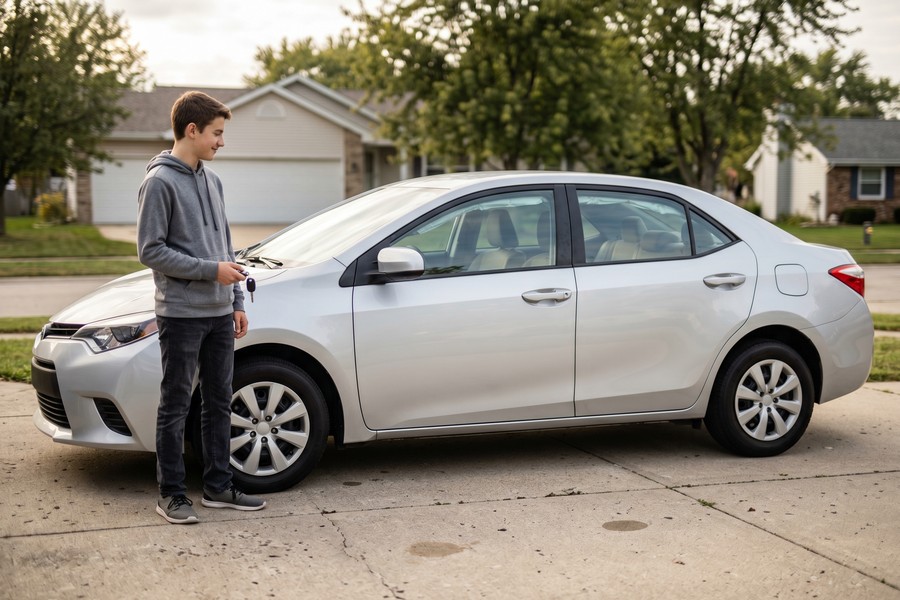
| Vehicle Category | Example Model | Est. Annual Teen Premium (added cost) | Key Advantage |
|---|---|---|---|
| Older Midsize Sedan | 2014 Honda Accord | $1,400–$1,900 | Low market value, good safety ratings |
| Older Full-Size Sedan | 2013 Toyota Camry | $1,500–$2,000 | Mass = protection in crashes |
| New Compact SUV | 2023 Honda CR-V | $2,200–$3,000 | Good safety tech, higher comp/collision |
| New Luxury Sedan | 2023 BMW 3-Series | $3,500–$5,000 | High repair costs = expensive premiums |
| Sports/Performance Car | 2020 Ford Mustang GT | $4,000–$6,500 | Highest risk profile, worst rates |
Avoid sports cars, muscle cars, and high-horsepower vehicles entirely. Insurers code these as statistically associated with aggressive driving behavior, and the premium surcharge is severe, sometimes adding $1,500–$3,000 annually beyond what a comparable safe vehicle would cost.
Coverage Structure: What to Keep, What to Trim
Adding a teen is also a natural moment to audit your entire policy structure. Some coverages that made sense before may now be worth reassessing, not eliminating, but recalibrating to reflect your actual financial exposure.
Liability Limits: Don’t Cut Here
This is the one area where many financial advisors, and this guide, strongly recommend maintaining or even increasing coverage when a teen is added. Teen drivers cause more accidents. When they do, liability claims can be substantial.
A serious accident caused by your teen could result in bodily injury claims of $300,000 or more. State minimum liability limits of $25,000/$50,000 are dangerously inadequate. Carry at least $100,000/$300,000 per occurrence, and consider an umbrella policy if your net worth warrants it. As detailed in our overview of what liability insurance is and how it works, the gap between minimum and adequate coverage can be financially catastrophic.
Collision and Comprehensive: Match Coverage to Vehicle Value
An older vehicle with a market value under $5,000 may not justify carrying collision and comprehensive coverage with a $500 deductible. The math: a car worth $4,500 with collision adding $600/year to your premium means you’re paying 13% of the vehicle’s value annually for coverage that will only pay out a few thousand dollars in a total loss.
Raising your deductible from $500 to $1,000 or $1,500 on the teen’s assigned vehicle can reduce physical damage premiums by 15–25%. Just make sure you can actually afford to cover that deductible out of pocket if needed.
According to the National Association of Insurance Commissioners, the average collision claim in the U.S. is approximately $3,900. If your teen’s vehicle is worth less than $6,000 and you’re paying $800/year for collision coverage, you may be over-insuring the risk.
For a deeper look at the relationship between your deductible choices and total annual costs, our guide on deductible vs. out-of-pocket maximum covers the core trade-offs in accessible terms, the logic applies equally well to auto insurance decisions.
Shopping Carriers: Why Teen Pricing Varies Wildly
Here is a fact that surprises most families: the variation in teen driver pricing between major insurers is enormous. For the exact same driver profile, you can see a $1,200 annual difference between the highest-priced and lowest-priced carriers. That gap is pure savings if you do the legwork.
How Carrier Pricing Algorithms Differ
Each insurer builds its own proprietary actuarial model. Some carriers are more willing to compete aggressively for the household policy even when a teen is involved. Others treat teen drivers as pure loss leaders and price to deter. The only way to know which is which, for your specific zip code, vehicle, and driver profile, is to get quotes.
Our step-by-step guide to car insurance quote comparison walks through the full process. The core principle: always quote at least five carriers, use identical coverage limits for each, and factor in any available discounts before comparing final numbers. Regional carriers like Erie Insurance often price teen drivers more favorably than national brands, so don’t limit your search to the companies with the biggest advertising budgets.
“Parents who shop for quotes before adding a teen driver — not after they’ve already made the change — consistently secure better rates. The leverage is in the timing. Once you’ve already moved forward with your current carrier, you’ve given up your negotiating position.”
The Multi-Policy Bundling Angle
Auto and homeowners policies split across different carriers represent a missed opportunity. Adding a teen is the right moment to consolidate. Multi-policy bundling discounts typically run 5–15% across both policies. On a combined annual premium of $4,000, a 10% bundle discount saves $400, partially offsetting the teen surcharge.
Some carriers sweeten this further with loyalty discounts for households that have been with them five or more years. Ask explicitly whether your tenure qualifies you for any retention pricing when you’re negotiating the teen add. Carriers regulated by your state’s insurance commissioner are required to disclose all available discounts, so ask directly rather than waiting for your agent to volunteer them.
A 2023 analysis by ValuePenguin found that the cheapest and most expensive major insurers for a 16-year-old male driver differed by an average of $2,184 per year for identical coverage, a 58% price gap on the teen’s portion alone.

Graduated Licensing Laws and Their Insurance Impact
Graduated driver licensing (GDL) programs now exist in all 50 states. They restrict new teen drivers progressively, limiting night driving, passenger counts, and phone use, before granting full driving privileges. These laws were designed for safety, but they have a meaningful insurance dimension as well.
How GDL Restrictions Affect Claims and Rates
Research published by the Insurance Institute for Highway Safety shows that strong GDL laws reduce fatal crash rates for 16-year-old drivers by up to 26%. States with the most restrictive GDL programs see corresponding reductions in claim frequency for newly licensed teens.
Some insurers explicitly factor GDL phase into their pricing models. A teen in the restricted Phase 2 license stage may be rated more favorably than a teen with a full unrestricted license, because their exposure to high-risk driving situations (late nights, multiple passengers) is legally limited.
Enforcing Restrictions at Home
Beyond legal requirements, voluntarily extending GDL-style restrictions at home, no night driving until age 17, no more than one peer passenger for the first year, signals lower risk to insurers who use telematics data. These behaviors are measurable through the monitoring apps discussed earlier.
The combination of legal GDL compliance and voluntarily conservative driving patterns is one of the most powerful risk-reduction strategies available. It takes time, but it builds toward dramatically lower rates by the time the teen turns 18 or 19.
Building a Long-Term Rate Reduction Strategy
Teen driver insurance is not a permanent condition. Rates improve every year with a clean driving record. The families who navigate this period most successfully aren’t just looking for one-time discounts, they’re executing a multi-year strategy.
The Rate Trajectory: What to Expect Year by Year
Year one with a new teen driver is typically the most expensive. Rates often moderate slightly between ages 17 and 19 if the record stays clean. The largest single drop typically occurs at age 25, the point at which most actuarial models fully exit the “young driver” surcharge zone.
Meaningful rate reductions happen earlier, though. A teen with zero claims and zero violations at age 18 will typically see their premium share drop 10–20% from the age-16 baseline. By age 21, that drop can reach 30–40%. Keeping a clean record is the single most powerful long-term premium reduction tool available.
“The three-year clean driving record is a genuine inflection point in teen driver pricing. Families who avoid claims and traffic violations between ages 16 and 19 are positioned to see their rates normalize faster than almost any discount program can achieve on its own.”
Annual Policy Review Discipline
Set a calendar reminder to re-shop your policy every 12 months while a teen is on your household policy. Carrier competitiveness shifts. New telematics discount structures emerge. Your teen’s age changes their rating class. None of these changes happen automatically, you have to initiate the review.
Reassess your coverage levels annually as well. As the teen-assigned vehicle ages, dropping comprehensive and collision becomes increasingly sensible. As your teen builds a clean record, ask your current insurer for re-rating. Many will adjust rates mid-policy cycle if presented with evidence of improved risk profile.
Monitoring the Broader Insurance Cost Environment
Teen driver premiums don’t exist in isolation. The broader auto insurance market has been experiencing significant rate inflation, our analysis of why insurance premiums are exploding covers the macro drivers in detail. Understanding those forces helps you contextualize your own rate changes and negotiate more effectively with carriers.

Some insurers now offer “teen rate graduation” programs that formally re-rate a teen driver at the 3-year clean record mark without requiring a full policy re-quote. Ask your agent whether this program exists and whether your teen qualifies.
Real-World Example: The Martinez Family’s $1,140 Annual Savings
When David and Carla Martinez of suburban Columbus, Ohio added their 16-year-old son, Marco, to their existing State Farm policy in early 2023, their annual premium jumped from $2,340 to $4,820, an increase of $2,480. Like most families, their first instinct was to accept the quote and move on. Instead, they spent two weekends executing a structured review of every available option.
First, they enrolled Marco in a state-certified driver’s education course ($185 tuition) and submitted his 3.4 GPA transcript to unlock the good student discount. Combined, those two steps reduced the teen surcharge by approximately 22%, saving $545 annually. Next, they enrolled Marco in State Farm’s Drive Safe & Save telematics program. After six months of careful driving, Marco averaged a 94 out of 100 safety score, they received an additional 18% discount on his portion of the premium, worth another $310 per year. They also reassigned Marco’s primary vehicle from the family’s 2021 Chevrolet Equinox to a 2012 Honda Civic they purchased for $7,200, reducing collision and comprehensive premiums by $285 annually on the vehicle assignment change alone.
Total annual savings: approximately $1,140. Their net added cost dropped from $2,480 to roughly $1,340 per year, still significant, but 46% lower than their original quote. The driver’s education course paid for itself in less than five days of premium savings.
By Marco’s 18th birthday, with a completely clean record and two full years of telematics data, the family re-shopped their policy and found that Erie Insurance could cover the entire household, with Marco fully listed, for $3,420 annually. That’s $1,400 less than their peak post-add premium, and just $1,080 more than their pre-Marco baseline. By executing a systematic strategy rather than passive acceptance, the Martinez family recovered more than half the cost of adding their teen.
Your Action Plan
-
Notify Your Insurer Immediately When Your Teen Gets a Learner’s Permit
Don’t wait for a full license. Call your carrier the same week the permit is issued, confirm coverage terms in writing, and ask specifically about any grace period provisions. Getting this step right protects you from claim denials and avoids policy fraud implications.
-
Enroll Your Teen in a State-Certified Driver’s Education Course Before Adding Them
Choose a course that is on your insurer’s approved provider list. Completion documentation, typically a certificate of completion, should be submitted with the policy endorsement request. This alone can reduce the teen premium by 5–15% immediately.
-
Submit Your Teen’s Academic Transcript for the Good Student Discount
A teen maintaining a 3.0 GPA or higher should have their transcript submitted to the insurer. This must typically be renewed annually. Set a calendar reminder for re-submission each August or January when new report cards are issued.
-
Enroll in a Telematics Program, But Choose Carefully
Select a no-penalty telematics program (such as Allstate DriveWise or Nationwide SmartRide) if you’re uncertain about your teen’s driving habits. Review the data together weekly. After six months of clean data, evaluate whether switching to a program with higher maximum discounts makes sense.
-
Assign Your Teen to the Lowest-Value Vehicle in Your Household
Formally specify this assignment in writing with your insurer. Avoid sports cars, performance vehicles, and any car with repair costs above $8,000. The IIHS recommended list for teen vehicles is a reliable starting point for identifying appropriate models.
-
Shop at Least Five Carriers Before Committing to Adding the Teen
Use identical coverage parameters across all quotes. Include regional carriers and independents, not just the national brands. Use an independent insurance broker to access multiple carrier quotes simultaneously. Our guide on nine ways to reduce your auto insurance covers additional comparison strategies worth reviewing.
-
Evaluate Bundling Your Auto and Home Insurance
Auto and homeowners policies currently split across different carriers represent a missed bundling opportunity. Adding a teen is the ideal moment to consolidate. Request bundled quotes alongside your standalone auto quotes. A 10–15% multi-policy discount partially offsets the teen surcharge and simplifies your policy management.
-
Set an Annual Policy Review Date and Stick to It
Mark your calendar 11 months after each policy renewal to re-shop. Specifically re-evaluate: the value of the teen’s assigned vehicle, whether telematics data supports requesting a mid-term re-rate, and whether competing carriers have improved their pricing for your profile. Consistent annual reviews routinely uncover $300–$700 in additional savings.
Frequently Asked Questions
At what age does a teen driver stop paying elevated insurance rates?
The most significant rate reduction typically occurs at age 25, when most insurers fully exit the “young driver” surcharge tier. Meaningful reductions happen earlier, though. A clean driving record between ages 16 and 21 generally produces rate improvements of 20–40% from the peak teenage rate. Each additional year without a claim or violation accelerates that improvement.
Is it cheaper to put a teen on their own policy rather than a parent’s policy?
In almost all cases, adding a teen to an existing parent policy is significantly cheaper than writing a standalone policy. A standalone policy for a 16-year-old typically costs $3,000–$8,000 annually, while the added cost to a parent’s household policy is usually $1,500–$3,500. The parent’s existing discounts, claims history, and multi-policy bundles don’t transfer to a standalone teen policy.
Does a teen driver’s traffic ticket affect the entire household policy?
Yes. Moving violations recorded against a teen driver are visible on the household policy and can trigger a rate increase for all drivers on the policy, not just the teen. The severity depends on the violation, a speeding ticket adds less than an at-fault accident. This is a critical reason to emphasize safe, clean driving from day one.
What happens to our rates if our teen causes an accident?
An at-fault accident involving a teen driver typically triggers a surcharge of 20–40% on the relevant portion of the premium, lasting 3–5 years depending on the carrier and state. On a household policy already elevated by the teen surcharge, an at-fault accident can push the total annual increase to $2,000–$4,500 above the pre-teen baseline. Accident forgiveness riders, available at many major carriers, can mitigate this, but verify that the rider covers drivers of all ages on the policy.
Should we buy a new car with advanced safety features for our teen, even though it costs more to insure?
Not necessarily. Newer vehicles with advanced driver assistance systems (ADAS), automatic emergency braking, lane departure warning, blind spot monitoring, do reduce crash risk measurably. But the higher market value of a new vehicle significantly increases comprehensive and collision premiums. A better approach is a 3–6 year old vehicle with good IIHS safety ratings, which balances crash protection with manageable physical damage costs.
Can we remove our teen from the policy if they go to college without a car?
Do not fully remove the teen, apply for the “away at school” discount instead. Removing them entirely leaves them uninsured when they drive your car during holidays and summers. The away-at-school endorsement keeps them on the policy at a dramatically reduced rate (typically 15–35% less than their active at-home rate) for coverage during visits home.
Does gender still affect teen insurance rates in all states?
No. Six states, California, Hawaii, Massachusetts, Montana, Michigan, and North Carolina, prohibit the use of gender in auto insurance pricing. In those states, a 16-year-old male and female with identical profiles will receive identical quotes. In the remaining 44 states, gender remains a significant pricing factor, with males typically paying 30–60% more than females of the same age during the teenage years.
How does adding teen driver insurance work if my teen lives with a co-parent at a different address?
Insurers generally require that all household residents who may drive the covered vehicles be listed on the policy. A teen splitting time between two households may need to be listed on both parents’ respective policies. Contact both insurers to disclose the arrangement, coordinate so there’s no gap in coverage and no duplicate billing that leaves one household exposed.
Is an umbrella policy worth it when you have a teen driver?
Strongly consider it. An umbrella policy provides liability coverage above and beyond your auto policy limits, typically $1 million in additional coverage for $200–$400 per year in premium. Given that teen-at-fault accidents can generate lawsuits well above standard policy limits, an umbrella policy is a cost-effective way to protect household assets. Our piece on why lawsuits are getting more expensive explains why this protection is increasingly relevant for families with young drivers.
How do I find out whether my current insurer is still competitive after adding a teen?
Request a re-quote at renewal, and simultaneously get quotes from at least four competing carriers. Use the same coverage levels, deductibles, and listed discounts for each. A current carrier’s post-teen quote more than 10–15% above the best competing offer for identical coverage warrants serious consideration of switching. The switching process typically takes 24–48 hours and should be timed to avoid a coverage gap or double-billing period.
Do telematics programs share driving data with anyone other than the insurer?
Each carrier’s data policy differs. Progressive, Allstate, State Farm, Nationwide, and Travelers all maintain privacy policies governing how Snapshot, DriveWise, Drive Safe & Save, SmartRide, and IntelliDrive data are used. Generally, data is used for internal rating purposes. Read the program’s terms carefully before enrolling, some programs permit data sharing with third-party analytics firms for product development purposes.
What credit-related factors affect teen auto insurance rates?
Most states allow insurers to use a credit-based insurance score, distinct from a FICO Score used for lending, as a rating factor for the household policyholder. Since teens typically have no credit history, the parent’s credit profile carries more weight. States including California, Hawaii, Massachusetts, and Michigan prohibit the use of credit in auto insurance pricing. In states where it is permitted, improving the primary policyholder’s credit profile can modestly reduce overall household rates.
Families that execute at least four of the strategies outlined in this guide, good student discount, driver’s education, telematics, and vehicle assignment, report average net added costs of $900–$1,400 per year, compared to the $1,800–$3,000 industry average for unoptimized policies.
Adding teen driver insurance is one of the most significant insurance cost events a family will face. With the right combination of discounts, vehicle strategy, carrier shopping, and long-term record building, families routinely cut 30–50% off their expected teen premium spike. For a complete overview of how auto insurance pricing works at every stage of life, our guide on everything you need to know about car insurance provides solid foundational context. Start with the steps in this guide, execute them systematically, and revisit your strategy annually, the savings compound over time.


