Fact-checked by the Smart Insurance 101 editorial team
Quick Answer
For most older homes, an HO-8 modified coverage policy is the best fit, it provides actual cash value protection for 11 named perils, with an average annual premium of $1,956 for a 100-year-old home. If your pre-1980 house has been extensively updated, an HO-3 with guaranteed replacement cost delivers broader coverage, averaging $2,514 per year for a 1980-built home. Both paths beat leaving yourself underinsured with a standard HO-3 that caps payouts at actual cash value for obsolete materials.
Updated August 2026
How We Chose
We evaluated the seven policy types most commonly recommended for homes built before 1980, consulting underwriting guidelines from the National Association of Insurance Commissioners (NAIC), state insurance department bulletins from Florida, Alabama, Minnesota, and Nevada, and premium data from Policygenius and Guardian Service. Each policy was scored on coverage breadth, how it handles replacement cost versus actual cash value, typical premium loads for older construction, and availability from standard and surplus-lines carriers. All information was verified.
Homeowners insurance for older homes follows a different risk logic than the standard policy on a new build. A house constructed in 1980 costs significantly more to insure than one built in 2024. Guardian Service data pegs the average annual premium for a 1980-built home with $350,000 in dwelling coverage at $2,514, while a brand-new home pays just $1,611. That gap, over $900 a year, exists purely because of the year the foundation was poured. For a 30-year-old home carrying $300,000 in dwelling coverage, the average premium sits at $1,925 according to Policygenius, roughly $800 more than the $1,107 average for a new home with identical coverage.
The single factor driving that premium surge more than anything else is the mismatch between what it costs to rebuild an older house to modern code and what the market says the property is worth. Insurance underwriters at carriers like Travelers or Chubb do not care how much you paid for the Craftsman bungalow. They care that the lath-and-plaster walls, cedar shake roof, and galvanized steel plumbing will cost a fortune to replicate after a fire. That rebuild number sets your rate, and it is a number you can change with the right upgrades and the right policy type.
Key Takeaways
- A 1980-built home averages $2,514 annually for $350,000 in dwelling coverage, over $900 more than a 2024-built home, according to Guardian Service.
- Homeowners insurance premiums across the U.S. rose by an average of $648 per year between 2021 and 2024, as reported by the Consumer Federation of America.
- A full re-wire with a 200-amp service panel is the single most impactful upgrade, often making standard HO-3 rates available from carriers that previously declined the risk.
- The NAIC confirms the HO-8 form is designed specifically for homes where the cost to rebuild exceeds the market value.
- An HO-3 with extended replacement cost is the best fit for pre-1980 homes that have documented electrical, plumbing, and roofing upgrades completed within the last decade.
- FAIR Plans serve as a temporary safety net for homes declined by standard carriers, but they settle claims at actual cash value, often leaving a significant gap on older roofs.
Why Pre-1980 Homes Face Steeply Higher Premiums
Insurance carriers price risk using actuarial models that treat the year of construction as a hard-edged variable. A house built in 1980, the cutoff used by many standard carriers as the start of “older construction,” is assumed to have wiring, plumbing, and structural systems that are more likely to fail and more expensive to repair than those in a 2024 build. That assumption is not arbitrary: the Florida Office of Insurance Regulation notes that homes over 40 years old often require materials that are more costly than the home’s market value, which is why they are steered toward specialized policy forms.
The premium gap is stark. A 1980-built home averages $2,514 annually for $350,000 in coverage, while a 2024-built home pays $1,611, a 56% increase according to Guardian Service. Move to a 30-year-old home with $300,000 in coverage and you are at $1,925, roughly $800 above the new-home rate of $1,107, per Policygenius. Even a house built in 2000, with modern Romex wiring and PVC plumbing, still carries a noticeable premium over brand-new construction.
The age-related surcharge is not linear. It jumps at specific thresholds, 40 years, 60 years, and 100 years, because those are the points where insurers’ claims databases show disproportionately higher water-damage and fire claims. Policygenius reports an average premium of $1,956 for a 100-year-old home, which is lower than the 1950 figure because very old homes are often insured under HO-8 policies with actual cash value coverage rather than replacement cost. That lower coverage level caps the insurer’s exposure, and your payout after a loss.
The Systems That Trigger Rate Hikes or Denials
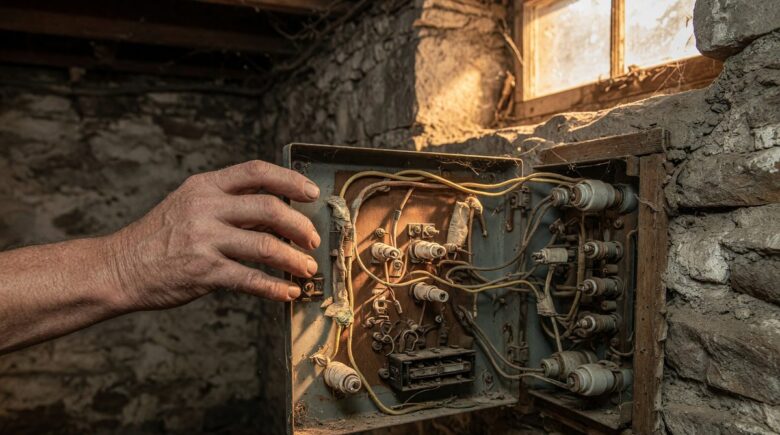
Age alone does not set your rate. Specific mechanical systems inside the house are the trigger points that underwriters at companies like State Farm or Allstate flag. An otherwise well-maintained pre-1980 home can still get a non-renewal notice if it has knob-and-tube wiring, a fuse box instead of circuit breakers, or polybutylene plumbing pipes. These are not cosmetic details; they are direct drivers of fire and water claims.
Electrical wiring is the most common dealbreaker. Alabama’s Department of Insurance explicitly calls out older homes where “historic or architectural aspects make replacement cost significantly higher than market value” as candidates for HO-8 coverage, and that category overwhelmingly includes houses with knob-and-tube (pre-1930) or aluminum branch wiring (1965–1973). Both carry elevated fire risk and can make a home uninsurable under standard HO-3 forms unless fully remediated. A complete re-wire typically costs $8,000–$15,000, but it is the single upgrade most likely to shift an older home from a surplus-lines policy back to a standard carrier.
Plumbing. Galvanized steel pipes, common through the 1960s, corrode from the inside out, causing leaks and a steady stream of water-damage claims that insurers track by pipe material. Polybutylene, installed in the 1970s through mid-1990s, is even worse: many carriers flat-out refuse to write a policy if it is present. Replacing it with copper or PEX can cost $4,000–$10,000, but zero carriers will give you a break for “planning to do it next year.” The work has to be completed and documented before the underwriter will budge.
Roofing and heating systems follow similar age thresholds. A roof older than 20 years on a pre-1980 home often triggers an actual cash value settlement instead of replacement cost, even on an HO-3 policy, unless a wind-mitigation inspection proves it is secure. A boiler or furnace older than 25 years is a red flag for fire and carbon monoxide claims. Upgrades here produce immediate premium relief: a new roof can drop premiums 10–20%, and a modern HVAC system can unlock credits with several national carriers.
Replacement Cost vs. Market Value: The Core Pricing Driver
Your homeowners insurance limit is not based on what you paid for the house. It is based on the rebuild cost, and for pre-1980 homes, that number is wildly disconnected from market value. A 1920s Tudor in a modest neighborhood might sell for $250,000 but cost $450,000 to reconstruct after a fire because the steep-pitched slate roof, custom millwork, and plaster walls require specialized trades and materials that are not available at the local building supply store. Insurance companies know this and set premiums accordingly.
The NAIC’s consumer guide explains this plainly: “The Modified Coverage Form (HO-8) is for older homes where the cost to rebuild is greater than the market value.” That is the fundamental pivot. On a standard HO-3 policy, the dwelling coverage is typically set at replacement cost, meaning the insurer pays to rebuild with materials of like kind and quality, up to the policy limit. But for a pre-1980 house with obsolete features, that promise becomes incredibly expensive for the carrier, so they either price it prohibitively high or push you into an HO-8 where claims settle on an actual cash value basis: replacement cost minus depreciation.
Modern code upgrades compound the problem. After a major loss, most policies include some ordinance-or-law coverage, typically 10% of the dwelling limit, but that often will not cover the full cost of bringing a 1960s house up to current electrical, plumbing, or seismic codes. In California, for example, mandatory seismic retrofitting on older foundations can add $5,000–$10,000 to an otherwise straightforward rebuild, and that bill lands on you unless you specifically purchased extra ordinance-or-law coverage. The Consumer Federation of America found that homeowners insurance premiums climbed by an average of $648 annually between 2021 and 2024, a trend that hits older-home owners hardest as rebuild costs continue to outpace general inflation.
The worked example puts it in perspective: a 1980-built home insured for $350,000 dwelling coverage pays $2,514 a year. A brand-new home with identical coverage pays $1,611. That is an extra $903 every year, $75.25 a month, purely because the rebuild would require matching 1980s materials and bringing everything to 2024 code. Over a 10-year span, that is $9,030 in additional premiums, which is roughly the cost of a full kitchen remodel in many markets.
Coverage Gaps in Standard Policies for Older Properties
Standard HO-3 and HO-5 policies were not designed for houses built before building codes standardized. They assume modern materials are available and that the dwelling limit reflects a straightforward rebuild, and both assumptions fail on older homes. The gaps show up in small print: actual cash value on roofs over 20 years old, sublimits on plaster repair, and exclusions for damage caused by outdated systems that were “known to be a risk” before the loss.
The 7 Best Policy Types for Older Homes
Homeowners insurance for older homes is not one-size-fits-all. The right policy depends on the home’s age, condition, and whether you have updated its core systems. Below, seven options ranked from broadest protection to the safety net for the toughest-to-insure properties.
| Policy Type | Best For | Typical Annual Premium* |
|---|---|---|
| HO-8 Modified Coverage | Homes over 40 years old with original materials | $1,956 (100-year-old home) |
| HO-3 with Extended Replacement Cost | Updated pre-1980 homes with modern systems | $2,514 (1980-built home) |
| HO-5 Comprehensive Form | High-value historic properties with premium finishes | $3,200–$5,000+ |
| DP-3 Dwelling Fire Policy | Older homes used as rental properties | $1,200–$2,000 |
| FAIR Plan | Homes declined by standard carriers | $2,000–$3,500+ |
| Historic Home Specialty Insurance | Registered landmarks and architecturally significant homes | $2,800–$4,500 |
| Guaranteed Replacement Cost Endorsement | Full rebuild protection regardless of cost overruns | Adds 10–20% to base premium |
* Premiums assume $350,000 dwelling coverage and a $1,000 deductible, except HO-8 which reflects average for a 100-year-old home per Policygenius. Actual rates vary by location, claims history, and home updates.
HO-8 Modified Coverage, Best for Homes Over 40 Years Old with Original Materials
Verdict: This is the pragmatic choice for pre-1980 homes that retain their original wiring, plumbing, and roof, the policy that acknowledges reality and prices accordingly instead of punishing you for it.
Key numbers: $1,956 average annual premium for a 100-year-old home per Policygenius. Covers 11 named perils on an actual cash value basis, as confirmed by the Florida Office of Insurance Regulation. Dwelling and personal property claims settle at replacement cost minus depreciation, meaning you will get less for a 30-year-old roof than a 5-year-old one.
Best for:
- Homes built before 1980 where the cost to rebuild exceeds the market value
- Properties with plaster walls, slate roofs, or other materials that would be cost-prohibitive to replicate with modern equivalents
- Homeowners who want to keep premiums manageable without undertaking a full systems overhaul
Watch out for: Actual cash value payouts can leave a significant gap if you need to rebuild after a total loss. The $1,956 average premium is deceptive, that number reflects ACV coverage, not what you would actually receive in cash to reconstruct the home from scratch. Consider a personal articles floater for valuable historic fixtures.
HO-3 with Extended Replacement Cost, Best for Updated Older Homes
Verdict: If you have already invested in modern wiring, plumbing, and a new roof, this is the policy that treats your pre-1980 house like a standard property, and gives you the broadest open-peril coverage for the dwelling.
The numbers: $2,514 average annual premium for a 1980-built home with $350,000 dwelling coverage and a $1,000 deductible, per Guardian Service. Extended replacement cost typically adds 25–50% above the dwelling limit for rebuild overruns, and many carriers offer it for an additional 5–10% on the base premium.
This policy suits:
- Pre-1980 homes with documented electrical and plumbing upgrades completed within the last 10 years
- Homeowners who have replaced the roof in the last 5 years and want replacement cost coverage on it
- Properties in suburban areas where multiple standard carriers compete, making extended replacement cost endorsements widely available
Caveat: An HO-3 policy still excludes damage from system failures. If your old galvanized pipes leak and destroy the dining room ceiling, the water damage is covered but fixing the pipes themselves is not. And some carriers restrict extended replacement cost on homes over 50 years old, even with upgrades, so you will need to verify with the underwriter.
HO-5 Comprehensive Form, Best for High-Value Historic Properties
Verdict: For pre-1980 homes with six-figure interiors, custom built-ins, imported tile, hand-hewn beams, this is the only policy form that covers personal property on an open-peril basis, matching the dwelling coverage breadth.
Premium and coverage details: Premiums range from $3,200 to over $5,000 annually for high-value older homes, depending on limits and location. Coverage applies to both dwelling and personal property, settling nearly all claims at replacement cost unless the policy explicitly states otherwise. The Minnesota Department of Commerce notes that HO-5 is suited for homes where “architectural features make replacement cost higher than market value,” though it is typically restricted to well-maintained properties.
Who it’s for:
- Century-old Victorians with original stained glass and ornate millwork that would be impossible to value on a cash basis
- Pre-1980 homes with high-value contents, fine art, antiques, wine collections, that need the broader personal property coverage
- Homeowners willing to pay a premium for the fewest coverage gaps and exclusions
The catch: Many carriers will not write an HO-5 on a house over 75 years old unless it passes a rigorous interior and exterior inspection, and they may require you to carry higher liability limits, typically $500,000 or more, raising the total cost above the dwelling-coverage premium alone.
DP-3 Dwelling Fire Policy, Best for Older Homes Used as Rentals
Verdict: When a pre-1980 home is tenant-occupied, standard homeowners forms often will not apply. A DP-3 policy covers the structure on an open-peril basis while giving you the flexibility to insure the rental income stream separately.
Cost snapshot: Annual premiums for older rental homes typically fall between $1,200 and $2,000 for $350,000 dwelling coverage, according to industry pricing data, though homes with knob-and-tube wiring may push toward the higher end. The DP-3 insures the dwelling against all perils except those specifically excluded, a mirror of HO-3 coverage, but it does not automatically include personal property or loss-of-use coverage for the owner’s belongings.
Suited for:
- Pre-1980 duplexes or single-family homes rented out to long-term tenants
- Landlords who need dwelling coverage for the structure but do not need the personal property or liability extensions of a homeowners policy (a separate landlord liability policy can be paired with DP-3)
- Properties where the rental income is essential and fair rental value coverage is added as an endorsement
Be aware: A DP-3 typically offers only actual cash value on roofs and other structural components unless you purchase a replacement cost endorsement. On a 25-year-old roof, that difference can mean a payout of only 40–60% of what replacement actually costs.
FAIR Plan, Best When Standard Carriers Refuse Coverage
Verdict: When a pre-1980 home gets a non-renewal notice from two or three carriers due to age alone, the state FAIR Plan is the safety net. It provides basic fire and extended coverage, though it is not cheap and it’s limited.
What you’ll pay: Premiums vary widely by state but commonly range from $2,000 to $3,500+ annually for older homes in high-risk areas. Coverage is typically limited to fire, lightning, wind, hail, and a handful of other perils, not theft, water damage, or liability. The Nevada Division of Insurance confirms that FAIR-type plans are designed for properties that cannot find coverage in the voluntary market, often including older homes and historically designated structures.
Good for:
- Homes that have been declined by at least two standard insurers in the past 12 months
- Properties in wildfire zones or coastal areas where age compounds the location-based risk
- Homeowners in states with strong FAIR Plan coverage (California, New York, Florida, and about 30 others) that include basic dwelling protection while you work on upgrades
Downside: FAIR Plan policies settle claims at actual cash value, not replacement cost, and often carry sublimits for older roofs, meaning a full roof replacement after a windstorm might only pay out 30–50% of the actual cost. It is a temporary fix, not a long-term solution; the goal is to use the coverage while completing the upgrades that will let you move back to a standard carrier.
Historic Home Specialty Insurance, Best for Registered Landmarks
Verdict: For homes on the National Register of Historic Places or locally designated landmarks, specialty insurers like Chubb and AIG understand that rebuilding means custom work by preservation craftsmen, and they price it without the standard carrier’s sticker shock plus “we don’t want this risk.”
Pricing details: Premiums run from $2,800 to $4,500 annually for homes with high replacement values, though exact pricing depends on the level of preservation requirements and the availability of reimbursable historic tax credits that can offset rebuild costs. Policies generally provide agreed value or guaranteed replacement cost for the structure, and many include ordinance-or-law coverage to pay for mandatory updates that preservation boards require during a rebuild. The Florida Office of Insurance Regulation notes that homes qualifying as landmarks often need coverage that accounts for “materials needed for replacement [that] are often more expensive than the home’s value.”
Fits best:
- Officially designated historic properties where rebuilding must follow strict preservation guidelines
- Pre-1980 homes with features like original leaded glass, hand-carved stone, or rare wood species that cannot be sourced from modern suppliers
- Homeowners who have already completed a Historic Structure Report that documents the property’s materials and construction methods, the equivalent of an appraisal that carriers trust
Limitation: These policies are only available through a handful of specialty carriers. You will typically need an independent agent who specializes in historic properties to access them, and underwriting can take weeks.
Guaranteed Replacement Cost Endorsement, Best for Full Rebuild Protection
Verdict: When your pre-1980 home’s rebuild cost is a moving target due to code updates, material scarcity, or custom craftsmanship, this endorsement removes the cap and promises to rebuild it completely, no matter what it costs, which is the highest level of protection available.
Cost impact: Adding guaranteed replacement cost typically increases the base premium by 10–20%, according to industry underwriting data, but it eliminates the most painful post-loss surprises. The Alabama Department of Insurance notes that for older homes where “historic or architectural aspects make replacement cost significantly higher than market value,” an HO-8 with actual cash value is the default, but a guaranteed replacement cost endorsement (available on HO-3 or HO-5 policies) flips that entirely.
Ideal candidate:
- Pre-1980 homes with unique materials that are difficult to estimate, think hand-forged ironwork, imported ceramic tile, or timber-frame construction
- Homeowners in areas with aggressive building codes where post-disaster compliance costs can exceed standard ordinance-or-law sublimits
- Anyone who cannot afford a $50,000 rebuild gap after a total loss and is willing to pay the premium for certainty
Restriction: Guaranteed replacement cost is not available on HO-8 policies or FAIR Plans. You need an HO-3 or HO-5 with a carrier that offers the endorsement. Many insurers limit it to homes valued under $1 million and require a professional replacement cost appraisal completed within the last two years.
The overall winner for most pre-1980 homeowners is the HO-3 with extended replacement cost, if you have updated the wiring, plumbing, and roof within the last decade. It gives you the broad dwelling coverage you need and the cushion to absorb code-upgrade overruns. If the systems have not been touched, start with an HO-8, then upgrade to a standard policy after the re-wire and re-pipe are complete.
How to Choose the Right Policy for Your Older Home
The right policy turns on three questions. Answer them honestly and the choice largely makes itself.
How old are the house’s core systems? If the electrical panel is a 100-amp fuse box and the pipes are original galvanized steel, accept that you are in HO-8 territory, or commit to the upgrades that will let a carrier write an HO-3. If you have already done the work, and you have receipts from a licensed contractor, push for an HO-3 with extended replacement cost and get the roof and plumbing discounted in underwriting.
What would it really cost to rebuild today? Get a replacement cost appraisal from a contractor who works on older homes, not a real estate agent’s market analysis. If that number is 30% or more above your current dwelling limit, you need guaranteed replacement cost or at least a 50% extended replacement cost endorsement. Otherwise, a total loss could leave you $60,000+ short even with a full payout.
Are you in a high-risk region layered on top of the home’s age? In wildfire-prone California or coastal Florida, a pre-1980 home may face a double underwriting penalty, age risk plus catastrophe risk. If you get a non-renewal from two carriers, consider a FAIR Plan as bridge coverage while you harden the property (Class A roof, ember-resistant vents, hurricane straps), then reapply to the standard market. The steps to save on premiums are most effective when paired with the right policy structure.
Proven Tactics to Reduce Premiums
You cannot change the year your house was built, but you can change the risk factors that insurers plug into their pricing models. Three upgrades produce consistent, documentable premium reductions for pre-1980 homes.
Full re-wire with 200-amp service. Swapping knob-and-tube or aluminum wiring for copper Romex and upgrading to a modern circuit breaker panel is the single most impactful upgrade. Carriers that would not quote you before will suddenly offer standard HO-3 rates, and those that already cover you may lower the premium 15–25% once the work is verified. Keep the electrician’s permit and final inspection report, the underwriter will ask for them.
Roof replacement with wind-mitigation features. A new architectural shingle roof with secondary water barrier and ring-shank nails can cut windstorm premiums by 10–20% in coastal states, and it often removes the dreaded “actual cash value roof” clause from your policy. In several states, a wind-mitigation inspection, typically $150–$300, is all you need to document the upgrade and trigger the discount, even if you have not replaced the roof if it is in excellent condition.
Whole-house plumbing replacement. Out with galvanized or polybutylene, in with PEX or copper. This upgrade addresses the #1 non-weather water-loss cause and signals to the carrier that you have eliminated the leak risk they are pricing into every renewal. The premium drop is not instant, you will need to notify the agent and provide photos and a contractor invoice, but it is often $200–$400 per year on a 1980-built home, and it can be the difference between a standard carrier saying yes or no.
Even with these upgrades, there is no guarantee of a premium drop if you live in an area where insurers are pulling back. In wildfire-prone regions, some carriers are non-renewing entire ZIP codes, regardless of the home’s condition. The FAIR Plan might end up being your only option, at least temporarily.
Another honest trade-off: the savings from these upgrades rarely recoup the full upfront cost in under five years. A $12,000 re-wire might save you $600 a year, meaning you will break even in 20 years. The real justification is safety and insurability, not a fast financial return. If your current HO-8 premium is manageable and you plan to move in a few years, the upgrade may not pencil out.
When you are ready to negotiate, compare quotes from three types of carriers: your current insurer (who may have a loyalty discount but also a stale risk profile), a direct writer that uses automated underwriting, and an independent agent who can access surplus-lines carriers that specialize in older homes. The last category is where you will find the most competitive rates for a pre-1980 property with updated systems, because those carriers price on actual risk rather than broad-brush age surcharges. Understanding the basics of homeowners insurance helps you evaluate each quote on its real coverage, not just the price.
Navigating Non-Renewals and Finding Alternatives
Frequently Asked Questions
What is the average cost of homeowners insurance for a house built in 1980?
The average annual premium for a 1980-built home with $350,000 in dwelling coverage and a $1,000 deductible is $2,514, according to Guardian Service. That is over $900 more than the $1,611 average for a brand-new 2024-built home with identical coverage limits.
Why do older homes cost so much more to insure?
The premium gap is driven by the rebuild cost, not the market value. A pre-1980 home often contains obsolete materials like plaster walls, slate roofing, and galvanized plumbing that require specialized trades and expensive materials to replicate after a loss. The NAIC confirms that the HO-8 policy form exists specifically for homes where reconstruction costs exceed what the house would sell for.
What is an HO-8 policy and who needs one?
An HO-8 modified coverage form is designed for homes over 40 years old where the cost to rebuild is greater than the market value. It covers 11 named perils on an actual cash value basis, meaning claims pay replacement cost minus depreciation. The average annual premium for a 100-year-old home under an HO-8 is $1,956, per Policygenius.
Can I get standard HO-3 coverage on a pre-1980 home?
Yes, if the home’s core systems have been updated. Carriers like State Farm and Allstate will typically write an HO-3 with extended replacement cost on a pre-1980 house that has documented electrical, plumbing, and roofing upgrades completed within the last decade. Without those upgrades, most standard carriers will either decline the risk or steer you toward an HO-8.
What home upgrades lower insurance premiums the most?
A full re-wire with a 200-amp service panel is the single most impactful upgrade, often making standard HO-3 rates available and reducing premiums by 15–25%. Roof replacement with wind-mitigation features can cut windstorm premiums by 10–20%, and a whole-house plumbing replacement from galvanized or polybutylene to PEX or copper typically saves $200–$400 per year.
What is a FAIR Plan and when should I consider it?
A FAIR Plan is a state-run insurance pool for properties that cannot find coverage in the voluntary market. It provides basic fire and extended coverage, typically settling claims at actual cash value. The Nevada Division of Insurance confirms these plans are a safety net for older and historically designated homes. Premiums commonly range from $2,000 to $3,500+ annually, and the coverage is best used as bridge protection while you complete upgrades to qualify for a standard carrier.
How much have homeowners insurance premiums increased recently?
Homeowners insurance premiums across the United States rose by an average of $648 per year between 2021 and 2024, according to data from the Consumer Federation of America. Older homes have been disproportionately affected because rebuild costs for obsolete materials have risen faster than general construction inflation.
Does a new roof guarantee lower premiums on an older home?
A new roof produces measurable savings, typically 10–20% on windstorm premiums, and it often removes the actual cash value settlement clause that many carriers apply to roofs over 20 years old. However, the discount is not automatic. You need a wind-mitigation inspection (usually $150–$300) or contractor documentation submitted to your agent before the underwriter applies the credit.
What is the difference between replacement cost and actual cash value?
Replacement cost pays to rebuild or repair with materials of like kind and quality at current prices, with no deduction for depreciation. Actual cash value pays replacement cost minus depreciation, so a 25-year-old roof might only return 40–60% of what a new one actually costs. The Florida Office of Insurance Regulation notes that older homes are frequently steered toward ACV policies because the materials needed for replacement are often more expensive than the home’s market value.
How do I find an insurer that specializes in older homes?
Work with an independent agent who has access to surplus-lines carriers and specialty insurers like Chubb, AIG, and PURE. These carriers underwrite based on actual risk rather than broad age surcharges and are often the most competitive option for pre-1980 homes with updated systems. A direct writer or captive agent typically has fewer options for homes over 40 years old.
Sources
- Guardian Service, Homeowners Insurance Statistics (2025)
- Policygenius, How Much Does Homeowners Insurance Cost? (2024)
- Policygenius, Homeowners Insurance for Older Homes
- CNBC / Consumer Federation of America, Homeowners Insurance Premiums Report (2024)
- National Association of Insurance Commissioners (NAIC), Consumer Guide to Homeowners Insurance
- Florida Office of Insurance Regulation, Homeowners Insurance Overview
- Alabama Department of Insurance, Guidance on Older Home Coverage
- Minnesota Department of Commerce, Homeowners Insurance Coverage Types
- Nevada Division of Insurance, Home Insurance Guide
- Experian, Do Older Homes Need Special Homeowners Insurance?
- Smart Insurance 101, How to Save Money on Your Homeowners Insurance
- Smart Insurance 101, Homeowners Insurance Guide: A Beginner’s Overview


