Fact-checked by the Smart Insurance 101 editorial team
Quick Answer
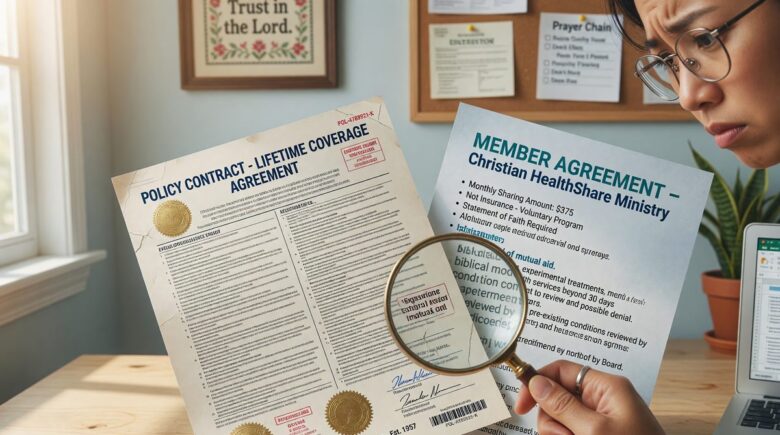
A health sharing ministry vs insurance comparison comes down to one core difference: ministries have no legal obligation to pay your medical bills, while licensed insurers do. Monthly contributions to ministries can run 40–50% lower than ACA premiums, but members bear full financial risk if funds run short or a claim is denied. Most healthy, faith-observant adults are the best fit; anyone with chronic conditions or significant medical history should think carefully before enrolling.
What happens when your $800 hospital bill turns into a $40,000 surgery, and the organization you’ve been paying into for two years decides it won’t share the cost? That’s not a hypothetical for some health care sharing ministry members. It’s a documented risk that state insurance regulators want you to understand before you sign up. The debate over health sharing ministry vs insurance is louder than ever: roughly 1.7 million Americans now use health care sharing ministries, drawn in primarily by monthly contribution costs that look dramatically cheaper than ACA marketplace plans.
That price gap is real. But so are the gaps in coverage. Premium costs on ACA plans have climbed sharply enough that our own coverage on why insurance premiums are exploding has never been more relevant, and it helps explain why millions of people are searching for alternatives. The problem is that most articles on this topic gloss over what the ministry guidelines actually say in small print, or they treat HCSMs as a straightforward cheaper substitute for insurance when they are legally, structurally, and functionally a very different animal.
This guide is written for anyone who has seen a health sharing ministry ad and wondered if it’s too good to be true, or for self-employed workers, gig contractors, or early retirees who are priced out of marketplace coverage and evaluating every option. By the end, you’ll know exactly what an HCSM is, where it falls short, and how to make a clear-eyed decision.
Key Takeaways
- Health care sharing ministries are not insurance and are not regulated by state insurance departments, according to the National Association of Insurance Commissioners (NAIC).
- An estimated 1.7 million Americans use health care sharing ministries, per KFF Health News citing Colorado regulators, a number that has grown significantly since the ACA’s individual mandate penalty was effectively eliminated.
- Ministries are not legally required to pay any member’s medical bills; multiple state agencies, including the Office of Public Insurance Counsel in Texas, explicitly state that members remain personally liable for all costs.
- Monthly contributions to HCSMs can run 40–50% lower than comparable ACA premiums, but there is no out-of-pocket maximum, meaning a denied large claim falls entirely on the member.
- 93% of 2024 ACA Marketplace enrollees qualified for premium subsidies, according to healthinsurance.org, which means many people comparing costs are not accounting for subsidies they may already be eligible for.
- The California Department of Insurance has issued cease-and-desist orders against certain HCSM-adjacent entities for transacting insurance without authorization and misleading consumers.
In This Guide
- Step 1: What Exactly Is a Health Care Sharing Ministry?
- Step 2: The Legal Difference, No Guarantee of Payment
- Step 3: How Do Costs Actually Compare?
- Step 4: Coverage Exclusions Buried in the Guidelines
- Step 5: What Happens When You Submit a Bill?
- Step 6: Who These Plans Are Designed For, and Who Should Avoid Them
- Frequently Asked Questions
Step 1: What Exactly Is a Health Care Sharing Ministry?
A health care sharing ministry (HCSM) is a nonprofit organization where members with shared religious or ethical beliefs pool monthly contributions to cover each other’s medical expenses. The federal government recognizes qualifying HCSMs as a category distinct from insurance: members of qualifying ministries are eligible for an exemption from the ACA’s individual shared responsibility provision, as confirmed by the Centers for Medicare & Medicaid Services (CMS). That exemption does not mean HCSMs provide equivalent coverage. It just means you won’t owe a penalty for lacking traditional insurance.
How They Work
Each month, members pay a “share”, the ministry’s term for a contribution, into a central pool or directly to other members with outstanding medical bills. When you have a qualifying medical expense, you submit your bills to the ministry, and funds are distributed from the pool to help cover them. The key word is “help.” According to the Alliance of Health Care Sharing Ministries, 647,767 Americans belong to Alliance member ministries, and those ministries shared $1.15 billion in total medical expenses in 2025. Those numbers sound substantial, but they also illustrate the scale of claims flowing through organizations with no legal reserve requirements, requirements that licensed insurers regulated by bodies like state insurance departments and the Centers for Medicare & Medicaid Services must meet.
Who Can Join
Most HCSMs require members to sign a statement of faith or agree to a lifestyle covenant. Common requirements include active membership in a Christian church, abstaining from tobacco and illegal drugs, and avoiding behaviors the ministry designates as contrary to biblical principles. Some ministries, like Liberty HealthShare and Sedera, have broadened eligibility to include non-Christian members who share general wellness values, but restrictions on lifestyle and medical history still apply. There are currently 107 Health Care Sharing Ministries certified by HHS as meeting the federal definition for ACA exemption eligibility. Medi-Share (operated by Christian Care Ministry), Samaritan Ministries, and Liberty HealthShare are among the largest by membership.
Unlike insurance premiums, HCSM contributions are generally not tax-deductible as a medical expense for federal income tax purposes. If you are self-employed, you cannot deduct them as a business expense the way you can deduct qualifying health insurance premiums. This is a meaningful cost difference that monthly comparison charts often leave out.
Dale Bellis, Executive Director of Liberty HealthShare, has described the core distinction this way: the sharing arrangement is voluntary and cooperative, driven by compassion and the urge to assist a fellow member, not by a contract of indemnity the way a traditional insurance policy works. That framing is accurate, and it explains exactly why the legal protections differ so sharply.
Step 2: The Legal Difference, No Guarantee of Payment
No contractual obligation to pay your bills. That single legal reality separates every health care sharing ministry from every licensed health insurer, and it should be the first thing you read before enrolling in anything. State insurance laws require licensed insurers to maintain solvency reserves, follow prompt-pay statutes, and honor approved claims. HCSMs operate under none of those rules.
What the Disclaimers Actually Say
The National Association of Insurance Commissioners (NAIC) is explicit: state insurance regulators do not supervise HCSMs because they are not considered insurance and thus not subject to the same requirements and protections. The Office of Public Insurance Counsel in Texas states plainly that “health sharing ministries are non-profit arrangements where the ministry is not legally obligated to pay for members’ health care costs.” Even the ministries acknowledge this themselves.
Christian Care Ministry, which operates Medi-Share, states directly in its member materials that neither Medi-Share nor any of its members assume any obligation to pay another member’s medical bills. That language is not buried. It is in the foundational member agreement.
What to Watch Out For
When a ministry runs low on member contributions, which can happen if membership drops or medical costs spike across the pool, it may reduce the share amount distributed for each bill, delay payment, or decline the bill entirely. Unlike an insurer facing insolvency, there is no state guaranty fund to step in and cover members’ outstanding claims. You could be left holding a six-figure hospital bill with no legal avenue to compel payment. As the California Department of Insurance’s enforcement actions demonstrate, consumer recourse is limited even when an organization behaved misleadingly.
“It’s buyer beware. If you have health costs not covered there is very little recourse for you. You can’t go to a government agency to complain.”
This is the sharpest contrast in any honest health sharing ministry vs insurance comparison. An insurer’s denial can be appealed internally, reviewed by an independent external reviewer, and challenged through state regulators, oversight coordinated in part by the NAIC across all 50 states. An HCSM’s denial is largely final, and the member typically has no equivalent appeals path.
If a hospital or provider doesn’t recognize your HCSM as a form of insurance coverage, they may treat you as an uninsured patient for billing purposes. That can mean losing access to the negotiated rates that insurers get, rates that are often 30–50% lower than the “chargemaster” list price billed to uninsured patients. Your actual out-of-pocket exposure may be much higher than the sharing limits in your ministry’s guidelines suggest.

Step 3: How Do Costs Actually Compare?
Monthly contributions are where HCSMs look most attractive, and where the comparison requires the most scrutiny.
A healthy 35-year-old non-smoker might pay around $250–$350 per month in HCSM contributions, compared to a benchmark Silver ACA plan at $450–$600 per month before subsidies in many states. That gap can reach $150–$250 per month, or $1,800–$3,000 per year. But 93% of 2024 ACA marketplace enrollees qualified for premium subsidies, meaning many people doing this comparison are measuring HCSM contributions against the full unsubsidized ACA premium they’d never actually pay. If you earn between 100% and 400% of the federal poverty level, your real ACA premium after the premium tax credit may be much closer to the HCSM cost than it first appears. For self-employed workers especially, our guide on health insurance options for self-employed workers in 2026 breaks down the subsidy math in detail.
The other number to watch is the unshared amount, the HCSM equivalent of a deductible, sometimes called an “initial unshareable amount” or IUA. These commonly run $1,000 to $5,000 per incident. Unlike an ACA plan’s out-of-pocket maximum, there is no federal cap on how much you might owe in a year across multiple incidents, and the ministry is not required to cover anything beyond its stated sharing limits.
There’s also a tax dimension that matters, particularly for self-employed professionals and gig workers. Qualifying health insurance premiums are fully deductible as a business expense under IRS rules. HCSM contributions are not. Someone in a 22% federal bracket paying $3,600 per year in HCSM contributions loses roughly $792 in deductions compared to a similarly priced insurance premium. That narrows the real-dollar advantage further.
A worked example: If a member pays $300/month in HCSM contributions versus $520/month for a Silver ACA plan (before subsidies), the annual savings are $2,640. But if one unshared medical event costs $4,000 out-of-pocket, a realistic figure for a single ER visit, the HCSM member recovers only about 65% of that annual savings in year one, and nothing if the ministry denies the claim. The math favors HCSMs only in years with zero or minimal medical events.
Step 4: Coverage Exclusions Buried in the Guidelines
The fine print in most ministry guidelines is where the health sharing ministry vs insurance gap becomes impossible to ignore. Standard HCSM guidelines routinely exclude or severely limit entire categories of care that licensed health insurers are federally required to cover under the Affordable Care Act.
Common Exclusion Categories
Pre-existing conditions are the most significant. Most ministries apply a waiting period of one to five years before sharing any costs related to a condition you had before joining. During that period, any care connected to that condition, even indirectly, is your responsibility. Beyond pre-existing conditions, typical exclusions include:
- Mental health and substance use treatment (excluded entirely by many ministries)
- Maternity care for pregnancies conceived before membership or outside of marriage
- Preventive care visits and routine screenings (sometimes excluded or capped)
- Prescription drugs beyond a narrow formulary, often with strict monthly limits
- Experimental treatments and many specialty referrals
Lifestyle Restrictions and Moral Clauses
Many ministries deny sharing for conditions the organization attributes to lifestyle choices the guidelines prohibit. Injuries related to alcohol use, recreational drug use, tobacco, or activities the ministry classifies as “risky” or “immoral” may be excluded. The South Carolina Department of Insurance warns that “health sharing plans are very limiting and individuals that have certain lifestyles may not be accepted.” That’s a polite way of saying the ministry controls whether your claim is morally eligible, a standard no licensed insurer can apply.
Sharing Limits
Per-incident and lifetime sharing caps are another category that disappeared from regulated insurance after the ACA. ACA-compliant plans cannot impose lifetime or annual dollar limits on essential health benefits. HCSMs face no such prohibition. A ministry might share up to $250,000 per incident, which sounds large until you face a cancer diagnosis or a premature birth with a 60-day NICU stay. Medical bills in those scenarios routinely exceed $500,000.
| Feature | Health Care Sharing Ministry | ACA-Compliant Health Insurance |
|---|---|---|
| Legal payment obligation | None, voluntary sharing only | Yes, enforceable contract |
| Pre-existing conditions | Often excluded 1–5 years | Must be covered immediately |
| Mental health coverage | Frequently excluded entirely | Required as essential benefit |
| Annual out-of-pocket cap | None required | $9,450 individual cap (2026) |
| Preventive care | Often excluded or capped | Required at no cost-sharing |
| Lifetime sharing/coverage cap | Common (e.g., $250K–$1M/incident) | Prohibited on essential benefits |
| State regulatory oversight | None | Full state and federal oversight |
| Appeals / external review | Internal only; no state recourse | Internal + independent external review |
| Typical monthly cost (age 35) | $250–$350 | $450–$600 (before subsidies) |
| Tax deductibility (self-employed) | Generally not deductible | Fully deductible as business expense |
Before you compare monthly costs, read the ministry’s Member Guidelines document, not the marketing brochure, from cover to cover. Look specifically for the words “unshared amount,” “pre-existing condition waiting period,” “sharing limit per incident,” and “ineligible expenses.” These sections determine what you’d actually receive in a real medical crisis, and they are almost never mentioned in ads or broker presentations.
Step 5: What Happens When You Submit a Bill?
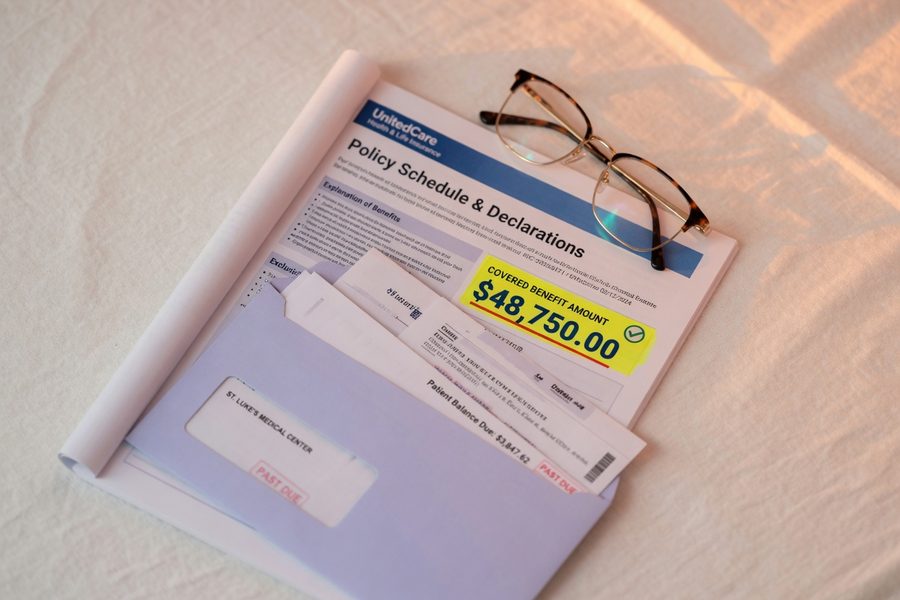
Submitting a medical bill to a health care sharing ministry looks nothing like filing a claim with a licensed insurer. The process is slower, less standardized, and carries no legally mandated timeline for resolution.
How Submission Works
After receiving care, you typically pay the provider directly (or arrange a payment plan), then submit the itemized bill to the ministry along with documentation showing the expense meets sharing guidelines. Ministry staff review the bill for eligibility, which can include checking whether the condition predates membership, whether the treatment was for an “eligible need” as defined in the guidelines, and whether the provider qualifies. This review is conducted internally by ministry employees, not by licensed adjusters operating under state claims regulations overseen by bodies like the NAIC or individual state insurance commissioners.
No Network, No Negotiated Rates
Licensed insurers, whether national carriers like UnitedHealthcare, Aetna, or Blue Cross Blue Shield, or regional plans, maintain provider networks with pre-negotiated rates. When you see a network provider, the insurer pays a contracted amount, and the provider writes off the rest. HCSMs have no equivalent: most have no formal network. That means providers can bill full list price, which ministry guidelines may or may not cover. Some major HCSMs have developed preferred provider arrangements or recommend using cost-sharing tools to negotiate bills down, but there is no guarantee the provider will accept a lower amount, and the ministry is under no obligation to cover the difference if they don’t.
What to Watch Out For
Delays of 60 to 120 days for bill review are common. During that time, your provider may send the account to collections. Licensed insurers in most states are subject to prompt-pay laws that require payment within 30 to 45 days of a clean claim. HCSMs are not. That operational gap has real consequences for your credit, a collections entry can drop a FICO Score by 100 points or more, affecting your ability to qualify for a mortgage, auto loan, or even a credit card with a competitive APR. Our broader look at how medical coverage is shrinking as costs explode puts this problem in wider context.
If a ministry’s sharing pool runs low in a given month, members may receive a reduced payment, for example, 70 cents on the dollar, rather than the full shared amount. This is a documented practice at several ministries, not a theoretical risk. You would then owe the remaining balance to the provider with no recourse against the ministry.
Step 6: Who These Plans Are Designed For, and Who Should Avoid Them
HCSMs are not a scam, but they are a specific tool built for a specific situation. Being clear about that match is the most useful thing this guide can do.
Who Is a Reasonable Candidate
The ideal HCSM member is generally healthy with no significant ongoing medical needs, comfortable with the ministry’s religious or ethical requirements, financially capable of absorbing a large unexpected bill if sharing is denied, and ideally someone who has already verified they don’t qualify for meaningful ACA premium subsidies. Younger individuals or families who rarely use healthcare and want lower fixed monthly costs while maintaining some cost-sharing community may find real value in programs like Samaritan Ministries or Sedera. If you’re evaluating the structure of traditional plan types like HMOs and PPOs alongside HCSMs, that comparison is worth doing before you decide.
Who Should Avoid HCSMs
The list of situations where traditional insurance is strongly preferable is long:
- Anyone with a chronic condition (diabetes, heart disease, autoimmune disorders) that will generate regular medical costs the ministry won’t share for the first 1–5 years
- Anyone planning a pregnancy, particularly one that might involve complications or NICU care
- Anyone with mental health or substance use treatment needs
- Anyone who cannot financially survive a $50,000+ unshared bill
- Anyone who qualifies for Medicaid or substantial ACA subsidies, where the premium gap largely disappears
- Anyone whose employer offers group health coverage with a significant contribution
The Honest Tradeoff
HCSMs transfer financial risk from a regulated insurer with legal payment obligations to a voluntary community with no such obligations. For healthy members in low-use years, that tradeoff generates real savings. For members who face a serious illness or injury, that same tradeoff can mean financial catastrophe with no safety net. State guaranty funds, which back licensed insurers when they become insolvent, do not apply to HCSMs. That is not a theoretical concern. It is the documented experience of members whose ministries have reduced shares, imposed new eligibility restrictions mid-membership, or ceased operations entirely, leaving outstanding bills as the member’s personal debt, with no agency equivalent to a state insurance commissioner or the NAIC to compel any remedy.

Frequently Asked Questions
Are health care sharing ministries legal?
Yes, health care sharing ministries are legal in all 50 states, but they are not regulated as insurance. Federal law explicitly exempts qualifying HCSM members from the ACA’s individual mandate penalty, as confirmed by the Centers for Medicare & Medicaid Services. That legal status also means they operate without the consumer protections that apply to licensed health insurers.
Can a health sharing ministry deny my medical bill?
A ministry can decline to share any medical expense, and you have very limited recourse when it does. There is no external appeals process, no state insurance department with jurisdiction, and no guaranty fund. As Sabrina Corlett of Georgetown University’s Health Policy Institute has noted, “you can’t go to a government agency to complain.” Your only options are internal appeals through the ministry’s own review process.
Do health sharing ministries cover pre-existing conditions?
Most do not cover pre-existing conditions for an initial period ranging from one to five years after enrollment. During that time, any medical costs linked, even loosely, to a condition you had before joining are your responsibility. This is a fundamental difference from ACA-compliant insurance, which is required to cover pre-existing conditions from day one with no waiting period.
Is a health sharing ministry cheaper than health insurance?
Monthly contributions are often 40–50% lower than unsubsidized ACA premiums, but the cost comparison is misleading without two adjustments: first, 93% of marketplace enrollees qualify for subsidies that reduce their actual premium, per healthinsurance.org; second, HCSM contributions are not tax-deductible for self-employed individuals the way qualifying health insurance premiums are. The real cost gap is often narrower than the advertised monthly amounts suggest.
What is the “unshared amount” in a health sharing ministry?
The unshared amount, sometimes called the initial unshareable amount or IUA, is the portion of each medical bill you pay before the ministry begins sharing costs. It functions like a deductible, typically ranging from $1,000 to $5,000 per incident. Unlike a deductible on an ACA plan, there is no annual out-of-pocket maximum capping your total exposure across multiple incidents in a year.
Can I use a health sharing ministry if I’m self-employed?
Self-employed individuals are among the most common HCSM enrollees, drawn by lower monthly costs at a time when group employer coverage isn’t available to them. However, the inability to deduct contributions as a business expense, unlike qualifying health insurance premiums, meaningfully reduces the after-tax savings. Before enrolling, review the best health insurance plans for self-employed workers in 2026 to compare the subsidy-adjusted costs of ACA plans against HCSM contributions.
What happens if a health sharing ministry goes bankrupt?
If an HCSM becomes insolvent or ceases operations, members have no state guaranty fund protection, the mechanism that covers policyholders when a licensed insurer fails. Any unpaid medical bills submitted to the ministry remain the member’s personal liability. This is one of the most significant financial risks of HCSM membership and a key reason state insurance regulators, including the NAIC and individual state insurance departments, consistently advise consumers to understand exactly what they are and are not buying.
Do doctors and hospitals accept health sharing ministries?
Providers are not required to accept or bill HCSMs, and many treat members as self-pay or uninsured patients. Without a formal provider network or legal billing requirements, members often pay providers directly and seek reimbursement from the ministry afterward. That process can expose members to list-price “chargemaster” billing rather than the negotiated rates an insurer’s network would secure, often rates 30–50% higher than what an insured patient pays.
Should I join a health sharing ministry if I’m young and healthy?
A healthy young adult with no chronic conditions and no planned major medical needs is the closest thing to an ideal HCSM candidate, the lower monthly contributions may outweigh the risks in years when medical use is minimal. The key caveat: you need financial reserves to absorb a large unexpected bill if the ministry declines to share it. If a single $30,000 bill would be financially devastating, the monthly savings do not offset the risk, regardless of how healthy you feel today.
Sources
- National Association of Insurance Commissioners, What You Should Know About Health Care Sharing Ministries
- Centers for Medicare & Medicaid Services, Individual Shared Responsibility Provision Exemptions
- California Department of Insurance, Cease-and-Desist Orders Against Health Care Sharing Entities
- Office of Public Insurance Counsel (Texas), Health Sharing Ministries
- South Carolina Department of Insurance, Insurance When Retiring Early
- Alliance of Health Care Sharing Ministries, Data and Statistics (2025)
- healthinsurance.org, Health Care Sharing Ministry (Glossary with KFF Health News Citation)
- healthinsurance.org, Healthcare Sharing Ministries: A Leap of Faith (Expert Quotes)
- Smart Insurance 101, Best Health Insurance Plans for Self-Employed Workers in 2026
- Smart Insurance 101, Health Insurance Deductible vs Out-of-Pocket Maximum
- Smart Insurance 101, Insurance Premiums Are Exploding, Here’s Why
- Smart Insurance 101, Medical Coverage Is Shrinking as Costs Explode Nationwide


