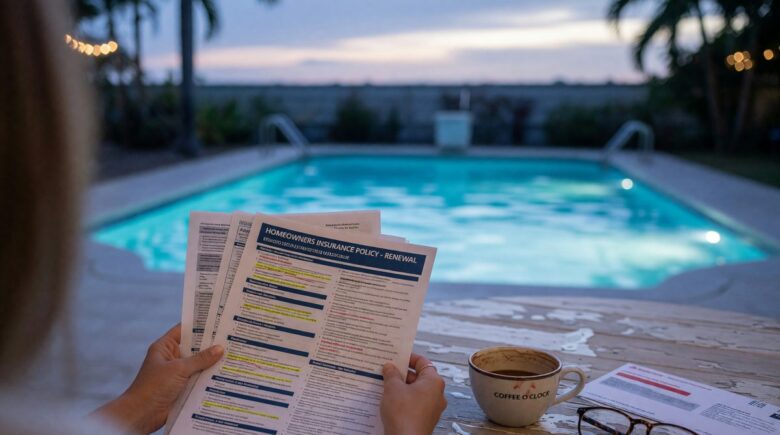
Reviewed by the Smart Insurance 101 Editorial Team
Our Take
Every homeowner with a pool needs liability coverage of at least $300,000 to $500,000, plus a personal umbrella policy starting at $1 million, the standard $100,000 base limit is not enough to cover a serious drowning or spinal injury claim. This holds for any in-ground pool and for most above-ground pools used regularly. The case against it is narrow: if your total assets are minimal and your pool is seasonal and unfenced, you may avoid the umbrella cost short-term, but the attractive nuisance doctrine still exposes you legally.
Pools are one of the most litigated features a homeowner can own. Drowning is the leading cause of unintentional injury death for children ages one to four, according to the CDC’s drowning data, and a significant share of those incidents happen in residential pools. That single fact reshapes what swimming pool homeowners insurance liability should look like for anyone who owns one. The financial exposure is real, and standard policies were not designed with pools in mind.
This article is for homeowners who already have a pool or are about to install one and want to know exactly where their coverage stands. What makes the recommendation work is compliance: insurers will not pay a liability claim on a pool that fails their safety requirements, so coverage limits and physical safeguards must be addressed together.
Key Takeaways
- Standard homeowners policies typically carry only $100,000 in liability coverage, the Insurance Information Institute calls this insufficient for pool owners and recommends raising limits to at least $300,000–$500,000.
- Pools are classified as an attractive nuisance under common law, meaning you can be held liable for injuries to trespassers, including children, who enter your property without permission, per the South Carolina Department of Insurance.
- Diving boards and slides are excluded from liability coverage under many major carrier policies; the Texas Department of Insurance specifically flags these as common exclusions homeowners overlook.
- Property coverage for an in-ground pool usually falls under the “other structures” sub-limit, typically 10% of dwelling coverage, which can leave a six-figure replacement cost partially uncovered, according to III’s homeowners coverage guide.
- In my experience reviewing reader questions, the single most common gap is homeowners who use their pool for short-term rentals without telling their insurer, a scenario that voids most standard liability protections immediately.
Why Pools Create Unique Insurance Risks for Homeowners
A pool is legally different from a trampoline, a deck, or even a firepit. Courts across the U.S. apply the attractive nuisance doctrine to pools, which holds that property owners owe a heightened duty of care when a feature on their land is likely to attract children who cannot appreciate its danger. That doctrine shifts liability onto you even if no one had permission to be in your yard.
Here’s the thing: most homeowners assume liability only attaches to invited guests. It does not. A neighboring child who climbs your fence and drowns is still your legal exposure. That is the core reason swimming pool homeowners insurance liability demands more than a default policy provides.
Pools also increase claim frequency. Slip-and-fall injuries on wet pool decks, diving injuries in shallow water, and chemical exposure incidents all generate liability claims under homeowners policies. Serious drowning or spinal cord injury claims can easily exceed $1 million in damages once medical costs, lost wages, and pain-and-suffering are factored in. A $100,000 base liability limit covers a fraction of that exposure.
What I see in practice: Readers often discover their pool coverage gaps only when they shop for a new policy. The prior insurer quietly added an exclusion for their slide or hot tub at renewal and never sent a direct notice. Check the declarations page and any endorsements every single year, not just when you first install the pool.
Pools also affect policy eligibility. Some carriers refuse to write new homeowners policies for homes with certain pool features, unfenced pools, above-ground pools exceeding a specific height, or pools with diving boards. If you are shopping for coverage, as we explain in our homeowners insurance beginner’s guide, disclosure of a pool at application is required; failing to disclose it is grounds for policy rescission.
What Standard Homeowners Coverage Actually Includes for Pools
Standard homeowners policies cover pool liability through the personal liability section, but the scope is narrower than most owners expect. Coverage applies to third-party bodily injury and property damage claims: a guest who breaks a wrist on your pool deck can trigger your liability coverage. It does not apply to injuries suffered by members of your household, who must rely on health insurance.
Property Damage Coverage for the Pool Structure
The pool structure itself is covered under Coverage B (“other structures”) in a standard HO-3 policy. The sub-limit there is typically 10% of your dwelling coverage. On a home insured for $400,000, that is $40,000 in other-structures coverage, split across your fence, detached garage, and pool. An in-ground pool with a concrete deck, water features, and equipment can cost $60,000 to $100,000 to replace. The math does not work unless you request a higher sub-limit or a scheduled endorsement.
What Gets Excluded
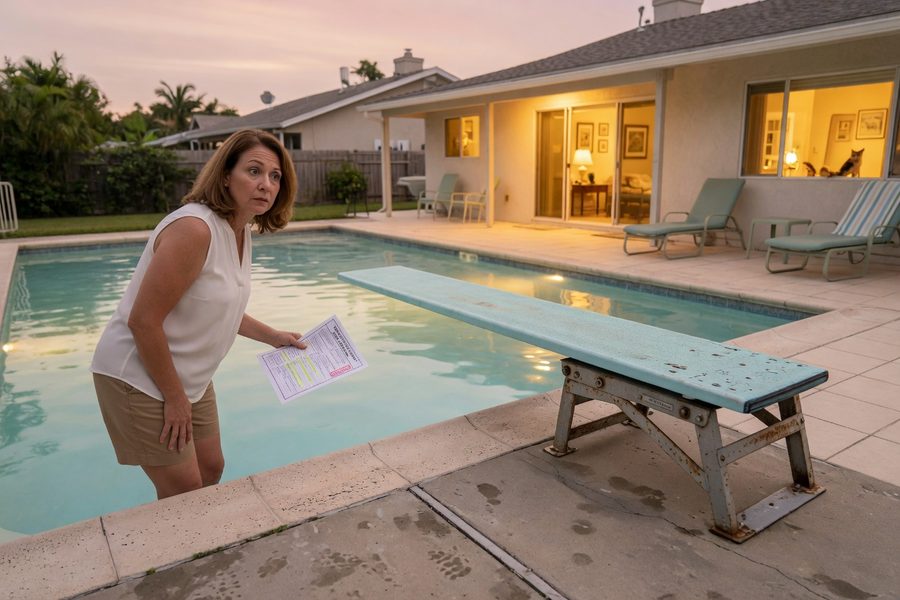
Diving boards and slides are the most commonly excluded accessories. The Texas Department of Insurance warns that many policies specifically exclude liability arising from diving boards and slides, and that pools lacking required enclosures may lose coverage entirely. Pool heaters and automated lighting add electrical fire risk; some carriers require separate notation of these features or apply higher deductibles to pool-related claims. Hot tubs and spas attached to the pool may be bundled into coverage or treated as separate structures, ask your insurer directly.
Above-Ground vs. In-Ground: How Coverage and Cost Actually Differ
Above-ground pools are treated more leniently by most carriers, but not uniformly. Temporary or inflatable pools under a certain depth, often 24 inches, may require no policy changes at all. Semi-permanent above-ground pools with decking, ladders, and filtration systems are closer to in-ground pools in the insurer’s risk calculus.
In-ground pools trigger the highest scrutiny: mandatory disclosure, potential underwriting review, and often a requirement for four-sided fencing with a self-latching gate before the policy is issued. Premiums for homes with in-ground pools can run $50 to $75 more per year on average, though this figure varies significantly by carrier, state, and whether you can document safety compliance. The real cost difference is not the premium increment, it is the coverage gap if you do not adjust your liability limits upward.
When You Need Higher Limits or an Umbrella Policy
Raise your liability limits immediately if you own an in-ground pool, period. The Insurance Information Institute recommends pool owners carry at least $300,000 to $500,000 in liability coverage, with a personal umbrella policy if your assets, including home equity, retirement accounts, and future income, exceed that amount. The South Carolina Department of Insurance echoes the same thresholds.
A personal umbrella policy typically starts at $1 million in additional coverage and costs roughly $150 to $300 per year for that first million, according to III estimates. For the coverage it provides, an umbrella is one of the most cost-efficient products in personal lines insurance. It kicks in after your underlying homeowners liability limit is exhausted, which matters when a pool-related claim goes to litigation. As we cover in our piece on why liability lawsuits are getting more expensive, jury awards in personal injury cases have climbed sharply, making base-limit coverage increasingly inadequate.
Short-Term Rentals Change the Equation Entirely
Here’s the thing: if you rent your home through Airbnb or VRBO, even occasionally, your standard homeowners liability coverage almost certainly does not apply when guests use your pool. Most personal lines policies exclude commercial activity. You need either a home-sharing endorsement, a short-term rental policy, or a commercial landlord policy that explicitly covers pool use. This is a gap that carriers rarely flag proactively, and a denied claim here could leave you personally liable for the full judgment.
What clients often miss: Umbrella policies require underlying liability minimums to be met first. If your homeowners policy carries $100,000 in liability, your umbrella insurer may require you to raise that to $300,000 before the umbrella attaches. Skipping the homeowners increase to “save money” can leave a gap between the two policies that neither covers.
| Pool Type | Typical Liability Recommendation | Other Structures Sub-Limit Risk | Common Exclusions |
|---|---|---|---|
| Inflatable / Portable (<24 in.) | $100,000 base may suffice | Low, minimal replacement cost | Trampolines; combined water toys |
| Above-Ground Semi-Permanent | $300,000 recommended | Moderate, deck/filtration adds value | Unfenced setups; slides; diving boards |
| In-Ground (no accessories) | $300,000–$500,000 + umbrella | High, often exceeds 10% sub-limit | Unfenced; no self-latching gate |
| In-Ground with Slide/Diving Board | $500,000 + $1M umbrella | High, accessories add replacement cost | Slides and diving boards often fully excluded |
| In-Ground Used for Short-Term Rentals | Commercial or home-share policy required | High, standard policy may not apply | Commercial activity exclusion applies |
Safety Requirements Insurers Demand to Keep Coverage in Force
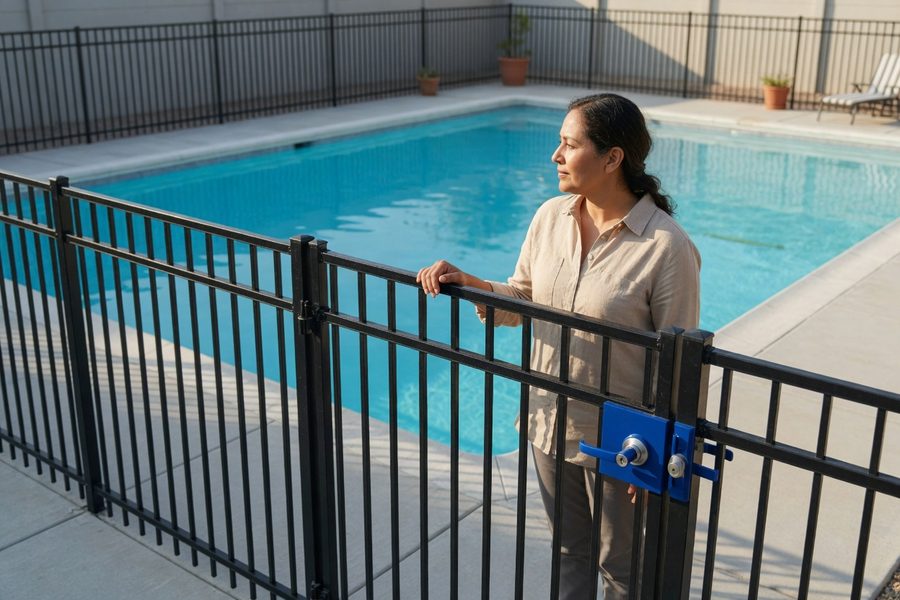
Fencing is non-negotiable for most carriers writing in-ground pool coverage. Most insurers require a four-sided barrier, not just a perimeter property fence, with a minimum height of 4 feet, self-latching gates, and no direct access from the home’s door into the pool area. Some states, including California and Florida, mandate this by law; where state law is silent, your insurer’s requirements still apply as a policy condition.
Pool alarms add another layer. Door and gate alarms that alert when the pool area is accessed are required by some carriers and strongly recommended by others. Above-ground pools may require a locking ladder or removable steps to prevent unsupervised child access. Failure to maintain these features is not just a safety concern, it is grounds for claim denial. If an adjuster determines your gate latch was broken at the time of an incident, the carrier can deny the liability claim on the basis of policy non-compliance.
Where this gets tricky: Readers sometimes remove a diving board to lower their premium, then reinstall it seasonally. Insurers view this as a material change in risk. If a claim occurs while the board is installed but was not disclosed, coverage can be voided retroactively. One conversation with your agent before reinstalling saves far more than the premium difference.
Documentation matters for underwriting too. Keep a file with your pool inspection records, fence installation receipts, and any safety upgrades. If your carrier requires pool safety compliance and you face a claim, that paper trail is what moves the adjuster from denial to payment. For a broader look at what homeowners policies cover and where gaps typically appear, our article on important homeowners insurance policies walks through the standard HO-3 structure in detail.
Where This Recommendation Falls Short
The recommendation to carry $300,000 to $500,000 in liability plus a personal umbrella is the right call for most pool owners, but it is not universally cost-effective, and there are real tradeoffs to name honestly.
The catch is this: umbrella policies require underlying liability minimums, sometimes forcing you to raise your homeowners liability limit before the umbrella even attaches. That is two premium increases, not one. For homeowners in lower-cost states with modest assets and a basic above-ground pool used only seasonally, the combined cost of increased homeowners liability plus an umbrella may outpace the realistic risk exposure. If your total net worth is under $150,000 and you have limited future earning potential, a creditor collecting a judgment against you has fewer assets to pursue, which changes the calculus, though it does not eliminate it.
There is also a practical drawback to raising liability limits without addressing underlying safety compliance. Higher limits do not protect you from claim denial; they just increase the payout if the claim is approved. A homeowner who skips the safety upgrades and buys more liability coverage has insured their way around the problem rather than solving it. Insurers can and do deny claims when safety conditions were not met.
The tradeoff with umbrella policies is also portability: umbrella coverage is tied to your underlying policies. If you switch carriers for your homeowners insurance, you may need to re-qualify for the umbrella or find a new one. Some insurers require the homeowners and umbrella to be written with the same company. That friction is real and worth factoring into the decision to bundle.
Finally, this recommendation does not address the scenario where a carrier simply refuses to insure your home because of pool features. If your pool has a slide, diving board, or lacks the required fencing and you cannot get standard coverage, the answer is not a surplus lines policy at three times the price, it is removing the feature or installing the fence first. No amount of additional coverage can substitute for insurability itself. If you are struggling to find competitive rates due to pool features, comparing quotes through specialized channels is worth the effort; our guide on getting the best home insurance quotes covers how to approach that process.
How We Sourced This
This article draws from verified institutional guidance published by the Insurance Information Institute (III), the Texas Department of Insurance, and the South Carolina Department of Insurance, all accessed in January and February 2026. Coverage structure details reference standard HO-3 policy forms as described by the III and NAIC. Premium estimates for umbrella policies are drawn from III published ranges and reflect data current as of early 2025. Statistics on drowning risk are sourced from CDC injury data current through the most recently published cycle. No figures were used that could not be attributed to a named, linkable institutional source.
Frequently Asked Questions
Does homeowners insurance automatically cover my pool?
Most standard homeowners policies include some pool coverage, but it is not automatic or complete. Property coverage for the pool structure typically falls under the “other structures” sub-limit, and liability coverage is subject to exclusions for features like diving boards and slides, as well as compliance with safety requirements like fencing.
How much liability coverage do I need as a pool owner?
At minimum, $300,000 to $500,000 in personal liability coverage, per guidance from the Insurance Information Institute. If your assets exceed that threshold, add a personal umbrella policy starting at $1 million. The $100,000 base liability most policies default to is not sufficient for a serious pool injury claim.
Are diving boards and pool slides covered by homeowners insurance?
Often, no. Many carriers explicitly exclude liability arising from diving boards and slides, and some will not write a policy at all for homes with these features. Check your declarations page and endorsements carefully, and confirm the exclusions in writing with your insurer before installing any accessory.
What is the attractive nuisance doctrine and how does it affect me?
The attractive nuisance doctrine holds that property owners can be held liable for injuries to children who trespass to access a dangerous feature, like a pool, that is likely to attract them. You do not have to invite someone onto your property for liability to attach. This is why fencing, alarms, and adequate liability limits are all legally important, not just practically useful.
Will my homeowners insurance cover pool incidents if I rent my home on Airbnb?
Almost certainly not under a standard policy. Most personal lines homeowners policies exclude commercial activity, and renting your home, even occasionally, typically triggers that exclusion for pool-related incidents. You need a home-sharing endorsement or a short-term rental policy that explicitly covers pool liability before hosting guests who will have pool access.
Can my insurer cancel my policy because of my pool?
Yes. Insurers can non-renew or cancel a homeowners policy if a pool does not meet their safety requirements, including fencing standards, gate specifications, or presence of prohibited accessories. The Texas Department of Insurance notes that non-compliance with enclosure requirements can affect your coverage status. Proactive disclosure and safety compliance are the only reliable protections against this outcome.
Sources
- Insurance Information Institute, Pool Safety and Insurance
- Texas Department of Insurance, Swimming Pools and Insurance
- South Carolina Department of Insurance, Pools and Insurance: What You Should Know
- Insurance Information Institute, Homeowners Insurance Coverage Guide
- National Association of Insurance Commissioners, Homeowners Insurance Guide
- Insurance Information Institute, Do You Need an Umbrella Policy?