
Reviewed by the Smart Insurance 101 Editorial Team
Our Take
For most homeowners, standard personal property coverage is a reasonable starting point, but it is almost certainly not enough as-is. The default limit of 50% of your dwelling coverage sounds substantial until you realize it applies to actual cash value, not replacement cost, and that jewelry, electronics, and cash each carry their own sublimits that can cap a payout well below what you lost. The recommendation: verify your limit, add replacement cost valuation, and schedule any item worth more than $2,500 separately. The case for skipping those upgrades is only strong if your belongings are minimal and easily replaced.
Personal property coverage is the part of a homeowners policy most people never think about until they need it. According to the Insurance Information Institute’s 2023 data, 97.3% of all homeowners insurance claims involve property damage, including theft. Yet the gap between what policyholders assume they’re covered for and what the policy actually pays out at claim time is one of the most persistent problems in personal insurance.
This article is for homeowners who want to know exactly what Coverage C does and does not protect. What makes the recommendation work is understanding both the valuation method and the sublimit structure; what breaks it is assuming the headline number tells the whole story.
Key Takeaways
- Standard personal property coverage is set at 50% of your dwelling limit in most policies, per New York Department of Financial Services 2025 guidance.
- Only 47% of homeowners have prepared a home inventory of their belongings, according to a 2023 Insurance Information Institute consumer survey, meaning most people have no documentation to support a claim.
- Jewelry, cash, and firearms each carry their own sublimits, typically $1,500 to $2,500 for jewelry, regardless of your total personal property limit, as noted by the North Carolina Department of Insurance.
- Standard policies pay actual cash value (depreciated), not replacement cost, unless you explicitly add an RCV endorsement, a distinction that can mean thousands of dollars on a single electronics or furniture claim.
- In my experience reviewing policies with readers, the single most common coverage gap is not the overall limit but an unscheduled engagement ring or a home office full of equipment worth more than the business-property sublimit covers.
What Personal Property Coverage Really Means in a Standard Policy
Coverage C is the section of your homeowners policy that protects your belongings. Not the structure, not the garage, not the fence. Your stuff: furniture, clothing, electronics, appliances, and everything else you’d load into a moving truck.
A standard HO-3 policy divides protection into four main buckets. Coverage A covers the dwelling itself. Coverage B covers other structures, like a detached garage. Coverage C is personal property. Coverage D covers loss of use if you’re displaced. The Virginia State Corporation Commission’s homeowners insurance guide explains that the personal property amount is typically set at 50% of the dwelling policy limit and provides more limited coverage for property stolen or damaged away from home.
Here’s the thing: that 50% figure is a floor, not a ceiling. The Minnesota Department of Commerce notes that many policies allow increases to 70–75% of the dwelling limit. If your home is insured for $400,000, your default personal property limit sits at $200,000, but you can often push it to $280,000–$300,000 for an incremental premium increase. Whether the default is enough depends entirely on what you own.
What I see in practice: Readers frequently discover their personal property limit after a loss, not before. A $400,000 dwelling policy sounds protective until they realize the $200,000 Coverage C limit applies to actual cash value, and that a six-year-old laptop and three-year-old sofa are each worth a fraction of what they cost to replace.
Everyday Belongings Covered, and the Ones Hit by Sublimits
Most household contents are covered: furniture, clothing, kitchen appliances, sporting goods, tools, electronics, and books. The breadth of coverage sounds reassuring. The sublimits are where the real story lives.
Categories With Hard Dollar Caps
Even if your total Coverage C limit is $200,000, several categories are subject to separate, much lower caps. These sublimits apply per claim regardless of the item’s actual value. Common examples across standard HO-3 policies include:
- Cash and bank notes: typically $200–$500
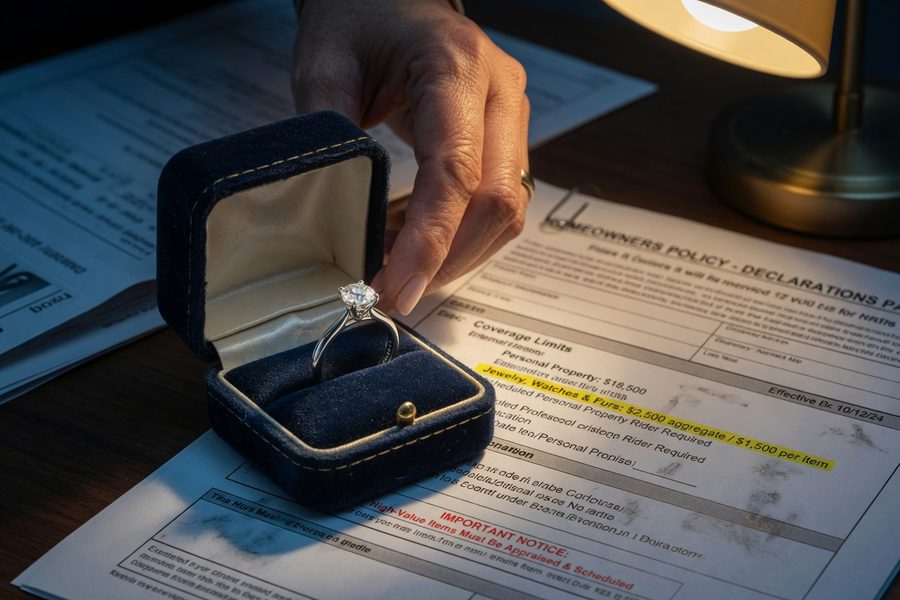
- Jewelry, watches, furs: typically $1,500–$2,500 for theft losses
- Firearms: typically $2,500
- Securities and gift cards: typically $1,500–$2,000
- Manuscripts and personal records: typically $1,500
- Business property on premises: typically $2,500
- Watercraft and trailers: typically $1,500
The North Carolina Department of Insurance confirms that jewelry, furs, manuscripts, and stamp and coin collections all carry special limits, with options to purchase additional coverage or schedule those items separately. That scheduling option matters. A $5,000 engagement ring covered under a standard policy’s theft sublimit gets you $1,500 at best. A scheduled jewelry endorsement gets you the full appraised value.
What clients often miss: Remote workers are especially exposed. Most standard policies cap business property at $2,500 on premises. A home office with a quality monitor, standing desk, docking station, and business laptop can easily exceed that. A separate commercial inland marine policy or a business-property endorsement closes the gap.
Which Perils Actually Trigger a Payout
Standard HO-3 policies cover personal property on a named-perils basis, which is a meaningful restriction. Fire, lightning, windstorm, hail, theft, vandalism, smoke, burst pipes, and the weight of ice and snow are all standard covered perils. If the cause of loss is not on the list, the claim is denied.
That named-perils limitation is precisely why understanding the specific perils in your policy matters before you need to file. An HO-5 policy covers personal property on an open-perils basis (all causes except specific exclusions), which is a broader and stronger form of protection if you can get it. According to Insurance Information Institute data, 5.3% of insured homes filed a claim in 2023, and the overwhelming majority of those were property damage or theft. Named-perils coverage handles those events well. It is the less common causes where gaps appear.
How Much You Actually Receive: Limits, Deductibles, and Valuation
Three variables determine your actual payout: your limit, your deductible, and your valuation method. Most policyholders know the first two and underestimate how much the third one changes the outcome.
Actual Cash Value vs. Replacement Cost
Actual cash value (ACV) pays what your item is worth today, after depreciation. Replacement cost value (RCV) pays what it costs to buy an equivalent new item today. The difference is not academic. A three-year-old 65-inch television purchased for $900 might have an ACV of $350 at claim time. The RCV endorsement pays closer to $850 after your deductible. On a house full of furniture and electronics, that gap accumulates fast.
Here is a concrete example using real numbers. Suppose your home suffers a fire and you lose $40,000 worth of personal property at current replacement prices. Under ACV with an average depreciation rate of 40% on mixed household goods, the insurer values the loss at $24,000. Subtract a $2,000 deductible: you receive $22,000. Under RCV, the insurer pays $40,000 minus the $2,000 deductible, so $38,000. That $16,000 difference is the cost of not adding the RCV endorsement.
The Illinois Department of Insurance advises consumers to ask specifically how much coverage is needed for personal property and what valuation method applies when shopping for a policy. That question alone can save thousands of dollars at claim time.
| Scenario | Replacement Cost of Loss | ACV Payout (After 40% Depreciation & $2,000 Deductible) | RCV Payout (After $2,000 Deductible) |
|---|---|---|---|
| Fire loss, mixed household goods | $40,000 | $22,000 | $38,000 |
| Theft of electronics only | $8,000 | $3,800 (after 55% depreciation & $1,500 deductible) | $6,500 (after $1,500 deductible) |
| Jewelry theft (sublimit applies) | $5,000 | $1,500 (sublimit, no deductible applied above sublimit) | $1,500 (sublimit still applies without a floater) |
What Standard Policies Explicitly Exclude
Flood damage to personal property is excluded. Full stop. A standard homeowners policy does not cover belongings destroyed in a flood, whether from a storm surge, overflowing river, or heavy rainfall. Coverage requires a separate policy through the National Flood Insurance Program (NFIP) or a private flood insurer.
The same logic applies to earthquake damage. Sewer backup and water that enters from the ground up are also excluded unless you purchase a specific endorsement. Wear and tear, mechanical breakdown, and intentional acts are universally excluded. If your laptop dies because the battery finally failed after four years, that is not a covered loss.
Business property deserves special attention. Remote workers who assume their employer-issued laptop or home office setup is protected under their personal property coverage often find out otherwise. The standard $2,500 business-property sublimit applies to property used for business purposes on your premises. Above that cap, there is no coverage unless you carry a separate endorsement or a business owner’s policy. If you are self-employed and running a business from home, commercial property coverage may be worth a close look alongside your homeowners policy.
Where this gets tricky: State definitions of “business property” vary. In some states, a single freelance client on a home computer can push equipment into the business-use category. I always recommend readers check the exact policy language, not the sales summary, the actual contract, before assuming personal items double as business tools without consequence.
Off-Premises Coverage and When Scheduling Becomes Necessary
Personal property coverage extends beyond your four walls in most standard policies, and that is genuinely useful. Clothes stolen from your hotel room, a camera damaged at a rental property, or a laptop taken from your car: all can be covered under Coverage C, subject to the same sublimits and named perils that apply at home.
The Virginia State Corporation Commission notes that personal property coverage provides more limited protection for items stolen or damaged away from home, such as on vacation. Some carriers cover personal property worldwide; others limit coverage to the United States. Knowing which applies to your policy matters if you travel internationally with expensive gear.
When scheduling items separately, also called adding a personal property floater or endorsement, the coverage shifts to an open-perils basis for that specific item. A scheduled engagement ring is typically covered for mysterious disappearance (you simply can’t find it), accidental loss, and the usual covered perils. An unscheduled ring is subject to the theft sublimit and named perils only. For any single item worth more than $2,500, the scheduling endorsement is almost always worth the small additional premium. To see how these decisions fit into the broader picture of managing your home protection costs, the full guide on saving money on homeowners insurance covers the trade-offs in more detail.
How to Verify and Adjust Your Actual Protection Level
Start with a home inventory. Only 47% of homeowners have one, according to the Insurance Information Institute’s 2023 data. Without documentation, a claim becomes a negotiation, and the insurer has more leverage. A basic video walkthrough of every room, stored in cloud backup, gives adjusters something concrete to work with.
Steps to Adjust Your Coverage
Once you have an inventory, the adjustment process is straightforward:
- Add up the replacement cost of your belongings by room. Use current retail prices, not what you paid years ago.
- Compare that total to your current Coverage C limit. If your belongings exceed the limit, contact your insurer to raise it.
- Ask specifically whether your policy pays ACV or RCV. If ACV, get a quote for the RCV endorsement.
- Identify any items that exceed the relevant sublimit. Schedule those items separately with individual appraisals.
- Review business property. If you work from home, confirm whether your equipment falls within or outside the policy’s sublimit.
The homeowners insurance beginner’s overview on this site covers the broader policy structure if you need context before diving into these details. And if you are navigating rising premiums alongside these coverage decisions, the breakdown of why insurance premiums are rising explains the market forces behind the cost increases you may be seeing on your renewal.
Where This Recommendation Falls Short
The standard advice to “increase your limit, add RCV, and schedule valuables” is sound. But it is not free, and it is not necessary for every household. Here is where it falls short.
The tradeoff is cost versus actual exposure. A renter who just bought their first home and furnished it with modest, easily-replaced items from budget retailers has minimal exposure above a standard ACV limit. Adding a full RCV endorsement might cost $100–$200 extra per year, and the likely claim payout difference may not justify the premium over a long policy period without a major loss. The math only tilts strongly in favor of RCV when you own appliances, electronics, and furniture that depreciate fast and cost a lot to replace.
The catch with scheduling is similar. Scheduling an engagement ring or a vintage guitar requires an appraisal, often at the owner’s expense, and means paying a small ongoing premium for each scheduled item. For someone with a $1,200 watch and modest jewelry, the sublimit may actually cover their realistic loss. Scheduling every item of modest value creates administrative friction that outweighs the protection gain.
There is also a legitimate argument for accepting ACV if you are already carrying a high deductible in exchange for lower premiums. In that scenario, a mid-size property loss nets a similar payout under ACV or RCV once the deductible eats a chunk of the claim, and the premium savings from skipping RCV can fund a self-insurance reserve instead.
The recommendation also does not apply to everyone equally across states. State-specific regulations affect what carriers must offer and what constitutes mandatory minimum coverage. The Virginia administrative code (14VAC5-342-40) codifies the 50% minimum as a regulatory floor, not just an industry norm. Residents in states with weaker default minimums may need to be more assertive in pushing their limits up. Personal property coverage for homeowners is ultimately not a set-it-and-forget-it line item; it should be reviewed every two to three years as belongings and their replacement costs change.
How We Sourced This
This article draws from official guidance published by the North Carolina Department of Insurance, Illinois Department of Insurance, Minnesota Department of Commerce, Virginia State Corporation Commission, New York Department of Financial Services, and Virginia administrative regulations (14VAC5-342-40). Statistical data comes from the Insurance Information Institute’s 2023 Facts and Statistics report on homeowners and renters insurance. All regulatory sources were accessed in January 2026, and all statistics cited reflect data current–2025. Sources were selected based on official government and regulator status; no carrier marketing material was used as a primary citation. Any dollar figures used in examples (depreciation rates, deductible amounts) are illustrative approximations within documented industry ranges, not policy-specific values.
Frequently Asked Questions
What does personal property coverage homeowners insurance actually include?
It includes most physical belongings you own: furniture, clothing, electronics, appliances, sporting goods, and tools. It does not cover your home’s structure, the land, or most motor vehicles. Items used primarily for business purposes are subject to a separate, lower sublimit in standard policies.
Is my personal property covered if something is stolen from my car?
Generally yes, under Coverage C’s off-premises protection. Your auto policy covers the vehicle itself, but personal items inside the car, a laptop bag, luggage, or camera, fall under your homeowners or renters policy. The same sublimits and named perils apply, so a stolen laptop may be subject to a sublimit depending on your policy’s category definitions.
What is the difference between actual cash value and replacement cost for personal property?
Actual cash value pays what your item is worth today after depreciation. Replacement cost pays what you would spend to buy an equivalent new item today. The gap is significant for electronics and furniture, which depreciate quickly. Most standard policies default to ACV; replacement cost requires an explicit endorsement.
Does homeowners insurance cover jewelry theft?
A standard policy covers jewelry theft, but only up to the sublimit, which typically runs $1,500 to $2,500 regardless of the item’s actual value. A $10,000 engagement ring gets you $2,500 at most without a scheduled jewelry floater. Scheduling the piece separately with an appraisal removes that cap and often broadens the covered perils to include accidental loss.
Do I need flood insurance if I already have homeowners coverage for my belongings?
Yes. Standard homeowners policies universally exclude flood damage to both the structure and personal property. Coverage requires a separate flood insurance policy through the National Flood Insurance Program or a private insurer. This exclusion applies even if the flooding is caused by a storm that also causes wind damage covered elsewhere in your policy.
How often should I review my personal property coverage limit?
Every two to three years is a reasonable baseline, and immediately after any major purchase or life change. Inflation in furniture and electronics prices has shifted what a $150,000 Coverage C limit actually buys. If you have not reviewed your policy since before 2022, the replacement cost of your belongings has likely risen faster than your limit has.
Sources
- Insurance Information Institute, Facts and Statistics: Homeowners and Renters Insurance (2023)
- New York Department of Financial Services, Basic Homeowners Insurance Coverage (2025)
- North Carolina Department of Insurance, Basic Homeowners Insurance
- Virginia State Corporation Commission, Virginia Homeowners Insurance Guide
- Minnesota Department of Commerce, Property Coverage Basics
- Virginia Administrative Code, 14VAC5-342-40 Minimum Standards for Homeowners Insurance (2025)