
Fact-checked by the Smart Insurance 101 editorial team
Quick Answer
Health insurance costs by age follow a predictable curve: a 21-year-old pays roughly $200-$300/month for a Silver Marketplace plan, while a 64-year-old can pay over $1,000/month for the same plan unsubsidized. Under ACA rules, insurers can charge older adults at most 3 times what they charge the youngest adults, but state rules and income-based subsidies can shift what you actually owe dramatically.
How much should you expect to pay for health insurance, and does your birthday really matter that much? The answer is yes, and the gap is wider than most people realize. Under the Affordable Care Act, insurers are permitted to vary premiums based on age, and according to HealthCare.gov’s official rate-setting rules, premiums for older adults can legally be set up to three times higher than those for younger enrollees. That single rule creates a premium curve that rises steadily from your 20s and can nearly triple by your early 60s.
Understanding health insurance costs by age matters because the wrong plan at the wrong time can cost tens of thousands of dollars per year, or leave you underinsured precisely when utilization starts climbing. This guide breaks down what people in each life stage actually pay, where subsidies change the picture, and where the biggest financial traps tend to appear.
Key Takeaways
- The ACA’s 3:1 age rating rule means a 64-year-old can legally be charged three times as much as a 21-year-old for identical coverage (HealthCare.gov).
- The average benchmark Silver plan premium for a 40-year-old in 2025 is $497/month, serving as the reference point for ACA subsidy calculations (KFF, 2025).
- Employer-sponsored family health coverage averaged $26,993 per year in 2025, with workers contributing roughly $6,850 of that cost (KFF 2025 Employer Health Benefits Survey).
- Adults aged 55 and older account for 54% of total U.S. health spending while comprising only 31% of the population, which is why insurers price this group highest (KFF, 2022).
- New York and a handful of other states use pure community rating with zero age variation, meaning a 60-year-old pays the same base premium as a 25-year-old in those markets.
In This Guide
- How Age Directly Impacts Your Health Insurance Premiums
- What Young Adults and Families with Kids Typically Pay
- Costs in Your 30s and 40s: The Gradual Climb
- The 50s Peak: Highest Pre-Medicare Premiums and Planning Strategies
- Medicare at 65: How Costs Change and What to Expect
- Frequently Asked Questions
How Age Directly Impacts Your Health Insurance Premiums
Age is the single largest factor insurers use to set individual market premiums, and the ACA’s 3:1 age rating rule defines the legal ceiling. Under this rule, the most an insurer can charge a 64-year-old is three times the rate charged to a 21-year-old for the same plan. Every age band between those points follows a federally defined curve, with rates rising gradually through the 20s and 30s, then accelerating noticeably after age 50.
The Federal Age Curve in Practice
The Centers for Medicare and Medicaid Services publishes specific age rating factors that all ACA-compliant plans must follow. A 21-year-old receives a factor of 1.000, the base rate. By age 30, that factor has risen modestly to about 1.278. At age 40, it reaches roughly 1.444. The jump accelerates from there: age 50 carries a factor near 1.786, age 55 climbs to about 2.222, and age 64 hits the statutory cap of 3.000. When the average benchmark Silver premium for a 40-year-old is $497/month according to KFF’s 2025 Marketplace data, a 64-year-old purchasing the same benchmark plan would pay roughly $1,032/month before any subsidy, a difference of $535 per month, or $6,420 per year, based solely on the 3:1 ratio applied to that benchmark figure.
States That Play by Different Rules
New York, Vermont, and Massachusetts enforce pure community rating, which prohibits age-based premium variation entirely. A 60-year-old in New York pays the same base rate as a 25-year-old on the same plan. That sounds like a win for older residents, and it often is, but it also means young, healthy enrollees pay significantly more than they would in age-rated states, which can suppress enrollment among younger adults and push community-wide premiums higher. The trade-off is real and worth naming upfront.
Under the ACA’s age rating rules, children under age 21 are charged a flat rate regardless of exact age, and adding additional children to a family plan past the third child adds no extra premium for the additional kids in many Marketplace plans.
What Young Adults and Families with Kids Typically Pay
Young adults generally pay the lowest individual premiums of any age group, but “low” is relative, and subsidies do most of the heavy lifting for households earning under 400% of the federal poverty level.
For a 21-year-old, Silver plan premiums on the Marketplace typically range from roughly $150 to $280 per month in standard ACA markets before subsidies, depending on location. A 27-year-old, still well within the low-cost band, might pay $200 to $320 per month. Children aged 0 through 14 are rated at a flat, lower tier, HealthCare.gov’s plan data shows carriers submit separate premium rates for age groups including 0-14, 18, 21, and onward, which is why family plan math can get complicated quickly. Young adults who are still eligible to stay on a parent’s employer plan under the ACA’s dependent coverage rule (up to age 26) often find that the least expensive option available to them, though they should compare it against Marketplace subsidies if their household income qualifies. For a deeper look at how individual and family medical coverage works, our full explainer covers plan structures in detail.

Costs in Your 30s and 40s: The Gradual Climb
Between ages 30 and 49, premiums rise steadily but not dramatically, this is the period where the age curve ticks upward without the sharp acceleration that hits after 50. What changes more visibly in this decade is total household exposure, not just the individual premium line.
The Family Coverage Calculation
Add a spouse in their late 30s and two children to a Marketplace plan, and the monthly premium for a Silver plan can exceed $1,200 to $1,500 per month in many markets, even though each individual component still falls in a relatively moderate age band. For families with employer access, the math sometimes flips. KFF’s 2025 Employer Health Benefits Survey found that annual family coverage through an employer averaged $26,993, with workers contributing an average of $6,850 out of pocket. That worker share, roughly $571 per month, is often lower than what the same family would pay unsubsidized on the Marketplace. But if only one spouse has employer access and the plan is expensive relative to the household income, the family could qualify for Marketplace subsidies instead. Knowing which option is actually cheaper requires running the numbers side by side.
Out-of-pocket utilization also begins rising in the 40s. Preventive screenings, prescription drug costs, and the occasional specialist visit add up even for relatively healthy adults. This is the life stage where the difference between a deductible and your plan’s out-of-pocket maximum starts to matter in concrete dollar terms, not just as abstract policy language.
Adults aged 55 and older account for 54% of total U.S. health spending while making up just 31% of the population, the core actuarial reason insurers price the 50-64 bracket so aggressively (KFF, 2022).
| Age | ACA Age Factor | Est. Monthly Silver Premium (2025) | Annual Premium (Unsubsidized) |
|---|---|---|---|
| 21 | 1.000 | $210 | $2,520 |
| 27 | 1.135 | $238 | $2,856 |
| 30 | 1.278 | $268 | $3,216 |
| 40 | 1.444 | $303 | $3,636 |
| 50 | 1.786 | $375 | $4,500 |
| 55 | 2.222 | $467 | $5,604 |
| 60 | 2.611 | $548 | $6,576 |
| 64 | 3.000 | $630 | $7,560 |
Estimates derived by applying federal ACA age rating factors to a base rate consistent with KFF’s 2025 benchmark data. Actual premiums vary by state, insurer, and county. Figures reflect individual Silver plan premiums before subsidies.
Plan Type Trade-Offs at This Stage
Adults in their 30s and 40s face a genuine choice between Bronze, Silver, and Gold metal tiers. A Bronze plan carries lower premiums but higher deductibles, often $6,000 to $7,000 for an individual. A Gold plan reverses that trade-off with lower cost-sharing but higher monthly premiums. For relatively healthy adults who rarely exceed their deductible, Bronze can look appealing on paper. The risk is that one hospitalization or unexpected diagnosis can push total annual costs above what a Silver or Gold plan would have cost. Comparing HMO versus PPO plan structures is equally important at this stage, since network restrictions affect both access and cost.
The 50s Peak: Highest Pre-Medicare Premiums and Planning Strategies
The decade between 50 and 64 is where health insurance costs by age hit their hardest, and the numbers justify treating this period as a distinct financial planning challenge. Unsubsidized Silver plan premiums for a 62-year-old can exceed $1,000/month in many markets based on multiple 2025 analyses, and that figure can be even higher in rural counties with limited insurer competition.
Why the 50-64 Bracket Hurts Most
The age rating curve accelerates sharply after age 50, as shown in the table above. But the premium increase is only part of the picture. Adults in this bracket are more likely to have chronic conditions requiring regular prescription drugs, specialist care, and diagnostic imaging. KFF data shows that people aged 55 and older account for 54% of total U.S. health spending despite being only 31% of the population, and insurers build that utilization pattern directly into rate filings. For firms where at least 35% of workers are age 50 or older, KFF’s 2025 employer survey found that single-coverage premiums averaged $9,599 annually, about $300 more per year than the overall single-coverage average of $9,032, reflecting that older workforce composition drives employer costs upward too.
COBRA vs. ACA Coverage After Job Loss
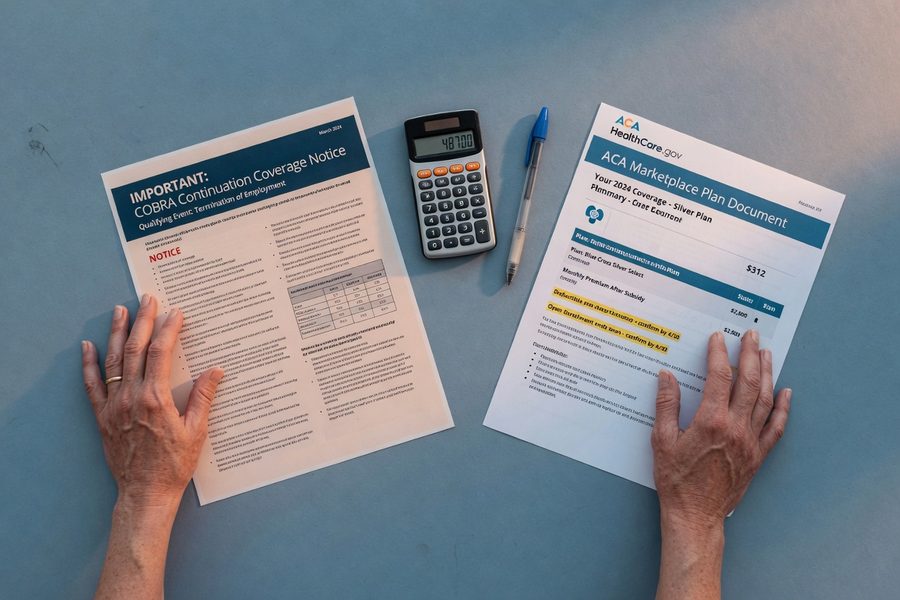
Losing employer coverage at 57 or 60 creates a genuine dilemma. COBRA lets you keep your existing employer plan, but you pay the full premium the employer was previously covering plus a 2% administrative fee. For a generous employer plan, that can mean $1,500 to $2,000 per month. ACA Marketplace coverage after a qualifying life event may be meaningfully cheaper, especially if your income qualifies for subsidies, but the plan network and coverage details may differ from what you’re used to. Running the side-by-side comparison is non-negotiable. For those who are self-employed in this age bracket, our guide to health insurance options for self-employed workers covers the Marketplace strategies that apply most directly.
If you are between 50 and 64 and your income falls near 400% of the federal poverty level, even a modest reduction in reported income, through maximizing HSA contributions or traditional IRA contributions, can shift you into a lower subsidy cliff threshold and cut your net Marketplace premium by hundreds of dollars per month.
Medicare at 65: How Costs Change and What to Expect
Turning 65 replaces the ACA’s age rating curve with a different cost structure entirely. Medicare Part A (hospital coverage) is premium-free for most people who paid Medicare taxes for at least 10 years. Medicare Part B (outpatient and physician coverage) carries a standard premium of $185.00/month in 2025, though higher earners pay more through the IRMAA (Income-Related Monthly Adjustment Amount) surcharge.
Medigap and Medicare Advantage Costs
Original Medicare alone leaves significant gaps: Part A has a hospital deductible of $1,676 per benefit period in 2025, and Part B covers only 80% of outpatient costs after the deductible. Most enrollees add either a Medigap supplement (also called Medicare Supplement Insurance) or a Medicare Advantage plan to cover those gaps. Medigap Plan G, one of the most popular options, runs roughly $100 to $200 per month depending on age at enrollment, state, and insurer. Medicare Advantage plans, offered by private insurers, often have $0 or low monthly premiums but restrict you to plan networks and may carry higher out-of-pocket costs for specialist care. The right choice depends heavily on how frequently you use healthcare and whether your preferred providers are in-network. If you are also thinking about protecting your family financially at this stage, our overview of the best term life insurance options covers products relevant to the 60-plus bracket.
One honest caveat: prescription drug costs can remain a significant burden even after Medicare enrollment. Medicare Part D coverage varies widely by formulary, and specialty drugs may still carry high cost-sharing. For anyone managing multiple chronic conditions, total annual out-of-pocket costs post-65 can still reach $3,000 to $5,000 even with solid supplemental coverage.
Frequently Asked Questions
At what age do health insurance premiums increase the most?
The steepest acceleration happens between ages 50 and 64, where the ACA’s federal age rating factors push premiums from roughly 1.786 times the base rate at age 50 to the statutory maximum of 3.000 times at age 64. In practical dollar terms, this means premiums for a 64-year-old can be more than 40% higher than those of a 50-year-old on the same plan, even before any changes in the underlying base rate.
Can an insurer charge me more than three times what a younger person pays?
No, not for ACA-compliant individual and small group plans. Federal law sets a hard ceiling at a 3:1 ratio between the oldest and youngest adult enrollees. Some states have set stricter limits, and a handful, including New York and Vermont, prohibit age-based variation entirely through community rating rules.
Do ACA subsidies offset the higher premiums older adults face?
Yes, for eligible households. ACA premium tax credits cap what you pay as a percentage of your income, so a 62-year-old earning 200% of the federal poverty level may owe the same net premium as a 30-year-old at the same income level, despite the gross premium being far higher. The subsidy absorbs the difference. The challenge comes at income levels near or above 400% of the poverty line, where subsidy phase-outs can create sharp cost cliffs for adults in their 50s and early 60s.
How does adding children to a health plan affect premiums?
Children are rated at a lower, flat rate, and in most ACA Marketplace plans, family premiums stop increasing after the third child, additional children are covered at no extra premium. This makes large families somewhat more efficient on a per-person basis than the individual rates would suggest, though total family premiums can still be substantial depending on the parents’ ages.
Is it cheaper to stay on an employer plan or buy coverage on the ACA Marketplace?
It depends on the employer’s contribution, your income, and your age. Employer plans are often, but not always, the better deal because employers typically cover 70% to 80% of the premium. However, if an employer plan is deemed “unaffordable” under ACA rules (meaning the employee’s share of single coverage exceeds a set percentage of household income), family members may qualify for Marketplace subsidies instead. Running the actual cost comparison, not just assuming one option is better, is the only reliable approach.
What happens to health insurance costs if I retire before 65?
Early retirement between 55 and 64 typically means paying full Marketplace premiums or COBRA costs without employer contributions, at the exact age when those premiums are highest. A 60-year-old retiring early could face unsubsidized Silver plan premiums exceeding $800 to $1,000 per month depending on location. Income-based subsidies can help if retirement income keeps you below the relevant thresholds, but careful income planning is often needed to stay subsidy-eligible. Our article on why insurance premiums are rising sharply explains the broader cost drivers behind these increases.
Does tobacco use affect health insurance premiums by age?
Yes. The ACA allows insurers in most states to apply a tobacco surcharge of up to 50% on top of the standard age-rated premium. Some states restrict or prohibit this surcharge, but where it applies, a 60-year-old who uses tobacco could pay up to 50% more than a non-tobacco-using enrollee of the same age, compounding an already high base premium significantly. Subsidies, however, cannot be applied to cover the tobacco surcharge portion of a premium, making it a direct out-of-pocket cost.
Sources
- HealthCare.gov, How Plans Set Your Premiums
- HealthCare.gov, Health Plan Information and Rating Scenarios
- KFF, Average Marketplace Premiums by Metal Tier, 2025
- KFF, 2025 Employer Health Benefits Survey
- KFF, Health Policy 101: Health Care Costs and Affordability
- ValuePenguin, Average Cost of Health Insurance by Age (2025-2026)
- KFF, Medigap Enrollment and Consumer Protections by State


