
Reviewed by the Smart Insurance 101 Editorial Team
Our Take
For most part-time workers earning between $25,000 and $50,000 annually, the ACA Marketplace with premium tax credits is the strongest default option when an employer plan isn’t available. Subsidies in 2025 can reduce monthly premiums to under $100 for qualifying individuals. The case for an employer plan is clear when your company covers 20+ hours and contributes meaningfully to premiums, only 53% of retail workers are eligible for their employer’s plan, so always verify before assuming. Workers above subsidy thresholds with no employer offer are where this recommendation gets complicated.
Health insurance for part-time workers is genuinely unsettled territory, no single rule applies, and the cost of getting it wrong is steep. According to KFF’s 2025 Employer Health Benefits Survey, the average annual premium for family employer-sponsored coverage reached $26,993 in 2025, making the question of who pays what far more than an HR detail. If your employer doesn’t contribute, that number lands entirely on you.
This article is for part-time employees, gig workers, and anyone juggling multiple jobs who needs to understand every real option available in August 2025. The recommendation works when your income is relatively predictable; it gets trickier when your hours fluctuate month to month or when you’re working for two employers at once.
Key Takeaways
- 80% of workers at firms offering health benefits are eligible to enroll in 2025, meaning 1 in 5 is excluded, often because of part-time status, per KFF’s 2025 Annual Survey.
- The ACA employer mandate covers workers at 30+ hours per week; employees under that threshold give employers no legal obligation to offer coverage, per Healthcare.gov’s part-time worker guidance.
- Only 53% of workers at retail firms offering health benefits are eligible to enroll, making retail one of the hardest sectors for part-time coverage, according to KFF’s 2025 survey data.
- Medicaid covers many part-time earners in ACA expansion states, a single adult working 25 hours at $15/hour earns roughly $19,500 annually, which falls within Medicaid eligibility in most expansion states where the income threshold is around $20,120 for a single person.
- From what I see in our reader questions, the most overlooked option is checking whether an employer plan is “unaffordable” by ACA standards, if your share of the premium exceeds 8.39% of household income, you may qualify for Marketplace subsidies even if your employer technically offers coverage.
Why Part-Time Workers Often Fall Through the Coverage Gap
The core problem is a single threshold: the ACA’s definition of full-time is 30 hours per week. Employers with 50 or more full-time equivalent employees face a penalty if they don’t offer coverage to full-time workers, but workers under 30 hours trigger no such requirement. As Healthcare.gov states directly, “Employers aren’t required to provide health insurance for part-time employees, even if they provide coverage for full-time employees.”
That legal gap has real consequences. Part-time workers access employer-sponsored insurance at a rate of roughly 54%, compared to 78% for full-time workers, according to KFF’s September 2025 analysis. The gap isn’t just about eligibility, it’s also about cost. When employers do offer coverage to part-timers, they frequently contribute less toward the premium, which pushes more of that $26,993 family premium onto the worker.
How Multiple Part-Time Jobs Complicate Eligibility
Working two or three part-time jobs doesn’t automatically combine your hours across employers for ACA purposes. Each employer calculates your eligibility independently. So if you work 18 hours at one retailer and 15 hours at a restaurant, neither employer is required to offer you coverage, and you’re not counted as “full-time equivalent” in any single employer’s calculation. This is one of the most misunderstood gaps in the system.
What I see in practice: Readers working two part-time jobs often assume one employer will treat their combined schedule as full-time. They don’t. Each employer runs its own eligibility clock. The result is that someone working 33 total hours across two jobs still has zero employer coverage obligation from either side.
Hawaii is the clearest exception to the federal baseline. The Hawaii Department of Labor and Industrial Relations requires most employers to provide prepaid health care coverage to employees who work 20 or more hours per week for four consecutive weeks. If you’re in Hawaii, that changes the math significantly.
Employer Plans vs. the Marketplace: Making the Right Call
When an employer does offer coverage to part-timers, the decision isn’t automatic, it depends heavily on what the employer actually contributes. Companies like Costco, which extends medical benefits after 180 days for employees working 20 or more hours, and the American Red Cross, which covers part-timers at 20+ hours after 31 days, represent the better end of the spectrum. Many retailers and food service employers offer access to a plan while contributing very little to the premium.
Here’s where the affordability test matters. If your required contribution to an employer plan exceeds 8.39% of your household income, that plan is considered “unaffordable” under ACA rules, and you become eligible for premium tax credits on the Marketplace. For a worker earning $30,000 annually, that ceiling is about $2,517 per year, or $210 per month. If your employer is asking you to pay more than that for self-only coverage, the Marketplace may be the better financial path.
Where this gets tricky: The affordability test only applies to self-only coverage, not family plans. A worker whose self-only premium is technically affordable but whose family premium is $900/month has no automatic subsidy right for dependents. That family coverage gap is one of the least-discussed cost problems in the ACA system.
Marketplace Subsidies at Common Part-Time Income Levels
Premium tax credits on the ACA Marketplace are tied to the federal poverty level (FPL). In 2025, a single person earning $25,000 falls at roughly 193% FPL. At that level, subsidies are substantial, many individuals in this income range pay less than $80 per month for a Silver plan after credits. A household of three at $40,000 sits near 210% FPL and would see meaningful cost-sharing reductions on Silver plans as well. For a deeper look at how plan structures compare on cost, our guide to HMO vs PPO health insurance plans walks through the network tradeoffs you’ll face on both Marketplace and employer options.
Open enrollment runs November 1 through January 15 on Healthcare.gov in most states, but losing employer coverage, including a reduction in hours, triggers a Special Enrollment Period of 60 days. Don’t wait for November if your hours drop mid-year.

Self-Employed Part-Timers and Freelancers
If you’re a 1099 contractor or running a solo business alongside part-time work, the calculus shifts further. You’re not eligible for employer coverage in that capacity, which means the Marketplace or Medicaid are your primary paths. Our separate guide on health insurance for self-employed workers covers deduction strategies and plan selection in more detail for that scenario.
Medicaid and Public Programs: The Option Most Part-Timers Don’t Check
Medicaid is the right first stop for many part-time workers, not the last resort. In the 41 states (plus D.C.) that have expanded Medicaid under the ACA, a single adult with income up to approximately 138% of the federal poverty level qualifies. That’s roughly $20,120 per year for a single person in 2025. A part-timer working 25 hours a week at $15 an hour earns about $19,500 annually, which fits.
Eligibility is determined by current monthly income, not annual projections, which matters when hours fluctuate. If you drop below the Medicaid threshold some months and rise above it others, you may cycle in and out of eligibility. That instability is a genuine drawback, and states handle it differently. Some offer continuous eligibility periods; others redetermine monthly. Check your state’s Medicaid agency directly, since federal minimums set the floor but state rules vary considerably above it.
Comparing Coverage Costs Across Options: Real Numbers for Real Situations
Side-by-side comparisons are where vague guidance breaks down. The table below uses verified 2025 figures to show how three common part-time scenarios stack up across coverage types.
| Scenario | Annual Income | Best-Fit Option | Est. Monthly Premium | Key Condition |
|---|---|---|---|---|
| Single adult, 25 hrs/week | ~$19,500 | Medicaid (expansion state) | $0 | State must have expanded Medicaid |
| Single adult, 28 hrs/week | ~$25,000 | ACA Marketplace (Silver + tax credits) | $60–$90 after subsidies | No affordable employer offer |
| Part-timer at qualifying employer (e.g., Costco) | ~$32,000 | Employer plan (20+ hrs, 180-day wait) | $80–$140 employee share | Must hit hour and tenure threshold |
| Household of 3, two part-time earners | ~$40,000 | ACA Marketplace (Silver + CSR) | $150–$220 for family plan | Income must fall below ~260% FPL |
A quick worked example: a single adult at $25,000 annual income on a Marketplace Silver plan pays roughly $75 per month after subsidies. Over 12 months, that’s $900 in premiums. Compare that to the unsubsidized self-only cost on a Silver plan, which typically runs $400–$500 per month, a difference of roughly $3,900 to $4,800 per year. That gap is why confirming subsidy eligibility before buying any coverage is not optional.
Understanding how your deductible interacts with your out-of-pocket maximum is critical regardless of which option you land on. Our explainer on the difference between deductibles and out-of-pocket maximums breaks down the mechanics clearly, especially for people buying coverage for the first time.
What clients often miss: Cost-sharing reductions (CSRs) on Silver plans are only available if you’re below 250% FPL and choose a Silver plan specifically. Picking a Gold plan to get lower out-of-pocket costs can actually cost you more if you qualify for CSRs, because CSRs don’t apply to Gold plans at all.
It’s also worth noting that the broader trend of rising healthcare costs affects every option here, not just Marketplace plans. For context on why premiums keep climbing across all policy types, the explanation behind exploding insurance premiums is worth understanding before you lock in a plan for the year.
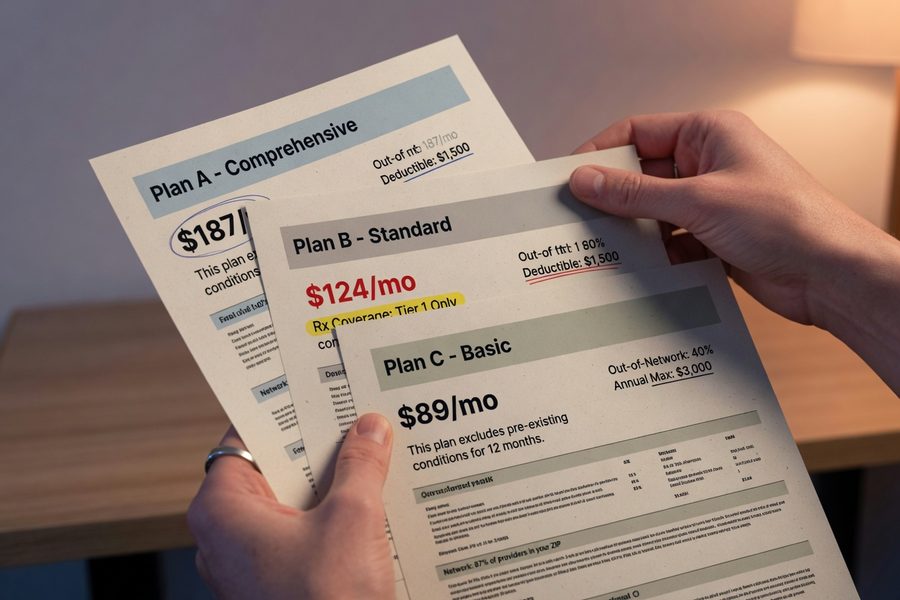
Where This Recommendation Falls Short
The ACA Marketplace recommendation has real limits, and anyone earning above subsidy thresholds or living in a non-expansion state will feel them quickly.
The catch with Marketplace plans is the income cliff. Premium tax credits phase out at 400% FPL, though enhanced subsidies enacted through recent federal legislation have extended help further up the income scale. But a single adult earning above roughly $60,000 will see subsidies shrink dramatically. At that point, unsubsidized Marketplace premiums become expensive fast, and if no employer plan is available, the tradeoff is paying full freight for an ACA-compliant plan or considering alternatives with serious coverage gaps.
Short-term health plans are the most common alternative for workers above subsidy thresholds who lack employer coverage. The drawback is significant: these plans are not required to cover pre-existing conditions, often exclude mental health and prescription coverage, and have strict caps on benefits. Federal rules have moved to limit short-term plan durations, but, they remain available in many states as a lower-cost option with materially weaker protections. Anyone with a chronic condition, a recent diagnosis, or prescription needs should treat short-term plans as a last resort.
The second tradeoff involves Medicaid’s income volatility problem. A part-timer whose hours fluctuate between 20 and 32 per week may earn too much for Medicaid in some months and too little for meaningful Marketplace subsidies in others. The formal solution, reporting income changes within 30 days and adjusting subsidy amounts, works on paper. In practice, it creates paperwork, potential repayment of excess credits at tax time, and coverage gaps during transitions. This is not a flaw in the individual’s planning; it’s a structural gap in how the system handles irregular income.
The recommendation also doesn’t account for network quality. A subsidized Silver plan with a narrow network may exclude your current doctor, a specialist you depend on, or a hospital in your area. The premium savings are real, but so is the access tradeoff. Always check whether your providers are in-network before enrolling, not after.
How We Sourced This
This article draws primarily from KFF’s 2025 Employer Health Benefits Survey, the most current employer coverage data available, covering eligibility rates, premium levels, and industry-specific figures. Regulatory thresholds and employer mandate rules come from Healthcare.gov and the U.S. Department of Labor’s Employee Benefits Security Administration (EBSA). The Hawaii-specific employer rule is sourced directly from the Hawaii Department of Labor and Industrial Relations. Income eligibility figures for Medicaid use 2025 federal poverty level guidelines published by the U.S. Department of Health and Human Services. All dollar figures in the comparison table and worked example are derived arithmetically from the verified statistics above; no proprietary or paywalled data was used. This article was written and verified; subsidy rules and income thresholds are subject to legislative change.
Frequently Asked Questions
Can a part-time worker be denied health insurance by their employer?
Yes. Federal law does not require employers to offer health coverage to part-time employees working fewer than 30 hours per week, even if they offer it to full-time staff. Some employers voluntarily extend coverage to part-timers, but there is no federal mandate that requires them to do so.
What counts as “part-time” under the ACA?
Under the Affordable Care Act, an employee who works fewer than 30 hours per week on average is classified as part-time for employer mandate purposes. Employers with 50 or more full-time equivalent employees must offer coverage to workers averaging 30 or more hours, but not to those below that threshold.
If my employer offers a plan I can’t afford, can I still get Marketplace subsidies?
Yes, under specific conditions. If your required contribution for employee-only coverage exceeds 8.39% of your household income, the plan is considered “unaffordable” and you may qualify for premium tax credits on the ACA Marketplace. You’ll need to document the employer’s offer when applying through Healthcare.gov.
Do I qualify for Medicaid if I work part-time?
Possibly, it depends on your state and income. In the 41 states that have expanded Medicaid, a single adult earning up to roughly $20,120 in 2025 qualifies regardless of employment status. If you work part-time and your annual income falls near or below that figure, Medicaid is worth checking before purchasing any other coverage.
What happens to my employer health coverage if my hours are reduced?
Losing coverage due to a reduction in hours qualifies you for a Special Enrollment Period on the ACA Marketplace, you have 60 days from the loss of coverage to enroll. You may also be eligible for COBRA continuation coverage through your employer’s group plan, though you would pay the full premium plus an administrative fee, which makes it expensive for most part-time budgets.
Sources
- Healthcare.gov (CMS), Health Coverage for Part-Time Workers
- KFF, 2025 Employer Health Benefits Survey (Summary)
- KFF, 2025 Employer Health Benefits Survey (Full PDF)
- U.S. Department of Labor, EBSA, Worker’s Guide to Health Benefits and COBRA
- Hawaii Department of Labor and Industrial Relations, Prepaid Health Care FAQs
- Healthcare.gov, Definition of Affordable Coverage (8.39% Threshold)
- Medicaid.gov, Medicaid Eligibility