Fact-checked by the Smart Insurance 101 editorial team
The Verdict
Request an insurance binder any time a third party wants proof of coverage before your formal policy shows up. It’s real protection, backed by an actual contract, not a promise on a handshake. Sometimes the risk window is as short as 24 hours, think mortgage closing day or driving a new car off the lot. Don’t bother if your full policy is already sitting in your inbox.
Updated August 2026
A binder is a short-term contract. It confirms real, enforceable coverage while your full policy works its way through underwriting. That’s the whole idea behind an insurance binder explained simply: it’s not a receipt, not a quote, not a placeholder someone hands you to make you feel better. Once an insurer looks at the risk and agrees to take it on, you’ve got coverage you can actually use. Whether any of this matters to you comes down to one thing: timing. Is a lender, landlord, or government office asking for proof of insurance before your permanent paperwork can land? The New York State Department of Financial Services puts it plainly: binders function as the legal equivalent of temporary insurance until a formal policy is issued.
In April 2025, this matters because closings, auto purchases, and lease signings all move at a pace that doesn’t leave much room for paperwork delays. Miss even one day of documented coverage and you could see a closing pushed back, a lease condition voided, or worse, no protection at all if something happens during that gap. Chase and Wells Fargo, like most lenders, want proof of homeowners insurance before they’ll fund a loan. A verbal assurance won’t cut it.
| Factor | Reasons to Get a Binder | Reasons You Might Not Need One |
|---|---|---|
| Legal protection | Enforceable coverage from the moment the insurer accepts the risk | Not needed if the full policy is already issued and delivered |
| Third-party requirement | Mortgage lenders, auto dealers, and commercial landlords routinely require immediate proof | Some transactions allow a certificate of insurance or policy declarations page instead |
| Closing timelines | Real estate closings can move up with little notice; a binder can be issued same-day | If closing is weeks away, there may be time to get a full policy first |
| Business start dates | Covers a new business or commercial space from day one of operations | Low-risk situations with no contractual proof requirement may not justify the paperwork |
| Claims during the gap | A binder means losses during the interim period are covered | Without active risk exposure, there is nothing to protect during the gap |
| Surplus lines policies | The NAIC Surplus Lines Model Law explicitly recognizes binders as valid evidence of coverage when a policy is not yet available | Standard admitted carriers often issue policies quickly enough that a binder is redundant |
Key Takeaways
- Request a binder any time a lender or third party requires proof of insurance and your full policy will not arrive within 48 hours.
- A written binder is legally enforceable; an oral binder may be valid in some states but is far harder to prove in a dispute.
- Most binders expire in 30 to 60 days; confirm the exact date in writing so you do not find yourself unintentionally uninsured.
- The binder’s named insured, coverage limits, and effective date must match the final policy exactly, any mismatch can create a coverage gap.
- A binder is not a certificate of insurance (COI); do not substitute one for the other, especially with lenders who specify which document they will accept.
- If underwriting reveals new information after the binder is issued, the insurer may modify or deny the final policy, which can affect claims filed during the binder period.
- Keep a copy of the binder in a safe location and confirm the transition to the full policy in writing before the binder expires.
What Is an Insurance Binder?
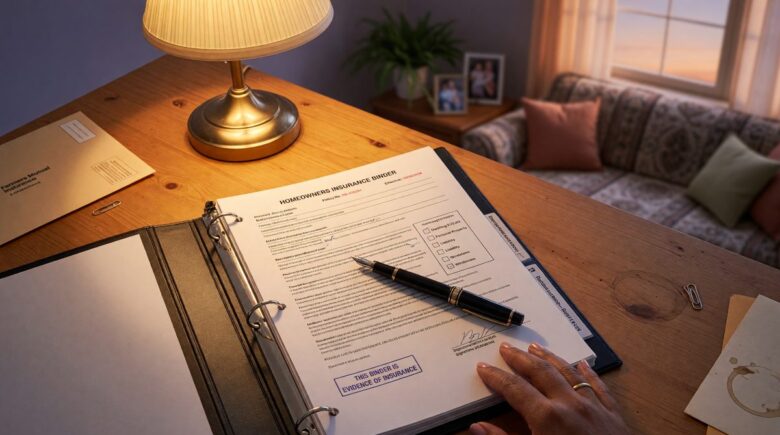
A binder is a temporary, legally binding insurance contract. It’s not a summary. Not a quote. Definitely not a letter of intent. The moment an insurer reviews the basic risk and agrees to cover it, real obligations kick in on both sides. You pay, or agree to pay, the premium. The insurer is on the hook for covered losses that happen during that window.
What separates a binder from an application comes down to finality. An application asks for something. A binder commits to it. It typically includes the named insured, the insuring company, the policy type (homeowners, auto, commercial general liability, whatever applies), coverage limits, the property or vehicle in question, plus effective and expiration dates. These details matter because a binder is supposed to be a preview of the permanent policy. Say the binder lists $300,000 in dwelling coverage but the final policy comes back at $250,000. That’s a real discrepancy, and it could complicate any claim you file in between.
For context: the average annual premium for a standard homeowners policy in the U.S. sat around $1,600 in 2024, per the NAIC Consumer’s Guide to Home Insurance. That’s about $133 a month. If your policy is delayed and you’re relying on a binder in the meantime, you’re not paying extra for the privilege, your premium is still tied to the full policy terms. But if the final policy lands with lower limits or altered coverage, you could end up underinsured without realizing it. A lot of people assume a binder covers exactly what the final policy will cover. It doesn’t always. Perils like flood or earthquake often get excluded from the eventual policy but aren’t spelled out one way or the other on the binder itself. That gap can bite you if a claim falls outside what the binder actually assumed.
State Farm, Allstate, and Liberty Mutual can usually get a binder out the same day they receive a completed application. Surplus lines markets, the ones that take on higher-risk properties or businesses standard carriers won’t touch, tend to move slower on the formal policy, which makes the binder even more essential in those cases. If you want a wider view of how coverage types fit together, the overview of types of insurance and their benefits walks through the categories people run into most, and where binders tend to show up.
When Do You Actually Need One?
Mortgage closings trigger this more than anything else. Most lenders, including those underwriting loans backed by Fannie Mae or Freddie Mac, require proof of homeowners insurance before releasing funds. Chase, Bank of America, SoFi, they’ve all built this into their closing checklists. A binder covers you if your policy isn’t fully finalized yet. The New York DFS has confirmed that accepting a binder as proof of insurance is ultimately up to the lender, so check with yours before closing day arrives.
Your mortgage application already surfaced your debt-to-income ratio and FICO Score for underwriting. Insurance binder requirements come at a different stage, but lenders tend to raise the issue around the same time they lock in your APR and loan terms. A delayed binder can stall the closing even when every other box has been checked.
Auto purchases follow a similar pattern. Drive a new or used car off the lot without active coverage and you’re exposed the second you leave the parking lot. An agent can often turn a binder around in a few hours, so you’ve got documented protection while the real policy processes. Dealerships tied to big finance arms, Toyota Financial Services and Ford Motor Credit among them, won’t hand over a financed vehicle without verified insurance. If you’re working through a car purchase for the first time, the guide to getting your first auto insurance covers what to line up ahead of time.
Commercial situations get overlooked but matter just as much. A new business signing a lease, a contractor starting a job that needs general liability, a company placing coverage through a surplus lines insurer, any of these can hit a wall where the paperwork isn’t ready on day one. The NAIC Surplus Lines Model Law addresses this directly: a surplus lines licensee has to deliver a policy promptly, and if it’s not ready yet, a binder or similar evidence of insurance fills that requirement. The CFPB has also noted that lenders can legally require insurance documentation before funding a loan, which underscores why binders carry actual legal weight rather than just serving as a formality. Business owners can find more on the risks of skipping documented coverage in the liability insurance guide for small business owners.
Binder vs. Certificate of Insurance vs. Full Policy
These three documents get confused constantly, and mixing them up causes real problems. A binder creates coverage on the spot. A certificate of insurance (COI) just shows that a permanent policy already exists somewhere; it doesn’t create anything new on its own. The full policy is the permanent version that eventually replaces the binder once underwriting wraps up.
Here’s where it gets practical: hand a lender a COI when they asked for a binder, and they might just reject it. COIs show up most often in commercial settings, where a contractor or vendor needs to prove ongoing coverage to a client. Binders, on the other hand, exist for one purpose, bridging a gap while the real policy gets issued.
Enforceability matters here too, especially if a claim comes up. Courts have generally treated binders as binding contracts, which means a legitimate claim filed during the binder period doesn’t just get denied because the formal policy hadn’t shown up yet. There’s a real catch worth knowing about, though. If underwriting later turns up a material misrepresentation, say the applicant left out a prior loss, the insurer might have grounds to rescind coverage retroactively. That could affect claims filed even while the binder was active. Credit bureaus like Experian, Equifax, and TransUnion don’t sit inside the underwriting process in most states, but some insurers do pull credit-based insurance scores as one input among several. So a surprise on your credit report at application time could still ripple into your final policy terms after the binder’s already in effect. This is one of the real risks of the binder period that a lot of consumer explainers skip right over.
Who Should and Who Should Not Use a Binder?
Good candidates
Most people caught in a time-sensitive transaction with a proof-of-insurance requirement will get real use out of a binder.
- A homebuyer closing within 48 hours whose homeowners policy has not yet been formally issued. A binder satisfies the lender requirement and prevents a delayed closing. The homeowners insurance beginner’s guide explains what that policy should cover before you request a binder.
- A first-time car owner picking up a vehicle at a dealership who needs active coverage before driving off the lot.
- A small business owner signing a commercial lease that requires proof of general liability insurance on the effective date of the lease.
- A contractor or vendor whose client requires documented coverage before work begins, and whose admitted carrier has not yet issued the formal policy.
- Any insured placing coverage through a surplus lines carrier, where policy issuance typically takes longer than standard admitted markets.
Who should skip it
Sometimes a binder is just extra paperwork. Skip it if coverage is already documented or your timeline has breathing room.
- Anyone whose full policy has already been issued and is in hand. A binder adds nothing at that point.
- A buyer whose closing is three or more weeks away and has time to get a permanent policy before the lender’s deadline.
- Someone renewing an existing policy with the same carrier, where the renewal policy is issued automatically without a gap.
- A business with an existing COI that already satisfies the third party’s proof requirement.
Frequently Asked Questions
Is an insurance binder the same as proof of insurance?
No. A binder counts as one form of proof, but “proof of insurance” usually points to a policy declarations page or ID card from a finalized policy. A binder proves coverage during the stretch before the formal policy shows up. Whether it satisfies a given lender or landlord depends on their own acceptance rules. Lenders regulated by the Federal Reserve or FDIC often set internal standards for this, so check directly with your loan officer rather than assuming.
How long does an insurance binder last?
Most run 30 to 60 days, though some insurers stretch that to 90 days depending on how complex the underwriting is or what state rules require. The expiration date is printed right on the binder. If the formal policy still hasn’t arrived by then, ask for a written extension. Coverage won’t just continue on its own.
Can an insurance binder be issued verbally?
Some states recognize oral binders, but good luck proving one exists if a dispute comes up. Skip the risk and request a written binder instead. It takes minutes and removes any ambiguity later. The Insurance Information Institute’s Insurance Handbook backs this up, noting written evidence is the standard for enforceability.
What happens to a claim filed during the binder period if the final policy is denied?
If the insurer later discovers a material misrepresentation, like an undisclosed prior claim, they can rescind coverage retroactively, binder period included. That means a claim filed during that window could get denied if the policy ends up voided. Claims unrelated to any misrepresentation are generally safe, though. The NAIC Consumer’s Guide to Home Insurance notes that insurers are expected to act in good faith throughout underwriting.
Does a binder cover everything the final policy will cover?
It’s supposed to, that’s the whole point. But insurers can and do adjust things during underwriting: lower limits, new exclusions, different perils covered. Compare the binder against the final policy side by side before you sign off on anything. The Insurance Information Institute’s guide breaks down standard coverage components if you need a reference point.
Do I need a binder for life insurance or health insurance?
Life insurance typically uses something called a conditional receipt, which works a lot like a binder, once you pay the first premium. Coverage kicks in when underwriting approves it. Health insurance skips binders entirely; coverage just starts on the effective date written into the plan documents. For more on how health plans are structured, the CFPB’s explanation of homeowners insurance offers useful context on how insurance paperwork works across different product types.
Can a binder be extended after expiration?
Yes, but only with written sign-off from the insurer. Binders typically run 30 to 60 days. If the formal policy still hasn’t shown up by then, call your agent and ask for an extension right away. Never assume coverage just keeps going on its own. The NAIC Surplus Lines Model Law requires timely policy delivery but does allow temporary evidence to bridge the gap.
Is a binder required for renters insurance at closing?
Not always. If a landlord or property manager wants proof of coverage, a binder will usually work. But plenty of rental agreements accept a certificate of insurance from a finalized policy instead. Confirm with the landlord directly before assuming either way. The III’s guide on auto insurance gives useful context on how these documents function across different insurance types.
Sources
- New York State Department of Financial Services, Opinion on Insurance Binders as Temporary Evidence of Coverage
- National Association of Insurance Commissioners, Surplus Lines Model Law (Model 870)
- National Association of Insurance Commissioners, A Consumer’s Guide to Home Insurance
- Consumer Financial Protection Bureau, What Is Homeowners Insurance and Why Is It Required?
- Insurance Information Institute, Auto Insurance Basics: Understanding Your Coverage


