Fact-checked by the Smart Insurance 101 editorial team
Quick Answer
The most common insurance declaration page mistakes include misreading coverage limits, overlooking exclusions, and ignoring deductible structures. As of July 2025, studies show that 1 in 3 policyholders cannot correctly identify their own coverage limits. Avoid costly gaps by checking your named insureds, verifying all listed coverages, and confirming your deductible before a claim arises.
Avoiding insurance declaration page mistakes starts with understanding what you are actually reading — and most people skip that step entirely. In July 2025, the Insurance Information Institute reports that a significant share of policyholders file claims only to discover their actual coverage differs from what they assumed. The declaration page — often called the “dec page” — is the single most important document in your policy, yet it is routinely misread or ignored.
Rising premiums are making this problem worse. As our coverage of why insurance premiums are exploding explains, consumers are under more financial pressure than ever — making it critical to know exactly what you are paying for. A misread dec page can mean the difference between a fully covered claim and a five-figure out-of-pocket bill.
This guide is for homeowners, auto insurance buyers, renters, and life insurance shoppers who want to read their declaration page correctly the first time. By the end, you will be able to identify every key field on your dec page, spot the five most dangerous mistakes, and take action to close coverage gaps before they cost you money.
Key Takeaways
- 1 in 3 policyholders cannot correctly identify their own coverage limits, according to Insurance Information Institute data.
- The named insured field determines who is legally protected — an omitted name means that person has no coverage, regardless of premiums paid.
- Homeowners who are underinsured by even 20% may receive a proportionally reduced claim payout under co-insurance clauses, per NAIC consumer guidance.
- Auto insurance declaration page mistakes related to liability limits cost drivers an average of $15,000 or more in uncovered damages per at-fault accident, based on industry loss data.
- Policy endorsements listed on the dec page can add or remove coverage worth thousands of dollars — yet fewer than 40% of consumers review them, according to consumer surveys cited by Consumer Reports.
- Deductible errors — choosing the wrong amount at sign-up — are among the top 5 reasons claim payments fall short of expectations, per the National Association of Insurance Commissioners (NAIC).
In This Guide
- What exactly is an insurance declaration page and what does it show you?
- Why does the named insured section matter and what happens if it’s wrong?
- How do I read the coverage limits on my declaration page correctly?
- How does the deductible on a declaration page work and can it be different for different claims?
- How do I find exclusions and endorsements on a declaration page and why do they matter?
- Frequently Asked Questions
Step 1: What Exactly Is an Insurance Declaration Page and What Does It Show You?
Your insurance declaration page is a one-to-three-page summary of your entire policy — it tells you who is covered, what is covered, for how much, and for how long. Think of it as the cover sheet of your insurance contract, condensing dozens of pages of legal language into a readable snapshot.
What the Declaration Page Contains
Every dec page, regardless of insurance type, contains a standard set of fields. Knowing each one is the first step to avoiding insurance declaration page mistakes.
- Named Insured(s): The person or entity legally covered by the policy.
- Policy Number: Your unique identifier for filing claims and making changes.
- Policy Period: The exact start and end dates of coverage (usually 6 or 12 months).
- Coverage Types and Limits: Each type of coverage and its maximum payout.
- Deductibles: The amount you pay out-of-pocket before the insurer pays.
- Premiums: The amount you owe and the payment schedule.
- Endorsements or Riders: Add-ons that modify standard coverage.
- Insurer and Agent Information: Contact details for your insurance company and broker.
What to Watch Out For
The dec page is not the full policy — it does not list every exclusion. Many policyholders assume that if something is not mentioned on the dec page, it must be covered. That assumption is one of the most dangerous insurance declaration page mistakes you can make. Exclusions live in the main policy document, not the summary.
The National Association of Insurance Commissioners (NAIC) recommends that every policyholder read the full policy document within 30 days of purchase — not just the declaration page. Most insurers offer a free-look period, typically 10 to 30 days, during which you can cancel for a full refund if the coverage does not meet your expectations.

Step 2: Why Does the Named Insured Section Matter and What Happens If It’s Wrong?
The named insured field determines who has legal rights under your policy — and if a name is missing or incorrect, that person may have no coverage at all, even if they live in your home or drive your car. This is one of the most overlooked insurance declaration page mistakes among new and experienced policyholders alike.
How to Read the Named Insured Field Correctly
Check that every person who should be protected is listed. For homeowners policies, both spouses or domestic partners should typically appear. For auto policies, all licensed drivers in your household may need to be listed as covered drivers, even if only one person is the “named insured.”
Business owners face a specific version of this problem. If your policy names you personally but your business operates as an LLC, claims related to your business activities may be denied. Our overview of commercial insurance essentials explains how entity structure affects coverage.
What to Watch Out For
A common scenario: a couple buys a home together, but only one partner’s name appears on the dec page. If the unlisted partner files a claim after the other partner passes away or moves out, the insurer may deny coverage. Always verify the named insured after any major life change — marriage, divorce, the birth of a child, or a move.
“The named insured section is the single most consequential field on a declaration page. If your name isn’t there — or if it’s misspelled — you’re not the policyholder in the insurer’s eyes. I’ve seen legitimate claims denied over a hyphenated last name discrepancy.”
After a divorce, your ex-spouse may still appear as a named insured on your policy. This gives them legal rights to file claims, receive payments, and make policy changes. Contact your insurer immediately after a divorce to update this field — do not wait for your renewal date.
Step 3: How Do I Read the Coverage Limits on My Declaration Page Correctly?
Coverage limits tell you the maximum dollar amount your insurer will pay for a specific type of loss — and misreading them is one of the most financially damaging insurance declaration page mistakes a policyholder can make. The numbers listed are ceilings, not guarantees.
How Coverage Limits Are Structured
Auto insurance limits are often written as a split format, such as 100/300/100. The first number ($100,000) is the per-person bodily injury limit; the second ($300,000) is the per-accident bodily injury limit; the third ($100,000) is the property damage limit. Many drivers assume a single large number covers everything — it does not.
Homeowners policies use a different structure. Coverage A (dwelling) covers the structure itself. Coverage B (other structures) covers detached garages and fences, typically at 10% of Coverage A. Coverage C (personal property) covers your belongings, usually at 50–70% of Coverage A. Coverage D (loss of use) covers temporary housing after a covered loss.
The Underinsurance Trap
One of the most serious insurance declaration page mistakes is confusing your home’s market value with its replacement cost. If your home’s market value is $400,000 but it would cost $600,000 to rebuild after a total loss, and your Coverage A limit is only $400,000, you are underinsured by $200,000. This gap is your responsibility to close. For a deeper look at how to set your coverage correctly, see our homeowners insurance beginner’s guide.
According to Insurance Information Institute research, approximately 64% of American homes are underinsured — meaning the stated Coverage A limit would not fully cover the cost to rebuild after a total loss. The average underinsurance gap is estimated at 20% or more of actual replacement cost.
| Coverage Type | What It Covers | Typical Limit | Common Mistake |
|---|---|---|---|
| Auto Liability (Split) | Bodily injury and property damage to others | 100/300/100 per state minimums vary | Choosing state minimum ($25,000) instead of adequate limits |
| Homeowners Coverage A | Structural rebuild cost of the dwelling | Equal to full replacement cost (e.g., $350,000–$700,000) | Setting limit to market value, not rebuild cost |
| Homeowners Coverage C | Personal property (furniture, electronics) | 50–70% of Coverage A | Not scheduling high-value items separately |
| Personal Liability | Lawsuits for bodily injury or property damage you cause | $100,000–$500,000 | Choosing $100,000 when net worth exceeds that amount |
| Renters Insurance | Personal property and liability for renters | $15,000–$50,000 for property | Underestimating total property value at purchase |
| Term Life Death Benefit | Lump-sum payment to named beneficiary | $250,000–$1,000,000 typical | Not updating beneficiary after marriage or divorce |
If you are shopping for life insurance, understanding the coverage limits section of your dec page is equally important. Our guide to the best term life insurance companies for 2026 explains how face amounts appear on your declaration page and what to verify before signing.
Request an “inflation guard” or “guaranteed replacement cost” endorsement from your homeowners insurer. This automatically adjusts your Coverage A limit each year to keep pace with rising construction costs — eliminating one of the most common insurance declaration page mistakes without requiring you to remember to update your policy manually.
Step 4: How Does the Deductible on a Declaration Page Work and Can It Be Different for Different Claims?
Yes — your declaration page can list multiple deductibles that apply to different types of claims, and confusing them is a costly mistake. Many policyholders discover only after filing a claim that their wind or hurricane deductible is far higher than their standard deductible.
How to Read Your Deductible Section
A standard homeowners deductible might be $1,000 for most losses. But the same policy may list a separate 1–5% hurricane or wind deductible, calculated as a percentage of your dwelling’s insured value. On a $500,000 home, a 2% wind deductible means you pay the first $10,000 out of pocket — ten times more than the standard deductible.
For health insurance, understanding the difference between your deductible and out-of-pocket maximum is just as important as reading the number itself on your dec page. The two figures work together to define your total annual financial exposure.
What to Watch Out For
Some states, including Florida, Texas, and Louisiana, have mandated separate wind or hurricane deductibles for coastal policies. These are not optional or negotiable with the insurer — they are embedded in the policy by state regulation. Always look for a secondary deductible line on your dec page, even if your agent did not mention it.
“I review hundreds of homeowners claims per year where the policyholder had no idea they had a separate wind deductible. It is listed clearly on the declaration page — but most people simply do not know what to look for. This is one of the most preventable financial surprises in the insurance world.”

Step 5: How Do I Find Exclusions and Endorsements on a Declaration Page and Why Do They Matter?
Exclusions tell you what is NOT covered, and endorsements tell you what has been added or removed from your base policy — both are critical to understanding your real protection. Failing to check these is one of the top five insurance declaration page mistakes that lead to denied claims.
How to Locate Endorsements on Your Dec Page
Endorsements appear on your declaration page as a list of form numbers or short titles, such as “HO 04 61 – Scheduled Personal Property” or “PP 03 03 – Rental Reimbursement.” These are not explained in full on the dec page itself — they reference attached documents that modify your base policy.
Look for a section labeled “Forms and Endorsements,” “Policy Modifications,” or “Attached Forms.” Every form number listed changes your coverage in some way. Request the full endorsement documents from your insurer or broker if they are not included with your policy packet. Our guide on important homeowners insurance policy types walks through common endorsements and what they add to standard coverage.
Understanding Exclusions Through the Dec Page
The dec page will not list every exclusion — those are in the policy itself. However, the absence of certain endorsements signals that coverage gaps exist. If you do not see a water backup endorsement listed, you likely are not covered for sewer or drain overflow. If you do not see a scheduled jewelry rider, your $5,000 ring is probably subject to a personal property sublimit of $1,000 to $2,500.
Standard homeowners policies universally exclude flood damage. If you do not see a separate flood insurance policy declaration page — either through the FEMA National Flood Insurance Program (NFIP) or a private insurer — you have no flood coverage. This is one of the most expensive insurance declaration page mistakes in high-risk areas. The average NFIP flood claim payout is approximately $52,000, according to FEMA data.
Liability exposure is another area where endorsement gaps cause major problems. Personal liability limits of $100,000 may be insufficient if your net worth exceeds that amount. If you do not see an umbrella policy or a personal liability endorsement with higher limits on your dec page, you may want to review our article on why liability lawsuits are getting more expensive to understand your risk.
The Renewal Check: A Step Most People Skip
Every time your policy renews, your insurer can change your endorsements, adjust your limits, or add new exclusions. These changes appear in the renewal declaration page sent to you — typically 30 to 60 days before the renewal date. Most policyholders file the renewal dec page without reading it. Comparing your new dec page to your previous one takes fewer than 10 minutes and can catch coverage changes before they affect a future claim.
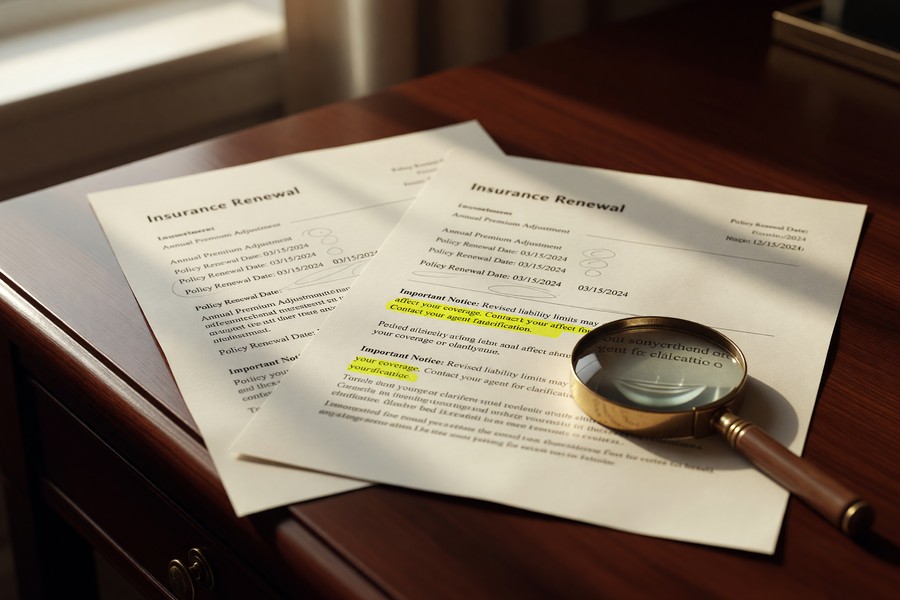
Create a one-page “coverage summary” by pulling the key figures from your dec page: named insureds, coverage limits, deductibles, and endorsement form numbers. Store it digitally and in print. When a claim occurs, you can quickly verify coverage without searching through a full policy document under stress.
Frequently Asked Questions
What is the difference between a declaration page and an insurance policy?
The declaration page is a short summary of your policy’s key terms — who is covered, coverage amounts, and the policy period. The full insurance policy is the complete legal contract, typically 30 to 60 pages, that contains all coverage terms, conditions, and exclusions. The dec page does not override the full policy; if there is a conflict, the full policy language controls. Always read both documents.
Can my insurer deny a claim based on something on the declaration page?
Yes — an insurer can deny a claim if the coverage type, limit, or time period listed on the declaration page does not apply to your loss. For example, if your auto dec page shows your policy expired before your accident date, your claim will be denied. This is why verifying your policy period and coverage types on renewal is essential. Review your dec page at every renewal cycle, not just at initial purchase.
What happens if my name is spelled wrong on my insurance declaration page?
A misspelled name can create legal complications when filing a claim, especially with life insurance or after a lawsuit. The insurer may require additional documentation to verify your identity, which delays payment. Contact your insurer immediately to issue a corrected declaration page — this is a simple administrative fix that costs nothing. Most insurers can correct name errors within one to three business days.
How do I know if I’m underinsured on my homeowners policy?
Compare your Coverage A limit on your dec page to your home’s estimated rebuilding cost — not its market value. Use a free online rebuild cost calculator or ask a licensed contractor or public adjuster to estimate the cost to rebuild your home from scratch. If your Coverage A limit is lower than the rebuild estimate, you are underinsured. Request an “extended replacement cost” endorsement to add a buffer of 25–50% above your stated limit.
Should I have the same deductible for every type of claim on my policy?
Not necessarily — and your declaration page may list different deductibles for different perils whether you realize it or not. A higher deductible on low-risk perils (like theft) can lower your premium, while a lower deductible on high-risk perils (like hail in storm-prone regions) reduces your out-of-pocket risk. Review each deductible line separately on your dec page and match it to your local risk environment and financial situation.
What does “per occurrence” versus “aggregate” mean on an insurance declaration page?
A “per occurrence” limit is the maximum payout for a single claim event. An “aggregate” limit is the maximum payout across all claims in a policy year. For example, a liability policy might show a $1,000,000 per-occurrence limit and a $2,000,000 aggregate limit — meaning no single claim pays more than $1 million, and total annual claims cannot exceed $2 million. This distinction is especially important for small business owners reviewing commercial general liability dec pages.
How do endorsements on a declaration page affect my coverage?
Endorsements either add coverage not included in the base policy (such as scheduled jewelry or water backup) or remove and restrict standard coverage (such as a business pursuits exclusion). Each endorsement is identified by a form number on your dec page. Request the full text of each endorsement from your insurer to understand exactly how it modifies your coverage. Ignoring endorsements is one of the five most common insurance declaration page mistakes.
Can I change my coverage limits after reading my declaration page?
Yes — you can request a mid-term policy change at any time by contacting your insurer or broker. Changes to coverage limits, named insureds, or endorsements take effect as of the date your insurer issues an updated declaration page, not the date you called. Ask for a written confirmation and a new dec page after every change to verify the update was applied correctly. Do not assume a verbal agreement changes your policy.
Do I need a separate declaration page for each type of insurance I own?
Yes — each policy has its own declaration page. Your auto, homeowners, life, and health policies each produce a separate dec page with their own coverage terms. If you have a package or bundle policy (such as an auto and home bundle), you may receive a combined dec page, but coverage for each type is still listed separately. Filing all your dec pages together in one folder makes it much easier to review and compare your total insurance picture.
What should I do if I find an insurance declaration page mistake after a claim is filed?
Document the error immediately and notify your insurer in writing — email with read-receipt or certified mail. If the error was the insurer’s fault (such as a data entry mistake), they are generally obligated to honor the coverage you applied for and paid for. If the error was yours (such as not disclosing all drivers), the resolution depends on your state’s laws and the nature of the discrepancy. Consider hiring a licensed public adjuster or consulting a policyholder attorney if the claim is being denied based on a dec page error.
Sources
- Insurance Information Institute — What Is Covered by Standard Homeowners Insurance
- Insurance Information Institute — Facts and Statistics: Auto Insurance
- Insurance Information Institute — Background on Homeowners Insurance
- National Association of Insurance Commissioners (NAIC) — Consumer Tools and Resources
- FEMA — National Flood Insurance Program (NFIP)
- Consumer Reports — Insurance Coverage Guidance
- United Policyholders — How to Read Your Declaration Page
- NAIC — A Consumer’s Guide to Home Insurance (PDF)
- Consumer Financial Protection Bureau (CFPB) — What Is Homeowners Insurance
- New York State Department of Financial Services — Homeowners Insurance Guide