
Verdict at a Glance
20-year term wins for parents and mortgage holders with obligations lasting 15 years or more, since a single policy beats two back-to-back 10-year terms priced at older ages. Choose 10-year term instead if your financial obligation clears in under 10 years, such as a short-term business loan or a near-empty-nest household.
Updated February 2026
If you’re within 10 years of paying off your mortgage or your youngest child turning 18, buying 20-year term wastes money on coverage you won’t need. But if that timeline runs long, splitting coverage into two 10-year terms almost always costs more in total, because the second policy gets priced at your older, attained age. Check your remaining obligation length before comparing quotes, as outlined in this NAIC consumer guide to term life.
Key Takeaways
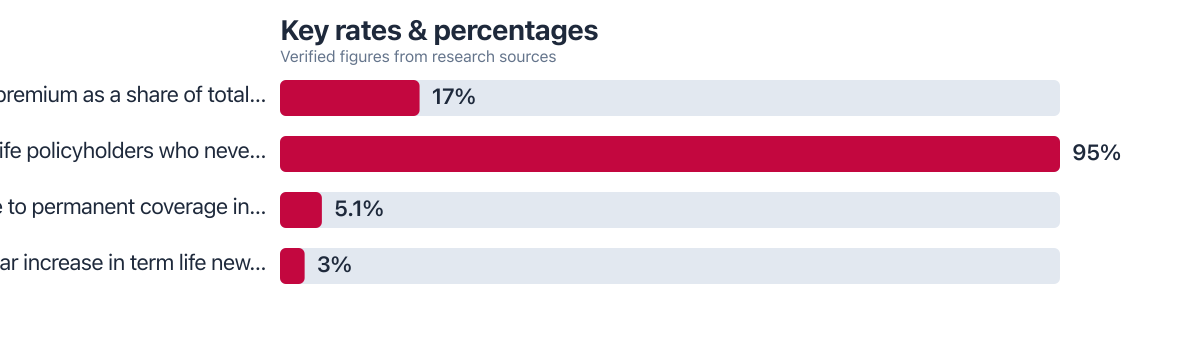
- Term life insurance pulled in $3.1 billion in new annualized premium in 2025, making up 17% of all individual life insurance sales in the U.S., according to LIMRA’s 2025 sales data.
- Adults age 30 and younger overestimate the cost of a $250,000, 20-year level term policy by 10 to 12 times the actual median price, per the 2025 Insurance Barometer Study from LIMRA and Life Happens.
- Approximately 95% of term life policyholders never convert to a permanent policy, based on data from the Society of Actuaries.
- Conversion to permanent coverage is rare, with only 5.1% of 10-year term policyholders converting in the final year, according to the Society of Actuaries Conversion Experience Study.
- Renewal premiums at age 50 or 60 often jump to two to four times the original rate, especially if health has declined since the initial underwriting, per Society of Actuaries research.
- Insurers like Chubb and Travelers reported strong underwriting results in Q2 2026, indicating stable pricing conditions and reduced risk of premium spikes.
Ten-year and 20-year term life policies look similar on paper: both pay a death benefit, both expire at a fixed date, and both skip the cash-value features of whole life. The real difference is how long your premium stays locked and what happens when the clock runs out. In the 10 vs 20 year term decision, term life overall pulled in $3.1 billion in new annualized premium in 2025, making up 17% of all individual life insurance sales in the U.S., according to LIMRA’s 2025 sales data.
The number that flips this decision isn’t your age or your health. It’s the length of your financial obligation. A mortgage with 22 years left, kids who are 2 and 8, or an income-replacement need that stretches past 2036 all point toward 20-year term. Anything shorter, and 10-year term saves real money without leaving you exposed.
| Attribute | 10-Year Term | 20-Year Term |
|---|---|---|
| Annual premium (age 40, $500k, healthy nonsmoker) | $201/year | $321/year |
| Rate lock period | 10 years | 20 years |
| Best fit for obligation length | Under 10 years | 15-25 years |
| Cost per $1,000 of coverage (age 40) | $0.40 | $0.64 |
| Renewal age if re-upped once | 50 | 60 |
| Typical conversion window to permanent | Final 1-2 years | Final 5 years (more flexible) |
| Share who convert to permanent coverage | 5.1% in final year | Similarly low across term lengths |
| Medical exam requirement | Usually required over $250k | Usually required over $250k |
| Best for | Short debts, near-retirees, temporary income gaps | Mortgages, young kids, long income-replacement needs |
How Do 10-Year and 20-Year Term Policies Differ in Cost Over Time?
Twenty-year term costs more per year, but it’s usually the cheaper option over the long run. For a healthy 40-year-old nonsmoker, $500,000 of 10-year term runs about $201 a year, while the 20-year version costs roughly $321 a year, based on 2026 rate averages. That’s a $120 annual gap, or $10 a month, to lock your rate for twice as long.
Run the math on what happens after the 10-year term expires. If that same person renews for another 10 years at age 50, the new premium is priced at the older age and whatever health changes occurred in between. Rates typically climb sharply in that 50-60 age band, often two to three times the original premium, which is why a single 20-year policy purchased at 40 usually beats two consecutive 10-year policies once you add up the total cost through age 60. If you want to see how quoted rates can be misleading before you commit, comparing term life insurance quotes without getting misled is worth doing before locking in either length.
Adults age 30 and younger overestimate the cost of a $250,000, 20-year level term policy by 10 to 12 times the actual median price, according to the 2025 Insurance Barometer Study from LIMRA and Life Happens. That misperception pushes many younger buyers toward shorter, cheaper-looking terms when a 20-year policy would cost far less than they assume.
On this factor: 20-year term wins for anyone keeping coverage past age 50, saving money over the long haul despite a higher sticker price today; 10-year term wins only if the coverage need genuinely ends within a decade, per LIMRA’s 2025 term life data.
How Should Your Financial Obligations Influence Term Length?
Your mortgage and your kids’ ages matter more than your age. If you have 22 years left on a mortgage and children who are 2 and 8, you’re looking at roughly two decades of real financial exposure: income replacement, remaining debt, and years until the youngest is financially independent. A 20-year policy covers that stretch in one purchase.
Laddering is the alternative worth naming directly, since it’s a genuine strategy and not just a fallback. Buying a 10-year term now and a second 10-year term later can lower your average premium during the first decade, when your coverage need might be higher (young kids, larger mortgage balance) and stepping down in the second decade as the mortgage balance and kids’ dependency shrink. But this only works cleanly if you can predict, with reasonable confidence, that your coverage need actually drops by year 10 and that your health won’t have changed enough to spike the second policy’s price. For the 22-year mortgage and 2-and-8 scenario, a single 20-year policy is usually the safer, cheaper default; a 10-plus-10 ladder only wins if you’re confident your needs shrink on schedule and are comfortable underwriting that risk twice.
What Really Happens at the End of a Term Life Policy?
Most term policies expire without ever paying out. In fact, roughly 95% of term life policyholders never convert to a permanent policy, according to Society of Actuaries research on term conversion behavior. That’s not a flaw in the product; it reflects that most people either outlive the need for coverage or replace it with something else before the term ends.
What’s rarely discussed is how thin the conversion rate actually is even in the final stretch of a policy. Conversion to permanent coverage sits at just 5.1% according to Society of Actuaries (Conversion Experience Study) in the last year of 10-year term policies, per the same Society of Actuaries data. That means renewal, not conversion, is what most people actually face: a new term quote priced at their current age, or a permanent policy that costs far more per month. Twenty-year policies typically offer a longer conversion window, often the final five years of the term, giving you more flexibility to lock in permanent coverage before health changes make it unaffordable or unavailable.
Renewal premiums at the end of either term type can jump hard. A policyholder renewing 10-year term at age 50 or 20-year term at age 60 is often quoted two to four times the original rate, sometimes more if a health condition developed. This is the single biggest hidden cost of choosing a shorter term: the assumption that you can just “renew cheaply later” rarely holds up once you’re actually at that age.
On this factor: 20-year term wins by avoiding a costly renewal decade earlier, though neither policy is designed to be renewed indefinitely; per Society of Actuaries conversion data, only 5.1% convert anyway.
How Does Age, Health, and Lifestyle Impact Your Choice?
Being young and healthy right now is the best argument for locking in the longer term. Insurers price term life on your current age and health class, and both tend to get more expensive, not less, as you get older. A 32-year-old in excellent health locking in 20-year term today is essentially freezing today’s low rate through age 52, which is usually the window when health issues start appearing more often.
Family medical history changes this calculation somewhat. If you have a strong family history of a condition that tends to appear in your 40s or 50s, an argument exists for buying as much term as you can afford now, precisely because a future health change could make you rated or uninsurable when you’d otherwise go shopping again. This cuts toward 20-year term, not away from it, since it locks in insurability for longer.
Life events mid-term matter too, and this is where most comparisons fall short. Getting married, having a child, or losing a job during your term doesn’t let you renegotiate your policy length or premium, but it might change how much coverage you need. Most term policies don’t allow you to extend the term itself, only to add a new, separate policy or use a conversion rider if one was included at purchase. If you’re already building coverage around family changes, restructuring an insurance portfolio after a new child arrives is often the more practical fix than trying to alter an existing term policy. Veterans and active military members face their own timing quirks around deployments and SGLI transitions, which is worth reading up on separately if that applies to you, via this piece on term life insurance for veterans and active military members in 2026.
On this factor: 20-year term wins for healthy buyers under 45 who want to lock in insurability, since rates generally only rise with age; 10-year term wins if you expect a major health change that would make longer-term underwriting risky to delay.
What Are the Real Pros, Cons, and Hidden Trade-Offs?
Ten-year term’s real advantage is flexibility at a lower entry price. If your income or obligations are genuinely temporary, such as a business loan with a fixed payoff date or a short gap before a pension kicks in, paying less now and walking away later without a renewal decision is a legitimate win. It also works for buyers layering coverage: someone who already has substantial permanent or workplace coverage might use a 10-year term policy to cover a specific, shorter-term gap without overpaying for length they don’t need.
Twenty-year term’s advantage is that it removes a decision point. You’re not gambling on your health staying good enough to re-qualify at 50, and you’re not exposed to the renewal premium spike that catches a lot of people off guard in their 50s. The trade-off is real, though: if your obligations genuinely shrink faster than 20 years, such as an aggressive mortgage payoff plan or older kids close to independence, you’ll be paying for protection you don’t need in the later years of the policy. That’s not a small thing. Overpaying for unused coverage for a decade adds up, and it’s a legitimate reason some buyers choose to ladder shorter terms instead.
Gender also shapes this comparison more than most guides mention. Premium gaps between men and women widen with term length, since women’s statistically longer life expectancy compounds over a 20-year lock compared to a 10-year one. If you’re quoting policies for a couple, expect the female premium advantage to be somewhat larger on the 20-year product than on the 10-year one, though exact spreads vary by carrier and underwriting class.
On this factor: Neither term wins outright here; 10-year term avoids overpaying for short-term needs, while 20-year term avoids the renewal cliff, so the honest answer depends entirely on your obligation timeline, not a blanket recommendation.
When Is 10-Year Term the Better Option?
- Your mortgage, business loan, or other major debt is scheduled to be paid off within 10 years
- Your children are already teenagers and will be financially independent before the policy would need to renew
- You’re layering coverage: you already have permanent or group life insurance and just need to cover a short income gap
- You’re within 5-8 years of a planned retirement where pension or savings will replace the need for income replacement
- Budget is tight right now and the $120/year premium gap versus 20-year term genuinely matters to your monthly cash flow
When Is 20-Year Term the Better Option?
- Your mortgage has 15 or more years remaining
- You have young children (under 10) whose dependency period will extend well past a decade
- You’re under 45 and in good health, making this the cheapest window to lock in a long rate
- You want to avoid the sharp renewal premium spike that typically hits in your 50s
- You have family health history that could complicate requalifying for coverage a decade from now
| Criteria | 10-Year Term | 20-Year Term |
|---|---|---|
| Cost (near-term) | Lower annual premium | Higher annual premium |
| Cost (long-term, 20-year horizon) | Higher total cost if renewed | Lower total cost |
| Flexibility | Better for short, defined obligations | Less flexible if needs shrink early |
| Renewal risk | High: hits at age 50 for most buyers | Lower: pushed to age 60 |
| Eligibility protection | Must requalify sooner | Locks in insurability longer |
| Overall winner for most families | Situational | Yes, for obligations over 15 years |
Insurers underwriting these policies aren’t standing still either. Chubb reported an 18.8% rise in property and casualty underwriting income in its second quarter of 2026, and Travelers posted similarly strong underwriting results the same quarter. Healthy insurer balance sheets generally support continued competition on term life pricing, though these companies are primarily known for property and casualty lines rather than life insurance specifically. The broader takeaway: 2026 isn’t a year where term life premiums are spiking due to insurer distress, which supports locking in a rate now rather than waiting. This stability is further reinforced by the Federal Reserve’s Z.1 report, which shows strong capitalization in the life insurance sector, including by major players like SoFi and Chase, whose life insurance offerings are backed by robust underwriting models.
What Does a 10-Year + 10-Year Ladder Really Cost?
Take a 35-year-old healthy nonsmoker who needs $500,000 of coverage for 20 years. Buying a 20-year policy today at age 35 locks a premium for the full term, roughly in the $280-$300/year range based on typical 2026 pricing patterns for that age and coverage amount.
Now compare that to buying a 10-year term at 35, then a second 10-year term at 45. The first policy might cost around $180/year at 35. But the second 10-year term, purchased at 45, prices off the older age, plus whatever health changes occurred over that decade. Using the 40-year-old benchmark of $201/year for 10-year term as a reference point, a 45-year-old buying fresh 10-year term would typically pay noticeably more than that, often 30-50% higher depending on the carrier and health class. Even in a best-case scenario where health stays flat, the second policy alone can end up costing close to or more than what the single 20-year policy charged for the entire second decade, on top of what was already paid in the first 10 years. Add it up across 20 years, and the ladder strategy rarely beats a single 20-year policy purchased at the younger age, unless the buyer’s coverage need genuinely drops enough by year 10 to reduce or drop the second policy’s face amount substantially.
Laddering only pays off if you actually reduce your coverage amount at the second purchase. Buying the same face value twice, back to back, almost always costs more than one longer policy bought at the younger age.
How Do I Apply This to Mixed Timelines?
Here’s the scenario that trips up a lot of buyers: a 22-year mortgage with kids ages 2 and 8. Neither obligation cleanly fits a 10-year or 20-year box. The mortgage runs slightly longer than 20 years; the younger child won’t be independent until roughly year 16, and the older one sooner.
In this case, a single 20-year policy is the more defensible default, even though it doesn’t perfectly match the 22-year mortgage. The 2-year gap at the end is minor compared to the risk of needing a second underwriting round at age 55-57, when renewal premiums are steep and health changes are common. Some buyers add a small supplemental 10-year policy now to cover that extra 2 years, layered on top of the 20-year base, rather than trying to force one term length to fit an odd number of years. If your budget allows for a slightly larger 20-year policy instead of stacking two products, that’s usually simpler to manage; if you do want to combine policies, understanding stacking multiple term life insurance policies as a strategy before you buy will help you avoid duplicate underwriting costs. This approach aligns with best practices from the Consumer Financial Protection Bureau (CFPB), which emphasizes transparency and predictable costs in insurance decision-making.
Whichever structure you land on, remember what happens well before payout ever matters: the policy has to be issued correctly, and your beneficiaries need to know how to file a claim years from now. It’s worth reviewing what beneficiaries need to do after a death alongside your policy documents, and understanding what the medical exam actually tests for before you apply, since a surprise finding there can change your quoted rate on either term length. The exam often pulls data from Experian or Equifax to assess risk, and your FICO Score may influence underwriting outcomes, especially for policies over $500k.
FAQs: 10-Year vs 20-Year Term Life Insurance
Is 10-year or 20-year term life cheaper overall?
Twenty-year term costs more per year but is usually cheaper overall if you’d otherwise need to renew a 10-year policy later. A healthy 40-year-old pays about $201/year for 10-year term versus $321/year for 20-year term, but a second 10-year policy purchased at 50 typically costs far more than the $120 annual difference would suggest.
Can I convert a 10-year term policy to permanent life insurance?
Yes, if your policy includes a conversion rider, but the window is usually limited to the final 1-2 years of the term. Very few people use this option: 5.1% convert in the final year of 10-year policies, according to Society of Actuaries data.
What happens if I outlive my 20-year term policy?
Coverage simply ends and no payout is made, which is the outcome for roughly 95% according to Society of Actuaries (via analysis of Conversion Experience Study) of term life policyholders. You can typically apply for a new policy at that point, but premiums will reflect your age and health at renewal, not your original rate.
Should I ladder 10-year and 20-year policies instead of buying one term length?
Laddering can lower costs if your coverage need genuinely shrinks partway through, such as a mortgage that’s half paid off. If your face amount needs stay flat, a single longer term purchased at a younger age usually beats two sequential shorter policies.
Does a 22-year mortgage mean I need a 20-year or longer term policy?
A 20-year policy is usually the practical choice, since the 2-year gap at the end is a smaller risk than needing to requalify for a new policy in your late 50s. Some buyers add a small supplemental term policy to close that final gap instead of stretching for a nonstandard term length.
How much do term life premiums rise if I renew after the term ends?
Renewal premiums are priced at your attained age and current health, and they commonly run two to four times the original rate, especially if health has declined since the initial underwriting, per Society of Actuaries research.
Related reading: Why 35.
Sources
- NAIC, Consumer Guide to Term Life Insurance
- LIMRA, U.S. Individual Life Insurance New Premium Tops $17.5 Billion in 2025
- LIMRA and Life Happens, 2025 Insurance Barometer Study
- MoneyGeek, Longevity and Lapse Rates for Term Life Insurance
- Reinsurance News, Chubb Reports 18.8% Rise in PC Underwriting Income (Q2 2026)
- Reinsurance News, Travelers Posts Strong Q2 2026 Underwriting Results
- Smart Insurance 101, How to Compare Term Life Quotes Without Getting Misled
- Smart Insurance 101, New Parents: Restructure Your Insurance Portfolio
- Smart Insurance 101, Term Life Insurance for Veterans and Active Military Members in 2026
- Smart Insurance 101, Stacking Multiple Term Life Insurance Policies
- Consumer Financial Protection Bureau (CFPB)
- Experian
- Equifax
- FICO Score
- Federal Reserve Z.1 Report, 2026
- Chase
- SoFi