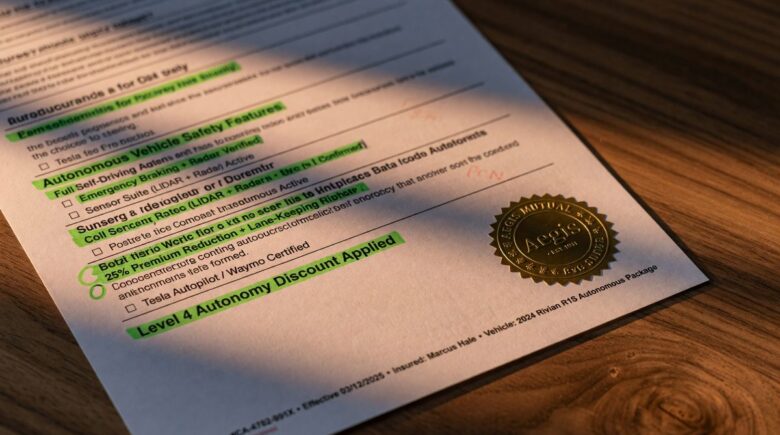
Fact-checked by the Smart Insurance 101 editorial team
The autonomous vehicle car insurance 2026 conversation is generating enormous hype, but the ground truth is more specific than most headlines admit., every consumer vehicle sold in the United States operates at SAE Level 2 autonomy or below, meaning a human driver remains legally responsible behind the wheel. “Full Self-Driving” is a Tesla brand name, not a regulatory classification. That single fact reshapes every question about premiums, liability, and what discounts you can actually expect to receive today.
The financial picture is complicated. The AV insurance market was valued at roughly $15–17 billion in 2025–2026 and is projected to reach $57 billion by 2034, driven almost entirely by commercial fleet and robotaxi products. But on the personal auto side, Fitch Ratings projected in February 2026 that premiums will see modest growth for at least the next decade, because higher per-claim repair costs on sensor-equipped vehicles are largely canceling out any safety-frequency benefit. Meanwhile, the average U.S. vehicle on the road is nearly 13 years old, so fleet turnover alone delays any meaningful premium shift for most households. If you’ve been waiting for autonomous technology to cut your car insurance bill, the timeline is longer than the marketing suggests.
This guide breaks down what is actually happening to car insurance rates in 2026 as ADAS technology spreads, who pays when an autonomous system causes a crash, what the first real mileage-based AV insurance product means for your policy, and the specific questions you should be asking your insurer right now. By the end, you will know exactly which features save you money, which ones cost you more, and what to do about it.
Key Takeaways
- Every consumer vehicle sold in the U.S. is SAE Level 2 or below; no insurer currently prices a policy assuming the car is driving itself.
- Vehicles with advanced sensor arrays typically cost 10–25% more to fully insure than the national average, driven by repair costs rather than accident frequency.
- Lemonade launched the first mile-level AV insurance product in January 2026, offering up to 50% lower per-mile rates for Tesla FSD-engaged miles, but only in Arizona and Oregon.
- California, the largest U.S. EV market, legally bars insurers from using telematics data to set premiums, creating a geographic two-tier system for AV savings.
- The AV insurance market is projected to grow from roughly $16 billion in 2026 to $57 billion by 2034 at a 16% CAGR, with commercial fleet and robotaxi products leading growth, not personal auto.
- Goldman Sachs’s widely cited forecast of insurance costs falling to ~$0.23/mile by 2040 applies to commercial robotaxi operations, not your personal auto premium.
In This Guide
- Where Things Actually Stand in April 2026
- The Repair-Cost Paradox Pushing Premiums Up
- The First Real AV Insurance Product on the Market
- Who Pays When the Algorithm Crashes
- The Over-the-Air Update Liability Problem
- The Cybersecurity Coverage Gap
- Telematics, UBI, and the Data-Ownership Question
- What the Long-Term Forecast Actually Means for Your Premium
- The AV Data-Log Preservation Problem After a Crash
- What Smart Drivers Are Doing Right Now
Where Things Actually Stand in April 2026
Here’s the thing: the way autonomy is marketed to consumers and the way it is defined by engineers and regulators are two completely different things. The SAE International Level 0–5 framework is the standard the industry uses. Level 0 means no automation. Level 2 means the car can handle steering and acceleration simultaneously, but the driver must remain attentive and legally in control at all times. Level 3 means the system can manage all driving tasks in specific conditions, with the human available to intervene. Level 4 and 5 are true autonomy, no human needed in defined or all scenarios respectively.
What Drivers Actually Have in 2026
Every consumer vehicle available for purchase in the U.S. right now tops out at Level 2, with one narrow exception. Tesla’s Full Self-Driving (FSD), which was rebranded following Autopilot’s discontinuation in January 2026, is a Level 2 system despite its name. The driver must keep hands on the wheel and eyes on the road. GM Super Cruise and Ford BlueCruise are also Level 2 systems that allow hands-free driving on mapped highways, but legal responsibility stays with the driver.
The genuine exception is Mercedes Drive Pilot, a certified Level 3 system approved for use in California and Nevada under strict conditions: speeds below 40 mph, mapped highways, and daylight hours without adverse weather. When Drive Pilot is engaged within those parameters, Mercedes has accepted legal liability for a crash. That is a significant milestone. But the conditions narrow the real-world window considerably, and no other manufacturer has received comparable Level 3 certification in the U.S..
Why “Full Self-Driving” Is a Brand Name, Not a Category
The marketing language around autonomy is genuinely misleading, and it creates real insurance risk. Drivers who believe FSD means the car is responsible may reduce their attention. IIHS research shows that hands-free Level 2 systems combining adaptive cruise and lane-centering have shown no aggregate safety benefit yet, partly because documented driver over-reliance offsets the technology’s potential gains. No insurer currently prices a policy on the assumption that the car is driving itself. Every standard auto policy you buy in 2026 treats you as the primary liable party.
Mercedes Drive Pilot is the only consumer vehicle system in the U.S. with Level 3 certification, and it is approved only in California and Nevada, only at speeds below 40 mph, only on mapped highway sections, and only in daylight without adverse weather.
The Repair-Cost Paradox Pushing Premiums Up
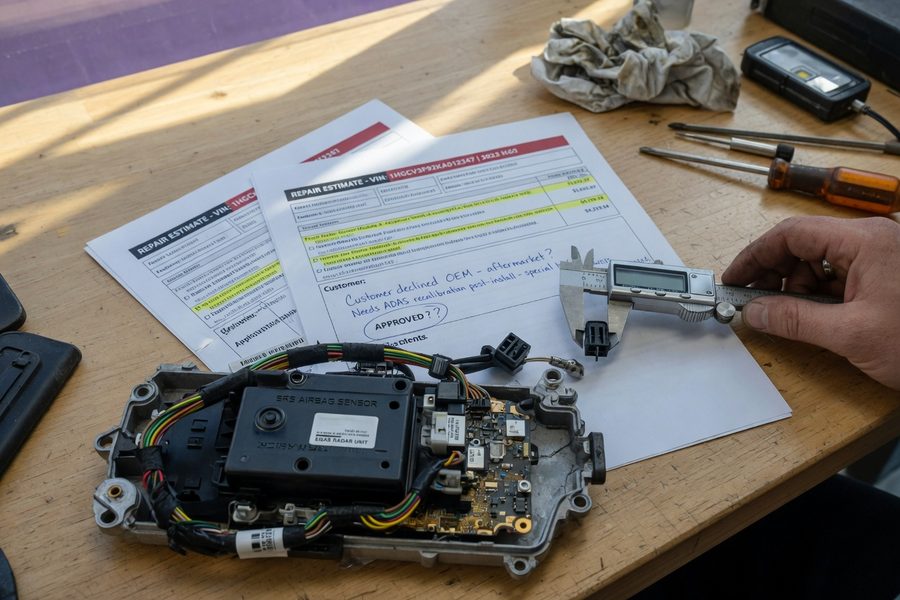
The dominant narrative about autonomous features and insurance is that more safety technology means lower premiums. The data tells a more complicated story. Vehicles equipped with ADAS sensor arrays, cameras, radar, LiDAR, cost significantly more to repair after even minor collisions. A windshield replacement on a standard vehicle once ran around $300. On a vehicle with a mounted camera array requiring post-replacement calibration, that same job now routinely exceeds $1,000. A fender-bender that once cost a few hundred dollars can now trigger LiDAR recalibration, camera array replacement, and radar realignment that collectively push the repair bill into the thousands.
The Net Premium Effect: Higher, Not Lower
Drivers of vehicles with advanced sensor packages typically pay 10–25% more for full coverage than the national average. This premium gap is driven almost entirely by repair cost inflation, not by higher accident frequency. The frequency side of the equation does improve: automatic emergency braking (AEB) reduces rear-end crashes by roughly 50% according to IIHS data. But the discount an insurer passes along for AEB, often 1–5% depending on the carrier, is routinely outweighed by the surcharge applied for the repair complexity of the vehicle’s sensor package as a whole.
The ADAS discount myth deserves direct attention. Some insurers do offer specific discounts for features like AEB or forward collision warning. But these discounts apply to claim frequency. The repair-cost surcharge applies to claim severity. Severity is winning right now. So the typical owner of a late-model ADAS-equipped vehicle pays more in total premium today, not less, compared to a comparable vehicle without those systems. If you want the full picture on why premiums are rising across the board, the broader forces pushing insurance costs up extend well beyond vehicle technology.
IIHS data shows automatic emergency braking cuts rear-end crashes by approximately 50%, yet the repair-cost surcharge on sensor-equipped vehicles adds 10–25% to full-coverage premiums, meaning the net effect for most ADAS drivers is a higher bill, not a lower one.
What Insurers Are Actually Pricing
Insurers underwrite repair cost risk every time they quote a vehicle-specific policy. A vehicle trim with a full sensor suite is a materially different repair risk than the base trim of the same model without those features. This distinction is already baked into how car insurance quotes are calculated, even if the quote tool doesn’t display a line-item called “sensor surcharge.” Understanding this helps explain why two drivers with identical records can get significantly different quotes for seemingly similar cars.
The First Real AV Insurance Product on the Market
Lemonade’s January 2026 product launch is the most concrete development in personal AV insurance to date. The product integrates directly with Tesla’s Fleet API to detect, mile by mile, whether FSD is engaged. When the system is engaged, the driver is charged a per-mile rate up to 50% lower than the standard rate. When the driver is manually in control, standard rates apply. The result is a single policy that prices autonomous and human-driven miles differently, a structural break from traditional annual flat-rate underwriting that has defined auto insurance for over a century.
Why This Product Matters
The significance is not the discount itself. It is the proof of concept. Lemonade has demonstrated that mile-level autonomous pricing is technically feasible using existing vehicle API infrastructure. If Tesla can transmit FSD engagement data to an insurer in real time, any manufacturer with comparable telemetry capability can do the same. This is the architecture that future AV pricing will likely be built on, not actuarial tables based on vehicle model year.
The honest limitation deserves equal weight., the product is available only in Arizona and Oregon. It works only with Tesla FSD. And California, the state with more Tesla registrations than any other, is entirely excluded due to the state’s ban on telematics-based premium pricing. More on that specific barrier below. For drivers outside those two states or outside the Tesla ecosystem, Lemonade’s launch is a meaningful signal about the industry’s direction, not a product they can actually buy today.
If you drive a Tesla and live in Arizona or Oregon, request a specific quote comparison between Lemonade’s FSD-mile product and your current insurer before your next renewal. The potential 50% reduction on FSD-engaged miles can offset some of the repair-cost premium increase common on sensor-equipped vehicles.
Who Pays When the Algorithm Crashes
Liability is the central legal question in AV insurance, and the answer differs significantly depending on what level of autonomy was active at the time of a crash. The framework is cleaner in theory than in practice.
Liability by Autonomy Level
| SAE Level | System Example | Who Bears Primary Liability |
|---|---|---|
| Level 2 | Tesla FSD, GM Super Cruise, Ford BlueCruise | Human driver, fully responsible |
| Level 3 | Mercedes Drive Pilot (CA and NV) | Manufacturer (Mercedes) when system is engaged in approved conditions |
| Level 4 | Waymo robotaxi, autonomous freight | Commercial operator and/or OEM; no personal auto policy involved |
| Level 5 | Not commercially deployed | Fully manufacturer/operator; no human driver liability |
The multi-party liability problem becomes real when a crash involves a Level 2 or Level 3 vehicle and multiple potential defendants: the vehicle owner, the fleet operator, the original equipment manufacturer (OEM), and the software provider. Traditional auto policies were designed around a single responsible driver. Adjudicating a claim across four potential defendants using a policy written for one is a process that courts and insurers are still working through. This complexity adds time and legal cost to AV-related claims, which eventually flows into premium pricing.
The Waymo Benchmark
Waymo surpassed 170 million cumulative fully driverless miles with zero serious crashes reported, a safety record that is genuinely impressive and forms the strongest statistical argument for eventual premium reduction at scale. But Waymo operates at Level 4 on defined routes with commercial-grade sensor packages and 24/7 remote oversight. That operational profile has almost nothing in common with a consumer driving a Level 2 vehicle on an unmapped rural highway. Citing Waymo’s record to predict personal premium relief conflates two very different insurance categories. For more on how liability insurance works in multi-party scenarios, that structural question is relevant well beyond the AV context.
The National Association of Insurance Commissioners (NAIC) has specifically flagged the need for a legal and regulatory framework to determine whether a human occupant or vehicle manufacturer is at fault in an autonomous-mode crash, a question that remains unresolved under federal law.
The Over-the-Air Update Liability Problem
Here’s the thing: this is the issue almost no one in the insurance industry is talking about publicly, and it is one of the most structurally significant problems in AV underwriting. An insurer prices your policy based on the vehicle’s risk profile at the time of underwriting. Software version 4.2 has a specific behavior set, collision avoidance logic, and speed-handling parameters. On Tuesday night, the manufacturer pushes an over-the-air (OTA) update to version 4.3. The risk profile of your vehicle has materially changed. Your annual policy has not.
This is not a hypothetical. Tesla, GM, and Ford all push OTA updates to vehicle systems on rolling schedules without requiring driver opt-in for safety-critical software changes. A post-update crash raises an immediate question: was the vehicle insured for the behavior of version 4.3, or the version the insurer priced? No standard personal auto policy currently contains a clause addressing OTA updates as a change in insured risk. That gap leaves both the driver and the insurer in legally ambiguous territory when a crash follows an update that altered how the system behaves.
The practical advice here is simple, if uncomfortable. Ask your insurer directly whether your policy covers liability arising from a crash that occurred after an OTA software update changed your vehicle’s autonomous behavior. In most cases, they will not have a policy-specific answer yet. That response itself tells you something important about where the industry stands.
If your vehicle receives an OTA software update that alters autonomous driving behavior and you are involved in a crash shortly afterward, document the pre-crash software version immediately. Your insurer’s liability assessment may hinge on which version was running at the time of the incident, and most policies contain no clause specifically addressing this scenario.
The Cybersecurity Coverage Gap
Standard auto insurance policies were written when cars had no internet connection and no remote-access vulnerability. That assumption no longer holds. A connected, sensor-equipped vehicle can, in principle, be compromised through a remote hack, GPS spoofing, or a corrupted OTA update that causes the vehicle’s navigation or braking system to malfunction. The resulting collision would be a physical event with bodily injury, exactly what a standard auto policy covers. But the initiating cause would be a cyber event, which most standard auto policies explicitly exclude or simply do not address.
Where Coverage Breaks Down
The gap is concrete: cyber liability policies cover data breaches and digital losses. Standard auto policies cover physical collisions. When a cyber event causes a physical accident, the two policies point at each other and neither clearly responds. Claimants have found themselves in gray areas where cyber insurers deny physical injury claims and auto insurers deny cyber-origin claims. The Insurance Information Institute notes that the growth of self-driving capabilities within certain conditions will require insurers to rethink how coverage categories are defined, but that rethinking has not yet produced standardized policy language at the consumer level.
What to Ask Your Insurer Now
Two specific questions are worth raising at your next policy review. First: does your comprehensive coverage respond to a physical loss caused by a remote hack of your vehicle’s systems? Second: does your policy cover a loss caused by GPS spoofing or a corrupted software update? Most agents will not have a clear answer, which points to the need for a written clarification or endorsement. This is a live coverage gap, not a future concern.

Telematics, UBI, and the Data-Ownership Question
Usage-based insurance (UBI) programs have existed for over a decade. The idea is straightforward: instead of pricing a policy on demographic proxies (age, zip code, credit score), an insurer uses actual driving behavior data, miles driven, braking patterns, time of day, to price risk more precisely. Autonomous vehicles accelerate this model’s relevance dramatically, because the vehicle already generates granular sensor and trip data. The technical barrier to per-mile AV pricing is largely solved. The legal and commercial barriers are not.
Who Owns the Data?
The vehicle manufacturer, the insurer, and the driver all have competing claims to the sensor and trip data that would enable accurate AV pricing. The OEM collected it through vehicle systems. The insurer needs it to underwrite the risk. The driver generated it with their behavior. No federal standard currently resolves who controls that data, who can sell it, or under what conditions an insurer can require access to it as a condition of coverage. Several states have passed data privacy laws with implications for vehicle data, but the patchwork is inconsistent and still evolving.
| State | Telematics for Pricing | Effect on AV Discounts |
|---|---|---|
| California | Banned for premium pricing | FSD-mile discounts unavailable; Lemonade product excluded |
| Arizona | Permitted | Lemonade FSD product available; up to 50% per-mile discount |
| Oregon | Permitted | Lemonade FSD product available; up to 50% per-mile discount |
| Most Other States | Permitted with disclosure | Standard UBI discounts available; AV-specific products not yet launched |
California’s telematics ban deserves direct attention because it creates a concrete, named inequity. The state with the highest number of Tesla registrations and the largest EV market in the U.S. legally prohibits insurers from using telematics data to set premiums. That means a Tesla driver in Los Angeles with 50,000 FSD-engaged miles cannot access the discount a comparable driver in Phoenix can. The same technology, the same behavior, two different pricing regimes based entirely on geography. If you are shopping for coverage and want to understand how to compare what’s available to you, a structured car insurance quote comparison approach helps clarify which discounts actually apply in your state.
The AV insurance market is projected to grow from roughly $16 billion in 2026 to $57 billion by 2034 at a 16% CAGR, but this growth is concentrated in commercial fleet, robotaxi, and cyber-liability products, not in personal auto lines.
What the Long-Term Forecast Actually Means for Your Premium
Two forecasts dominate the autonomous vehicle insurance conversation, and both are routinely misread. Goldman Sachs projects that insurance costs per mile will fall from roughly $0.50 today to approximately $0.23 by 2040. That figure is cited constantly as evidence that autonomous technology will cut your car insurance bill nearly in half. The critical context almost always left out: this projection applies to commercial robotaxi operations, not to personal auto premiums. Robotaxi insurance is priced per commercial mile on a purpose-built vehicle with professional-grade sensors. It has nothing in common with a consumer annual policy on a family sedan.
The Personal vs. Commercial Lines Distinction
| Insurance Type | AV Impact Timeline | Driving Factor |
|---|---|---|
| Commercial Robotaxi | Already evolving (2024–2026) | Per-mile pricing, high-volume data, OEM liability acceptance |
| Commercial Fleet/Freight | Significant change by 2028–2030 | Autonomous freight reduces driver-error claims at scale |
| Personal Auto (ADAS-equipped) | Modest increase now; slow improvement post-2030 | Repair-cost inflation outpacing frequency gains through 2030 |
| Personal Auto (standard) | Minimal AV-related change before 2035 | Fleet turnover takes 12–15 years; older vehicles dominate |
Fitch Ratings projected in February 2026 that personal auto premiums will see modest continued growth for at least the next decade. The reasoning is specific: higher repair costs per claim are offsetting frequency reductions from ADAS features. Until repair technology catches up with sensor technology, or until sensor repair becomes modular and cheaper, the per-claim cost trend runs counter to the per-accident-frequency trend. The net result is premium growth, not decline. For anyone wondering whether this fits within a broader pattern of rising insurance costs, the forces driving insurance premiums higher include repair inflation, litigation costs, and reinsurance pricing that extend far beyond autonomous vehicles.
The 13-year average age of vehicles on U.S. roads reinforces this timeline. Even if every new car sold from 2027 onward had Level 4 capability, the majority of vehicles being driven in 2035 would still be older models without those systems. Population-level premium effects require population-level fleet turnover. That takes time.
The AV Data-Log Preservation Problem After a Crash
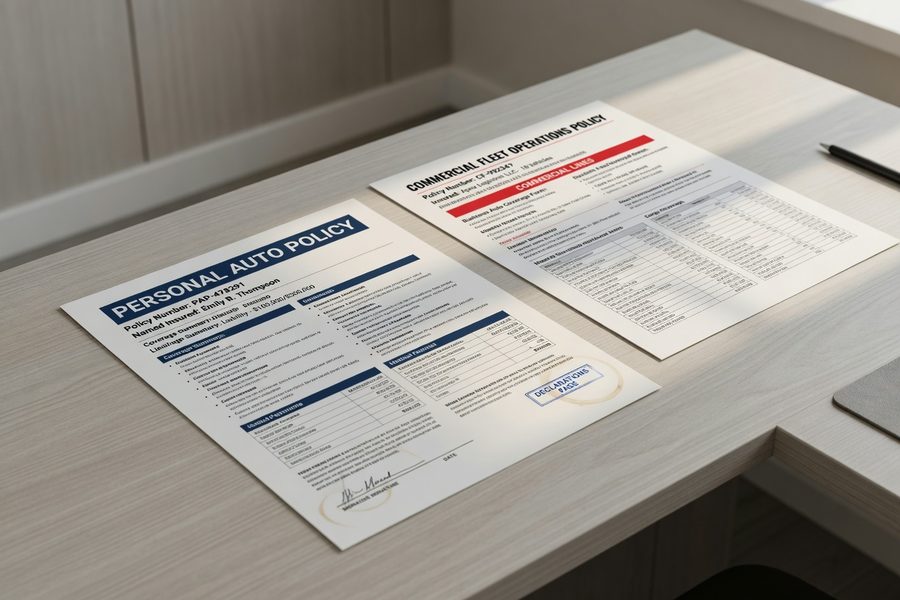
This is a risk that is almost entirely absent from mainstream AV insurance coverage, and it is immediately actionable. When a crash occurs involving a vehicle in autonomous or semi-autonomous mode, the vehicle’s onboard sensor logs, camera feeds, LiDAR point-cloud data, radar returns, system state records, are the primary evidence for any manufacturer-liability claim. These logs can establish whether the autonomous system was engaged, what inputs it received, and what decisions it made in the moments before impact.
The problem is data retention. Vehicle systems do not store sensor log data indefinitely. Many systems overwrite logs on a rolling basis, with retention windows measured in days or weeks, not months. If a driver involved in an autonomous-mode crash waits for the insurance claims process to move at its normal pace before anyone preserves that data, the primary evidence for a potential manufacturer-liability claim may be permanently overwritten. The practical step is immediate: contact your attorney or insurer within 24 hours of any crash involving autonomous mode engagement, specifically request preservation of all vehicle sensor logs and system state data, and follow up in writing. Do not assume the data will still be there when you need it.
What Smart Drivers Are Doing Right Now
The gap between AV marketing and AV insurance reality is wide, but it is navigable with the right information. Drivers of ADAS-equipped vehicles, Tesla FSD users, and anyone shopping for coverage on a late-model vehicle have specific, concrete actions available right now that can materially affect both their coverage quality and their premium. The most effective ways to reduce your auto insurance costs in 2026 require understanding which features actually help and which ones cost you more.
Do not assume that because your vehicle has advanced safety technology, your insurer has priced that benefit into your premium. In most cases, the repair-cost surcharge for sensor-equipped vehicles is built in; the frequency-reduction discount may not be, unless you specifically request it and your policy confirms it in writing.
| Driver Profile | Key Coverage Question | Action |
|---|---|---|
| Tesla FSD User in AZ or OR | Am I paying for FSD-miles at standard rates? | Compare Lemonade’s per-mile product at next renewal |
| Tesla FSD User in CA | Can I access telematics-based discounts? | No, state law bars it; focus on other discount categories |
| Any ADAS-Equipped Driver | Am I paying a repair-cost surcharge? | Request itemized quote; compare against base-trim equivalent |
| Any Connected Vehicle Owner | Does my policy cover cyber-origin physical losses? | Ask for written clarification or a cyber-physical endorsement |
| Any AV-Mode User | Does my policy address OTA update liability? | Ask insurer directly; document their response |
The Insurance Information Institute notes that as autonomous capabilities expand, the fundamental question of whether insurance will shift from personal auto lines to commercial product liability coverage, where manufacturers bear primary risk, is still unresolved and will likely require legislative action to settle definitively.
Real-World Example: The ADAS Premium Paradox
Consider an illustrative example: a driver in Phoenix, Arizona purchases a mid-size SUV with a full ADAS package including forward collision warning, automatic emergency braking, adaptive cruise control, and lane-centering. The vehicle’s base trim, without those features, would carry a full-coverage annual premium of approximately $1,650. The ADAS-equipped trim, same driver profile, same zip code, comes in at $1,960, a $310 annual increase, or roughly 19% more.
The insurer offers a 4% discount for the vehicle’s AEB system, saving approximately $78 per year. But the repair-cost surcharge for the sensor package adds $388 to the annual premium. Net effect: the driver pays $310 more per year for the ADAS-equipped vehicle, even after the safety discount. Over five years, that is $1,550 in additional premium costs. The features are genuinely reducing crash frequency, but the driver is not seeing that reduction reflected in their net premium.
Now consider the same driver switches to a Tesla Model Y with FSD and relocates to Phoenix. They compare Lemonade’s FSD-mile product against their current insurer. They drive approximately 12,000 miles per year; they estimate roughly 60% of those miles on mapped highways where FSD is engaged. At standard rates of $0.06/mile, their annual premium would total $720. On Lemonade’s hybrid model, they pay $0.06/mile for the 4,800 manually-driven miles ($288) and roughly $0.03/mile for the 7,200 FSD-engaged miles ($216), for a total of $504 annually.
The saving is real: $216 per year, or about 30% less than standard per-mile pricing. But it still does not fully offset the higher repair-cost premium that comes with owning a sensor-equipped vehicle in the first place. The before-and-after picture here is not “ADAS saves you money” but “FSD-specific telematics pricing partially recovers costs that ADAS repair complexity created.” That distinction matters for anyone budgeting their total cost of ownership.
Your Action Plan
-
Identify your vehicle’s actual SAE autonomy level
Look up your vehicle’s ADAS features using the manufacturer’s specifications or the NHTSA vehicle safety database. Confirm whether your system is Level 2 (driver always responsible), Level 3 (manufacturer liability in specific conditions), or something in between. This determines your liability exposure before you evaluate any policy.
-
Request an itemized premium breakdown from your insurer
Ask your insurer to identify which line items in your quote reflect repair-cost surcharges for sensor-equipped vehicles and which reflect safety-feature discounts. If the discount is not explicitly applied, ask why. Some carriers will apply AEB or forward-collision discounts only if requested, not automatically.
-
Ask specifically about OTA update liability
Contact your insurer or broker and ask in writing whether your policy covers a crash that occurs after an over-the-air software update changed your vehicle’s autonomous driving behavior. Document their response. If the answer is unclear, ask for a policy endorsement or a written clarification.
-
Clarify your cyber-physical coverage
Ask whether your comprehensive policy responds to physical losses caused by a remote hack, GPS spoofing, or a corrupted software update. If it does not, ask whether a cyber-physical endorsement is available. This is a live coverage gap on most standard personal auto policies.
-
Check your state’s telematics rules before shopping UBI products
If you live in California, telematics-based pricing is banned, meaning FSD-mile discounts and most UBI products are unavailable to you regardless of your vehicle or driving behavior. In Arizona, Oregon, and most other states, UBI discounts are available. Know your state’s rules before spending time comparing UBI quotes that may not apply to you.
-
If you’re a Tesla FSD driver in Arizona or Oregon, compare Lemonade’s product
Use Lemonade’s quoting tool alongside your current insurer’s renewal quote. Estimate your annual FSD-engaged miles versus manual miles. If more than half your driving occurs on mapped highways where FSD is typically active, the per-mile savings can be substantial, potentially 20–30% below your standard per-mile rate on a full-year basis.
-
Establish a data-preservation protocol for any crash involving autonomous mode
Before you ever need it, know this: if your vehicle is in autonomous or semi-autonomous mode during a crash, contact your attorney or insurer within 24 hours and specifically request preservation of all onboard sensor logs, system state data, and software version records. Vehicle systems overwrite logs on rolling schedules; delay can permanently destroy the evidence needed to establish manufacturer liability.
-
Revisit your policy at each annual renewal for new AV-specific products
The AV insurance market is moving faster than the annual policy cycle. Products that do not exist in your state or for your vehicle today may be available twelve months from now. Set a calendar reminder to spend 30 minutes at each renewal specifically researching whether any new AV-specific pricing programs have launched in your state. The fundamentals of auto insurance coverage remain stable, but the discount landscape for AV features is evolving quickly.
Related reading: Why Your Auto Insurance Premium Jumped 30% in 2026, Even With a Clean Record.
Frequently Asked Questions
Does owning a car with autonomous features lower my insurance premium?
Not necessarily, and for most drivers right now, the answer is no. Specific features like automatic emergency braking can earn a modest discount, typically 1–5% depending on the carrier, but the repair-cost surcharge for vehicles with sensor arrays routinely adds 10–25% to full-coverage premiums. The net effect for most ADAS-equipped vehicle owners is a higher total premium, not a lower one. That may change over the next decade as repair technology matures, but it is the current reality.
Is Tesla’s Full Self-Driving system actually autonomous?
No, in the regulatory sense. Tesla FSD is an SAE Level 2 system, which means the human driver must remain attentive and legally in control at all times. The name “Full Self-Driving” is a brand designation, not a regulatory classification. No insurer currently prices a policy on the assumption that FSD is operating the vehicle. You are still the legally liable party when FSD is engaged.
What happens to my insurance if my car gets a software update overnight?
This is a genuinely open question in current insurance law, and it is one of the most important coverage gaps to understand. Your annual policy was underwritten based on your vehicle’s characteristics at the time of the quote. An OTA update that materially changes how your autonomous system behaves creates a mismatch between the insured risk and the current risk. No standard personal auto policy currently contains a clause specifically addressing this scenario. Ask your insurer directly, and get their response in writing.
Can my car be hacked, and would my insurance cover the resulting crash?
Most standard auto policies do not clearly respond to a physical collision caused by a cyber event such as a remote hack, GPS spoofing, or a corrupted software update. Cyber liability policies cover data losses; auto policies cover physical collisions. When a cyber event causes a physical accident, claimants have found themselves in gray areas where neither policy clearly responds. Ask your insurer whether a cyber-physical endorsement is available on your policy.
What is Lemonade’s AV insurance product, and can I get it?
Lemonade launched a product in January 2026 that integrates with Tesla’s Fleet API to detect FSD engagement mile by mile, charging up to 50% lower per-mile rates for FSD-engaged miles versus manually-driven miles., the product is available only in Arizona and Oregon and applies only to Tesla FSD-equipped vehicles. California residents cannot access it due to the state’s ban on telematics-based premium pricing.
Will autonomous vehicles eventually reduce car insurance costs?
Yes, but the timeline is much longer than popular coverage suggests, and the near-term benefit will hit commercial lines first. Fitch Ratings projected in February 2026 that personal auto premiums will see modest continued growth for at least the next decade. Goldman Sachs’s widely cited projection of insurance costs falling to ~$0.23/mile by 2040 applies to commercial robotaxi operations, not personal auto. The average U.S. vehicle on the road is nearly 13 years old, so even rapid new-vehicle adoption takes over a decade to shift population-level risk.
Who is liable if a Level 3 autonomous vehicle causes a crash?
When Mercedes Drive Pilot is engaged within its approved conditions, below 40 mph, on mapped California or Nevada highways, in daylight without adverse weather, Mercedes has accepted liability. Outside those conditions, or when the driver should have taken control and did not, liability shifts back to the driver. For Level 2 vehicles like Tesla FSD, GM Super Cruise, and Ford BlueCruise, the driver is fully liable regardless of whether the system was engaged.
Why is California excluded from AV insurance discounts?
California’s insurance regulations prohibit insurers from using telematics data, real-time driving behavior and mileage information collected from vehicle sensors, to set premiums. This ban was designed to prevent discriminatory pricing based on where and when people drive. The unintended consequence is that Tesla drivers in California cannot access mileage-based FSD discounts available to identical drivers in Arizona or Oregon. The regulatory intent was consumer protection; the practical effect is exclusion from the most significant AV-related pricing innovation currently on the market.
What should I do immediately after a crash if my car was in autonomous mode?
Contact your attorney or insurer within 24 hours and specifically request preservation of all onboard sensor logs, camera data, system state records, and software version information from the time of the crash. Do not assume this data will be available when the claims process gets to it. Vehicle systems overwrite sensor logs on rolling schedules, sometimes within days. That data is the primary evidence for any manufacturer-liability claim, and it may be permanently lost if not preserved immediately. This is one of the most concrete, time-sensitive actions an AV driver can take to protect their legal position.
Sources
- National Association of Insurance Commissioners, Autonomous Vehicles and Insurance
- Insurance Information Institute, Background on Self-Driving Cars and Insurance
- Insurance Institute for Highway Safety, Advanced Driver Assistance Systems
- SAE International, Taxonomy and Definitions for Terms Related to Driving Automation Systems (J3016)
- Waymo, Research and Safety Reports
- Fitch Ratings, U.S. Auto Insurance Outlook 2026
- California Department of Insurance, Auto Insurance FAQs and Telematics Regulations
- NAIC, Automated Vehicles and Insurance White Paper


