Fact-checked by the Smart Insurance 101 editorial team
Quick Answer
Usage-based car insurance uses telematics technology (a plug-in device, mobile app, or embedded vehicle system) to score your driving and adjust your premium. Programs typically weigh hard braking, nighttime driving, and total mileage most heavily. Safe drivers can save an average of $328 per year with programs like Progressive Snapshot, though high-risk patterns can trigger rate increases.
Usage-based car insurance (UBI) replaces traditional actuarial guesswork with real behavioral data. Instead of estimating risk from your ZIP code and credit score, the insurer monitors how you actually drive, then prices your policy accordingly. According to the National Association of Insurance Commissioners (NAIC), UBI uses information about your driving behavior to determine your premium, as opposed to traditional auto policies that rely on actuarial analysis of data like driving record, vehicle type, and insurance credit score.
For drivers who log few miles or drive conservatively, that shift can mean real savings. For everyone else, understanding the scoring system before enrolling matters far more than most people realize.
Key Takeaways
- UBI programs monitor behavior over a defined window, typically 90 to 180 days, and that scored result can affect your rate for multiple renewal cycles, per the NAIC’s UBI overview.
- Progressive Snapshot defines a hard brake as any deceleration faster than 7 mph per second, one of the few concrete scoring thresholds disclosed publicly by any major carrier.
- Safe drivers who qualify under Progressive Snapshot save an average of $328 per year, but the program can also produce a surcharge for poor scores.
- Telematics data may be retained for 2 to 5 years after a policy ends and can be shared with third-party vendors, depending on the program and your state’s privacy rules.
- OBD-II plug-in devices cannot identify who is driving, meaning a household member’s poor driving directly affects the primary policyholder’s score, per the Washington State Office of the Insurance Commissioner.
- California residents have explicit opt-out rights over their driving data under the CCPA; most other states provide significantly weaker protections.
What Usage-Based Insurance and Telematics Actually Are
Telematics is the technology layer that makes usage-based insurance possible. The Washington State Office of the Insurance Commissioner defines it as auto insurers monitoring and tracking your driving behavior to determine your premium using technology such as mobile apps or devices that track miles, time of day, location, rapid acceleration, and hard braking.
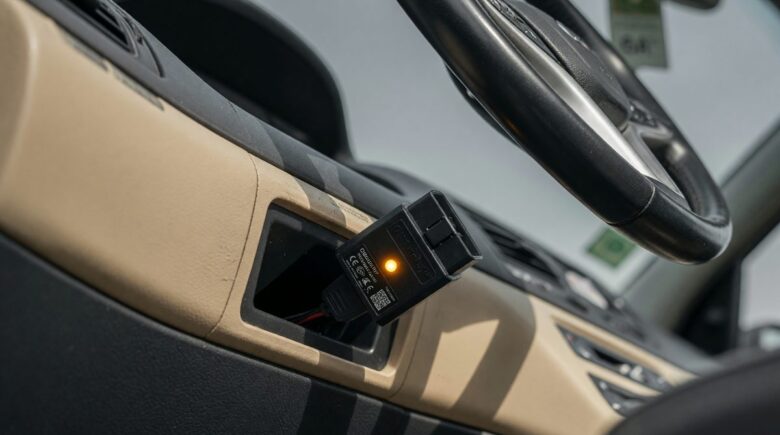
Three delivery methods are in common use today. A plug-in OBD-II dongle (like Progressive’s Snapshot device) connects to the diagnostic port beneath your steering column. A smartphone app (like State Farm’s Drive Safe & Save or Allstate’s Drivewise) uses your phone’s GPS and accelerometer. Newer vehicles may use an embedded telematics system built directly into the car by the manufacturer. The underlying data each method captures is broadly similar; the difference is hardware versus software and how easily the monitoring can be disabled.
Traditional pricing relies on demographics and history. UBI pricing relies on observed behavior during a defined monitoring window, typically 90 to 180 days. That distinction is worth understanding before you sign up, because the monitoring period is finite but its consequences are not.
Key Takeaway: Telematics programs from insurers like Progressive, State Farm, and Allstate collect driving data over a defined window (often 90–180 days) via OBD dongles, smartphone apps, or embedded vehicle systems, replacing demographic-based pricing with observed behavior. See the NAIC’s UBI overview for a plain-language breakdown.
How Telematics Devices and Apps Gather Your Driving Data
The sensors doing the actual work depend on the delivery method, but the core data streams are consistent across programs. GPS tracks location and calculates speed. An accelerometer (built into both OBD devices and smartphones) detects rapid acceleration and sudden deceleration. Gyroscopes help distinguish a sharp lane change from road vibration. Apps can also detect phone interaction events, flagging screen activity during trips as potential distracted driving.
What Gets Recorded (and What Doesn’t)
Most programs do not record audio or video. Insurers generally collect timestamped trip data rather than a continuous real-time feed, meaning data is batched and uploaded via cellular or Wi-Fi at intervals. One practical implication: the insurer may not know your exact route in real time, but they do retain a record of where and when every trip occurred.
Driver identification is a real gap in the system. OBD devices cannot distinguish who is behind the wheel, so a teenager borrowing the family car affects the primary policyholder’s score. App-based programs sidestep this partially by tying monitoring to a specific phone, but only if one driver uses the vehicle consistently.
Key Takeaway: Telematics captures GPS location, speed, acceleration, and phone interaction data, but most programs cannot confirm who is driving. If multiple people share your vehicle, every driver’s behavior affects your score. Review the Washington State OIC’s telematics guide for a clear summary of what is tracked.
The Behaviors That Feed Into Your Driving Score
Hard braking, nighttime driving, and total mileage are the three factors that appear most consistently across programs. A Consumer Federation of America analysis of multiple programs confirmed these as the dominant variables, with location data added by Allstate, Geico, and USAA in some cases.
Progressive’s Snapshot program is one of the few to disclose a concrete threshold: a hard brake is defined as any deceleration faster than 7 mph per second. That is roughly the force of a firm but not panicked stop. The program primarily weights hard brakes per mile driven, hours driven between midnight and 4 a.m., and total miles driven. Rapid acceleration is tracked but weighted less heavily in most published descriptions of the program.
The Factors Insurers Weight Differently
No insurer publishes the exact formula. The NAIC Center for Insurance Policy and Research has noted that precise algorithm weightings remain proprietary across the industry, which means a driver cannot calculate their own score with certainty. What you can do is focus on the factors that appear in every program: brake gently, avoid late-night driving, and keep total miles reasonable.
Distracted driving detection, typically measured as phone screen interaction during a moving trip, is increasingly common in app-based programs. Some programs differentiate between a handheld call and a single screen unlock; others do not. State rules on how phone-use data can factor into pricing vary, and not all insurers disclose which specific interactions trigger a flag.
| Behavior Factor | Progressive Snapshot | State Farm Drive Safe & Save | Allstate Drivewise |
|---|---|---|---|
| Hard Braking Threshold | >7 mph/sec deceleration | Not publicly disclosed | Not publicly disclosed |
| Nighttime Hours Penalized | Midnight–4 a.m. | Not specified publicly | Not specified publicly |
| Mileage Tracked | Yes (per mile weighting) | Yes (primary factor) | Yes |
| Phone Use Detection | Yes (app version) | Yes | Yes |
| Location Data Used | No (per policy terms) | No | Yes (some states) |
| Monitoring Period | ~6 months | Ongoing (discount recalculated) | Ongoing |
Key Takeaway: Progressive Snapshot’s disclosed hard-braking threshold of 7 mph per second is one of the few concrete benchmarks made public. Most carriers keep exact weightings proprietary, so focusing on the three universal factors (braking, nighttime hours, and mileage) is the most defensible strategy for any program. Learn more about how these factors connect to car insurance quote factors.
How Insurers Convert Scores Into Premium Adjustments
Most programs apply an initial participation discount just for enrolling, often between 5% and 10%, regardless of driving behavior. After the monitoring window closes, the insurer recalculates and applies a discount or surcharge based on your scored performance. That adjusted rate then persists at renewal even after the device or app is removed.
Progressive reports that Snapshot participants who qualify save an average of $328 per year. The caveat: drivers with poor scores can see their rates increase. The program does not guarantee a discount; it guarantees a score-based adjustment, which can go in either direction.
The score-to-rate translation is opaque by design. All major programs keep the precise formula proprietary, so no external source can verify exactly how a specific braking event translates into a dollar amount. What is documented is the structure: participation credit up front, behavioral score applied at renewal, static rate adjustment that follows you into subsequent policy terms. If you drive poorly during the monitoring window, that surcharge can persist for one or more renewal cycles even after monitoring ends. That is the detail most enrollees do not anticipate.
For drivers already working to lower their premiums, it is worth reviewing other strategies to reduce your auto insurance costs alongside telematics enrollment, since UBI is one tool among several.
Key Takeaway: Telematics discounts average $328 per year for qualifying Progressive Snapshot participants, but a poor monitoring-period score can result in a surcharge that persists beyond the monitoring window. Enrollment guarantees evaluation, not savings. See why insurance premiums are rising for broader context on rate pressures.
Privacy, Data Sharing, and Long-Term Retention Realities
Driving data does not stay neatly contained. Insurers may share aggregated or anonymized trip data with third-party analytics vendors, reinsurers, or data brokers, depending on the program’s privacy policy and the state in which you live. Retention periods after a policy ends are rarely disclosed prominently; some carriers retain raw trip data for two to five years.
According to John Davisson, Senior Counsel and Director of Litigation at the Electronic Privacy Information Center (EPIC), privacy policies for data-collection programs are often so lengthy and technically complex that even legal professionals can struggle to parse them. His guidance: look for programs that collect the minimum data necessary to provide the service, and treat any policy that does not explicitly prohibit selling driving data as one that may permit it.
State-level protections vary considerably. California’s Consumer Privacy Act gives residents explicit rights to opt out of the sale of their personal data, including driving data. Most other states offer weaker protections. Before enrolling, read the program’s privacy policy specifically for these terms: data retention period, third-party sharing, whether anonymized data may be sold, and your rights upon canceling the policy.
The Consumer Reports telematics analysis highlights that privacy policies for these programs are often lengthy and difficult to parse, even for legal professionals. If the policy does not explicitly state that driving data will not be sold to third parties, assume it may be. For further reading on how different types of insurance collect and use personal data, the overview of insurance types and their benefits provides useful context on how insurers structure these programs broadly.
Key Takeaway: Telematics data can be retained for 2–5 years after a policy ends and may be shared with third-party vendors depending on your state’s privacy rules. California residents have stronger opt-out rights under the CCPA; most other states do not. Always read the data-sharing clause before enrolling, per guidance from the NAIC’s consumer telematics resource.
Frequently Asked Questions
Can a telematics program increase my car insurance rate?
Yes. Most programs offer a participation discount for enrolling, but your final rate depends on your driving score. Poor scores, particularly from frequent hard braking or late-night driving, can result in a surcharge at renewal. That adjusted rate may persist for one or more policy cycles even after the monitoring period ends.
Does a bad score during the monitoring window affect future renewals permanently?
Not permanently, but the impact can last. Most programs recalculate your rate at each renewal based on the most recent monitoring data. If you were scored during the initial window and monitoring stopped, the resulting discount or surcharge typically carries forward until the next evaluation opportunity. Some programs allow re-enrollment to improve your rate.
Which driving behaviors matter most in a telematics program?
Hard braking, nighttime driving (typically midnight to 4 a.m.), and total miles driven are the three factors confirmed across the most programs. Progressive Snapshot specifically defines a hard brake as deceleration exceeding 7 mph per second. Phone use during driving is tracked by app-based programs and weighted differently by each insurer.
Is my location data shared or sold when I use a telematics app?
It depends on the insurer and your state. Programs like Allstate Drivewise use location data in some states; others, like Progressive Snapshot, state they do not use GPS location for scoring. Even when location is not used for scoring, it may still be collected and stored. Review the program’s privacy policy for data-sharing and retention terms before enrolling, and consult the Washington State OIC’s guidance on UBI privacy for a plain-language reference.
Sources
- National Association of Insurance Commissioners (NAIC), Consumer Insight: Understanding Usage-Based Insurance
- Washington State Office of the Insurance Commissioner, Usage-Based Insurance
- NAIC Center for Insurance Policy and Research, Usage-Based Insurance and Vehicle Telematics Study
- Consumer Reports, Car Insurance Telematics: Pros and Cons
- Consumer Federation of America, Insurance Research and Advocacy