Reviewed by the Smart Insurance 101 Editorial Team
Our Take
Most drivers overpay for car insurance not because good discounts don’t exist, but because insurers rarely volunteer them unprompted. For the average policyholder, stacking four to five overlooked discounts, telematics, bundling, continuous coverage, good student, and an affinity or group discount, can reduce annual premiums by 20-40%. The case against this approach is narrow: usage-based programs can raise rates for drivers with inconsistent habits, and bundling savings evaporate when your home insurer isn’t price-competitive. For everyone else, the ask costs nothing and the upside is real.
Car insurance premiums jumped significantly in 2024, with the Consumer Reports 2024 auto insurance survey of 40,566 Americans finding that 30 percent of policyholders switched insurers in the past five years, most motivated by cost. The median savings for those who switched was $461 per year, which tells you something important: a large share of drivers were already paying more than they had to.
This article is for drivers who haven’t shopped their policy recently and suspect they’re leaving money on the table. What makes the recommendation work is knowing which car insurance discounts require active enrollment versus which ones should already be applied, and asking the right questions when they’re not.
Key Takeaways
- Switching insurers saves a median of $461 per year, according to Consumer Reports’ 2024 survey, but most drivers who stay can still capture significant savings by stacking discounts they haven’t claimed.
- Bundling auto and homeowners insurance with the same carrier can reduce annual premiums by up to 30 percent, per Consumer Federation of America insurance director Douglas Heller.
- Telematics enrollment through programs like Progressive Snapshot saves an average of $120 per year in driver monitoring programs, according to the same Consumer Reports data, yet most eligible drivers never sign up.
- In my experience reviewing policies with readers, the most commonly missed discount is continuous coverage, a 5-25% reduction at carriers like Progressive and Travelers that disappears after even a brief lapse.
- The National Association of Insurance Commissioners (NAIC) explicitly recommends asking agents about discounts for multiple vehicles, driver education, good students, safety devices, and low mileage, noting that not all states offer all discounts.
Why You’re Probably Overpaying Right Now
Insurers are not in the habit of handing out discounts you didn’t ask for. The gap between what a carrier advertises and what actually appears on your declarations page is real, and it costs the average driver hundreds of dollars annually. Policies renew automatically, which means a discount you qualified for at age 25 may not still be applied at 35, and no one is going to call you to flag that.
The structure of the industry makes this worse. Agents working on commission have little financial incentive to reduce your bill. Direct-to-consumer carriers rely on you initiating the conversation. What this means in practice: the burden of discovery is entirely on you.
The NAIC advises consumers to proactively ask their agent or company about eligibility for discounts, including multi-vehicle policies, driver education courses, good student discounts, safety equipment, anti-theft devices, and bundling with homeowners insurance. The fact that a federal regulatory body has to publish that reminder is itself evidence of how rarely the conversation happens organically.
What I see in practice: Readers who audit their own policies for the first time frequently find two or three discounts that were never applied at signup, most often bundling credits and loyalty discounts. One reader found her insurer was charging her a higher rate because a prior lapse from six years ago hadn’t been cleared from her profile.
For a deeper look at how premium costs have shifted broadly, see our piece on why insurance premiums are climbing across all lines. The short version: rate increases in 2023-2024 make unused discounts more expensive to ignore than ever.
Discounts Most Drivers Qualify For But Rarely Claim
Several savings categories require almost no effort to claim, which makes it especially frustrating that so many drivers miss them.
Billing and Payment Discounts
Paying your premium in full rather than monthly typically saves 5-10% at major carriers including GEICO, Allstate, and Nationwide. Enrolling in autopay and going paperless can add another 2-5%. These aren’t transformative, but they stack with everything else and take about three minutes to set up.
Continuous Coverage and Loyalty
Most drivers assume they’re getting a loyalty discount just by staying. They’re often wrong. Continuous coverage discounts, ranging from 5-25% at carriers like Progressive and Travelers, require you to have maintained uninterrupted insurance coverage, sometimes across multiple carriers. A gap of even a few weeks can disqualify you, and the carrier won’t always tell you that’s why your rate is higher.
New-customer discounts work the opposite way: switching to a new insurer often comes with a lower introductory rate. That’s part of why the Consumer Reports data shows such high switching savings. If you’ve been with the same carrier for more than three years without renegotiating, you’re likely subsidizing someone else’s new-customer deal.
Telematics Programs: The Biggest Missed Opportunity
Usage-based insurance programs are the single highest-upside discount category for safe drivers, and adoption is still surprisingly low. Programs like Progressive Snapshot, State Farm Drive Safe & Save, and Allstate Drivewise use a mobile app or plug-in device to track driving behavior, hard braking, acceleration, nighttime driving, and mileage.
Enrollment itself usually triggers an immediate discount of 5-10%. From there, Consumer Reports data shows a median annual savings of $120 for drivers in monitoring programs, and WalletHub analysis puts the upside at up to 35% for consistently safe drivers. Progressive’s own data puts the average Snapshot savings at around $322 per year.
The Privacy Tradeoff
The reason most eligible drivers avoid telematics is privacy concern. That’s a legitimate consideration. These programs collect location and behavioral data. What they generally don’t do is share that data with third parties or use it to deny claims. The risk that matters more is this: if your driving habits are inconsistent, frequent late-night trips, hard stops, aggressive acceleration, some programs can raise your rate at renewal. Allstate Drivewise does not raise rates; Progressive Snapshot and some others can. Read the terms before enrolling.
Where this gets tricky: Telematics programs reward smooth, predictable driving patterns. Drivers with long commutes in stop-and-go traffic often score worse than they expect, not because they’re unsafe, but because the metrics penalize frequency of braking. Know what the program measures before you commit.
Affinity and Group Discounts: Often Untested
Employer, alumni, credit union, and professional association partnerships can shave 2-20% off your premium, and almost no one thinks to check.
GEICO, in particular, has an extensive affinity program covering hundreds of employers, federal agencies, and alumni associations. AAA membership can unlock discounts at multiple carriers. Credit union members often qualify for preferred rates through partnerships the credit union itself doesn’t prominently advertise. The catch: these discounts almost never apply automatically. You have to ask, name your organization, and sometimes provide documentation. If you haven’t done this recently, call your carrier and ask directly whether they have any group or employer partnerships that match your current employer, alumni status, or professional memberships.
Vehicle Features, Low Mileage, and Niche Discounts Worth Claiming
GEICO offers up to 23% off for qualifying anti-theft systems and 15% for vehicles under three years old. Most major carriers offer similar credits for factory-installed safety features like automatic emergency braking, lane departure warning, and anti-lock brakes. If you bought a new car in the last few years and didn’t specifically tell your insurer about its safety features, those discounts may not be on your policy.
The NAIC recommends asking agents about discounts for safety devices, anti-theft devices, and low mileage, and notes explicitly that not all states offer all discount categories. That geographic caveat matters: drivers in high-cost, regulated markets like California, Michigan, or Florida may find that some of these categories simply aren’t available to them.
Student, Senior, and Low-Mileage Options
Good student discounts range from 5-25% at most carriers for full-time students with a B average or better. The student-away-at-college discount is less well-known: if your child is on your policy but attends school more than 100 miles away without a car, you can often get a significant rate reduction.
Mature driver discounts are state-mandated in 33 states plus Washington D.C. for drivers who complete an approved defensive driving course. Many eligible seniors never claim this because they don’t know it exists. Check your state’s requirements through the NAIC’s consumer auto insurance guidance.
Low-mileage discounts apply if you drive fewer than 7,500-10,000 miles per year, depending on the carrier. Pay-per-mile programs from companies like Metromile (now part of Lemonade) go further for drivers under 5,000 miles annually. If your commute changed after 2020 and you haven’t updated your reported mileage, you may be rated for more driving than you actually do. That’s a straightforward fix.

How to Find and Stack Every Discount You’re Eligible For
A structured audit of your current policy takes about 30 minutes and is the most reliable way to find savings your insurer hasn’t volunteered.
The Audit Process
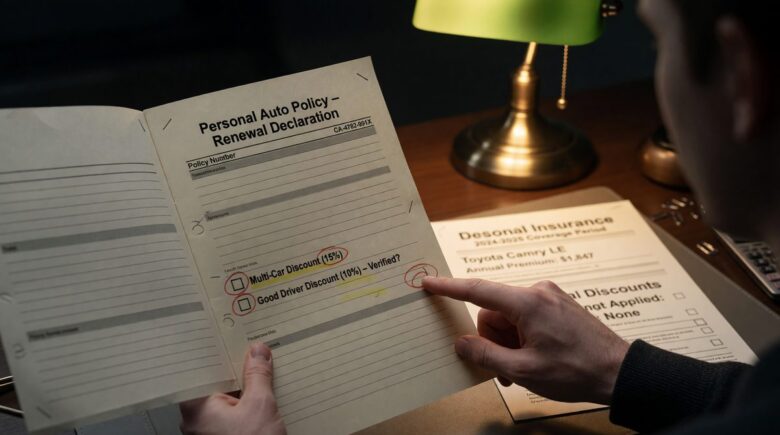
Pull your current declarations page and find the discounts section. Every discount currently applied to your policy should be listed there. Cross-reference it against this checklist: multi-car, bundling, paperless, autopay, continuous coverage, good student, telematics enrollment, anti-theft, safety features, low mileage, and any group or affinity discount. If any of these are missing and you might qualify, call your carrier and ask specifically. Don’t ask “do I get all my discounts?”, ask about each one by name.
Bundling: The Arithmetic Matters
According to Consumer Federation of America, bundling auto and homeowners insurance can cut your annual premium by up to 30%. Here’s how that works in real dollars: if your auto premium is $1,800 per year and your homeowners is $1,400, a 20% bundle discount saves $640 annually. At 30%, that’s $960. The discount typically applies to both policies, which is why it compounds so well.
For context on how homeowners savings stack alongside auto discounts, our guide on saving money on homeowners insurance covers the same bundling mechanics from the property side.
Raising your deductible is a separate lever. Moving from $500 to $1,000 cuts premiums by 20-25%, according to Insurance Information Institute vice president Loretta Worters. That’s not a discount in the traditional sense, but it achieves the same effect. The tradeoff is real: you’re accepting higher out-of-pocket exposure on a claim.
What clients often miss: Stacking discounts isn’t additive, it’s multiplicative. A 10% telematics discount applied after a 15% bundling discount doesn’t add to 25%; it compounds. The practical implication is that applying your highest-value discount first and layering others on top typically yields the best result.
Common Discount Ranges at a Glance
| Discount Type | Typical Range | Requires Action? |
|---|---|---|
| Bundling (auto + home) | Up to 30% | Yes, bundle at same carrier |
| Telematics / Usage-Based | 5–35% | Yes, enroll in program |
| Continuous Coverage | 5–25% | No lapse allowed; verify status |
| Good Student | 5–25% | Yes, submit GPA documentation |
| Anti-Theft Device | Up to 23% | Yes, report device to insurer |
| Multi-Car | 10–25% | Yes, add vehicles to same policy |
| Affinity / Group | 2–20% | Yes, verify and claim membership |
| Mature Driver Course | 5–15% | Yes, complete approved course |
| Low Mileage | 5–15% | Yes, update reported mileage |
| Paperless / Autopay | 2–10% | Yes, enroll online or by phone |
If you’re starting from scratch on your auto policy, our step-by-step car insurance quote comparison guide walks through how to get quotes that reflect all applicable discounts, not just the advertised rates.
Where This Recommendation Falls Short
The advice to aggressively stack car insurance discounts is sound for most drivers, but it’s not for everyone, and the drawbacks deserve honest treatment.
Start with telematics. The programs I’ve described work well for drivers with consistent, low-risk habits. If your daily commute involves a lot of stop-and-go traffic, you drive frequently at night, or you occasionally make long highway trips at speed, your behavioral score may not look as good as you expect. At carriers where telematics results can raise your rate at renewal (Progressive being the most prominent example), enrollment is a gamble, not a guaranteed win. If you’re not confident in how you’d score, test it on a month-to-month basis and read the renewal terms carefully before committing.
Bundling carries its own catch. The 30% discount sounds compelling, but it only makes sense if the bundled home rate is actually competitive. Some carriers that offer large auto-home bundle discounts are simply not price-competitive on homeowners insurance in certain states or risk profiles. Run separate quotes before assuming bundling is cheaper overall. Our analysis of ways to reduce your auto insurance costs covers this comparison in more detail.
The risk is also real for drivers in high-cost states like California, Michigan, or Florida, where state regulations limit certain discount types or where the insurance market is distressed. The NAIC explicitly notes that not all states offer all discounts, which means your geography can cap your upside.
Finally, the stacking strategy assumes you’re staying with a single carrier. Sometimes the better move is switching entirely. If your current insurer’s base rates are high, stacking discounts on top of an uncompetitive rate still leaves you overpaying. The Consumer Reports data showing $461 median savings for switchers is a reminder that no amount of discount layering beats a genuinely lower base premium. Don’t let the discount audit become a reason to avoid shopping around, they’re complementary, not competing strategies.
How We Sourced This
This article draws primarily from Consumer Reports’ 2024 auto insurance survey of 40,566 Americans, published in early 2025, which provided the switching rate, median savings, and telematics enrollment data cited throughout. Discount percentage ranges for specific carriers (GEICO, Progressive, Allstate, Travelers, State Farm) were sourced from WalletHub’s carrier-level discount analysis and the Insurance Information Institute’s published guidance on deductible adjustments, both current. The NAIC’s consumer auto insurance page and its consumer insight tips article provided institutional guidance on discount categories and state availability. Mature driver course state mandate data (33 states plus D.C.) was sourced from published industry summaries. All statistics were verified against their primary sources before publication; no figures were derived or extrapolated beyond the arithmetic explicitly shown in this article.
Frequently Asked Questions
What car insurance discounts do most drivers forget to claim?
Continuous coverage, telematics enrollment, and affinity or group discounts are the most commonly unclaimed. Most drivers also forget to update their mileage after a commute change, which can mean paying for coverage calibrated to more driving than they actually do.
Can I stack multiple car insurance discounts?
Yes, most carriers allow stacking, but the math is multiplicative, not additive. A 15% bundling discount followed by a 10% telematics discount doesn’t equal 25%; the second discount applies to the already-reduced premium. Stacking three to five discounts routinely produces total reductions of 20-40%.
Does enrolling in a telematics program always save money?
Not always. Enrollment typically triggers an upfront discount of 5-10%, but programs like Progressive Snapshot can raise your rate at renewal if your driving score is poor. Allstate Drivewise does not raise rates based on behavior, which makes it a safer starting point for drivers who are uncertain how they’ll score.
How does bundling auto and homeowners insurance affect my total cost?
Bundling can cut your combined premium by up to 30%, but only if your insurer is competitive on homeowners rates in your state. Run a standalone homeowners quote from another carrier before assuming the bundle saves money overall. In some high-cost states, it doesn’t.
What is the mature driver discount and who qualifies?
It’s a state-mandated discount available to drivers typically 55 or older who complete an approved defensive driving course. It applies in 33 states plus Washington D.C., but it requires proactive enrollment, carriers don’t apply it automatically. Check your state’s requirements through the NAIC or your state insurance department website.
Does a gap in coverage affect my discounts?
Yes, and this is one of the most expensive silent penalties in auto insurance. Continuous coverage discounts at carriers like Progressive and Travelers disappear after even a brief lapse, sometimes just a few weeks, and carriers don’t always disclose that the gap is the reason your rate is higher. If you’ve ever had a period without coverage, ask your current carrier directly whether it’s affecting your rate.
How do I find out which discounts are currently applied to my policy?
Pull your declarations page and look for the discounts section, every applied discount should be itemized there. If you see fewer than three or four, call your carrier and ask about each discount category by name. For a full walkthrough of what to look for when reviewing your policy, our guide to everything you need to know about car insurance covers declarations pages in detail.
Sources
- Consumer Reports, How to Save Big on Your Car Insurance (2025)
- National Association of Insurance Commissioners, Auto Insurance Consumer Guide
- National Association of Insurance Commissioners, Consumer Insight: Tips for Saving on Auto Insurance
- Insurance Information Institute, Auto Insurance Basics
- Progressive Corporation, Snapshot Program Data
- State Farm, Auto Insurance Discounts
- Consumer Reports, Car Insurance Hub


