
Fact-checked by the Smart Insurance 101 editorial team
You’re 30 days from closing on your first home, and your lender just emailed asking for proof of homeowners insurance first-time buyer coverage before the loan can fund. Your heart rate spikes. You’ve spent months obsessing over mortgage rates and inspection reports — and somehow insurance slipped to the bottom of the list. You’re not alone: according to the Insurance Information Institute, the average homeowner pays $1,428 per year for a standard policy, yet most first-time buyers admit they never compared more than one quote.
The financial stakes are higher than ever. The Consumer Financial Protection Bureau reports that home insurance premiums surged an average of 21% in a single year between 2022 and 2023, with some high-risk states seeing increases above 40%. Meanwhile, roughly 1 in 13 insured homes filed a claim in a recent year, and the average claim payout exceeded $15,000. Buying the wrong policy — or the cheapest one without reading the fine print — can leave you personally responsible for tens of thousands of dollars after a fire, flood, or liability lawsuit.
This guide cuts through the confusion. You will learn exactly what a standard policy covers (and what it does not), how to calculate the right coverage amount, where to find the best quotes, and what to hand your lender at closing. Every section is built around real numbers so you can make confident decisions — even on a tight timeline.
Key Takeaways
- The national average homeowners insurance premium hit $1,428 per year in 2023, but rates vary by up to 300% depending on your ZIP code and home characteristics.
- Most mortgage lenders require proof of insurance at least 3 to 7 business days before closing — waiting until the last minute can delay your loan.
- A standard HO-3 policy covers your dwelling, personal property, liability, and additional living expenses, but it excludes floods and earthquakes by default.
- Shopping at least 3 quotes can save first-time buyers an average of $300 to $500 per year according to industry surveys.
- Bundling home and auto insurance with the same carrier typically reduces your total premiums by 10% to 25%.
- Underinsuring your dwelling by just 20% can result in a claims payout that is reduced by thousands of dollars under co-insurance penalty clauses.
In This Guide
- Why Timing Matters More Than Most Buyers Realize
- What Homeowners Insurance Actually Covers
- How Much Coverage Do You Actually Need
- How to Shop for Homeowners Insurance as a First-Time Buyer
- HO-1 Through HO-8: Choosing the Right Policy Form
- Discounts, Bundling, and Ways to Lower Your Premium
- Exclusions and Red Flags to Watch Out For
- What Your Lender Actually Requires at Closing
- What to Do After Closing Day
Why Timing Matters More Than Most Buyers Realize
Most first-time buyers treat insurance as a last-minute checkbox. In reality, the process of finding and binding a policy can take anywhere from 3 to 14 days — and that timeline runs directly into your closing schedule.
Lenders require a declarations page (the official one-page policy summary) before they will fund your mortgage. Many title companies also require it at the closing table. Starting your insurance search in the final week before closing is one of the most common — and costly — rookie mistakes.
The Closing Timeline You Need to Know
A typical real estate purchase contract gives you 30 to 45 days to close. Insurance should enter your checklist no later than day 21. That gives you one week to gather quotes, one week to review and bind the policy, and a comfortable buffer before your lender’s deadline.
Some insurers require a home inspection before they will issue a policy on older homes. If your house was built before 1980, factor in an additional 5 to 10 business days for that inspection to be scheduled, conducted, and reviewed.
Roughly 36% of first-time homebuyers say they felt “rushed” when purchasing homeowners insurance, according to a J.D. Power survey — and rushed buyers are significantly more likely to end up underinsured.
Why Your Lender Cares So Much
Your mortgage lender has a financial interest in your home. If the house burns down and you have no insurance, the lender loses their collateral. That is why virtually every conventional loan — including those backed by FHA and HUD programs — requires homeowners insurance equal to at least the loan amount or the home’s replacement cost, whichever is lower.
If you fail to provide proof of insurance, the lender will purchase force-placed insurance on your behalf. Force-placed policies cost 2 to 10 times more than a standard market policy and provide far less protection for you as the homeowner.
What Homeowners Insurance Actually Covers
A standard homeowners policy is not a single product — it is a bundle of six distinct coverages. Understanding each one prevents expensive surprises when you file a claim.
The Six Core Coverage Components
| Coverage Type | What It Protects | Typical Limit |
|---|---|---|
| Coverage A — Dwelling | The physical structure of your home | Replacement cost of the home |
| Coverage B — Other Structures | Fences, detached garages, sheds | 10% of Coverage A |
| Coverage C — Personal Property | Furniture, electronics, clothing | 50–70% of Coverage A |
| Coverage D — Loss of Use | Temporary housing if home is uninhabitable | 20–30% of Coverage A |
| Coverage E — Personal Liability | Lawsuits for injury or property damage | $100,000–$500,000 |
| Coverage F — Medical Payments | Guest medical bills, regardless of fault | $1,000–$5,000 |
Coverage A is the most important number to get right. It should reflect the replacement cost of your home — the cost to rebuild it from the ground up at today’s labor and material prices. That number is almost always different from the purchase price or appraised value of the home.
For a deeper look at how these protections fit together, our homeowners insurance beginner’s overview walks through each component with plain-language examples.
What Standard Policies Do NOT Cover
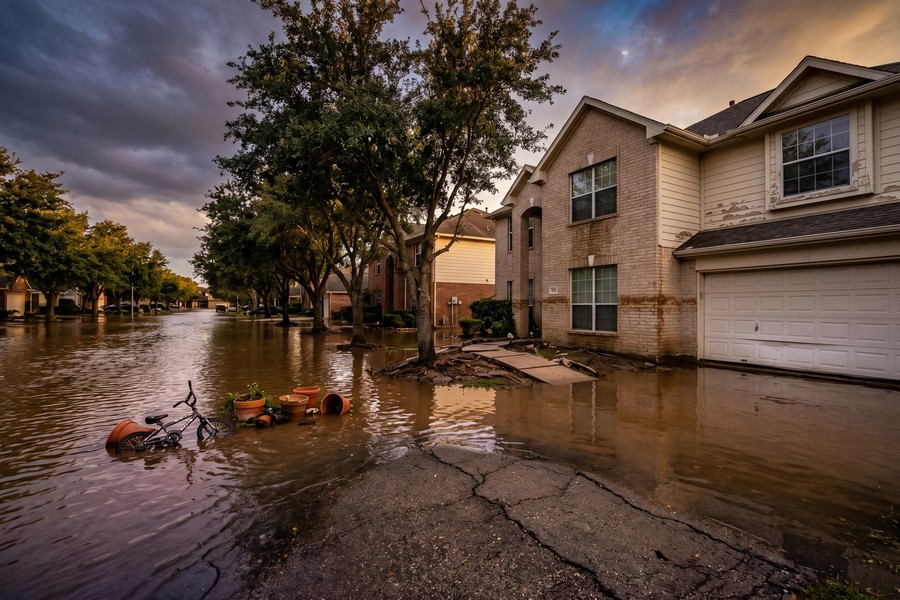
The most dangerous gaps in a standard policy are flood damage and earthquake damage. Neither is covered under a standard HO-3 form. Yet many first-time buyers assume they are protected.
Flood insurance must be purchased separately through the National Flood Insurance Program (NFIP) or a private insurer. The average NFIP policy costs about $888 per year. If your home is in a FEMA-designated flood zone, your lender will require this coverage — but even homes outside designated zones flood regularly.
About 20% of all flood insurance claims come from properties outside high-risk flood zones, according to FEMA. Yet fewer than 15% of homeowners carry separate flood insurance.
Other common exclusions include sewer backup, mold remediation beyond a small sublimit, wear and tear, and damage caused by pests or vermin. Each of these can be added back as an endorsement — usually for $50 to $200 per year.
How Much Coverage Do You Actually Need
Picking coverage limits is where most first-time buyers make their most expensive mistake. Too little coverage triggers co-insurance penalties. Too much means you are overpaying every month.
Calculating Your Dwelling Replacement Cost
Replacement cost is not the same as market value. A home worth $400,000 on the open market might cost $320,000 to rebuild or $550,000, depending on local construction costs and the home’s features. Your insurer should run a replacement cost estimator when you apply — but you can also request your own estimate through tools like CoreLogic or Marshall & Swift.
As a rough benchmark, residential construction costs in the United States averaged $150 to $250 per square foot in 2023, according to the National Association of Home Builders. A 1,800-square-foot home could therefore require $270,000 to $450,000 in Coverage A — a wide range that makes using an estimator essential.
“The single biggest mistake first-time buyers make is insuring their home for its purchase price rather than its rebuild cost. Those two numbers can differ by $100,000 or more, and the gap leaves homeowners catastrophically underinsured.”
Setting Personal Property Limits
Most policies default to insuring personal property at 50% of your dwelling coverage. On a $350,000 dwelling policy, that is $175,000 for all your belongings. That sounds like a lot until you add up the replacement cost of every piece of furniture, every appliance, every piece of clothing, and every electronic device you own.
Consumer advocates recommend conducting a home inventory before you close. Take a video walkthrough of every room, open every drawer, and list high-value items separately. The Insurance Information Institute’s home inventory guide provides a free downloadable template.
Liability Coverage: Don’t Skimp Here
The default liability limit on most policies is $100,000. That is dangerously low. A single dog bite lawsuit, a slip-and-fall accident on your property, or a contractor injured while working at your home can easily exceed that amount. Increasing liability coverage from $100,000 to $300,000 typically costs only $20 to $30 more per year.
If you have significant assets, consider a personal umbrella policy for $1 million or more in additional liability coverage. Umbrella policies typically cost $150 to $300 per year. Our article on why liability lawsuits are getting more expensive explains exactly why higher limits matter right now.
How to Shop for Homeowners Insurance as a First-Time Buyer
The homeowners insurance first-time buyer shopping process does not have to be overwhelming. With the right approach, you can collect meaningful quotes in about two hours.
What Information You Need Before You Start
Insurers will ask for specific details about the property before generating a quote. Gather this information from your purchase contract, home inspection report, and local records before you start calling.
- Year the home was built
- Square footage and number of stories
- Roof type and age (asphalt shingle, metal, tile, etc.)
- Heating system type (gas, electric, oil, or wood-burning)
- Presence of a swimming pool, trampoline, or wood-burning stove
- Distance to the nearest fire station and fire hydrant
- Prior claims history on the property (request a C.L.U.E. report)
- Your desired closing date and effective date of coverage
Where to Get Quotes
You have three main channels for shopping homeowners insurance: direct insurers, independent agents, and online marketplaces. Each has different advantages.
| Channel | Best For | Typical Time Investment | Notable Limitation |
|---|---|---|---|
| Direct Insurer (online) | Simple homes in low-risk areas | 15–30 min per quote | Only shows one company’s rates |
| Independent Agent | Complex properties, high-risk areas | 1 meeting, agent shops for you | Agent may favor higher-commission carriers |
| Online Marketplace | Comparing multiple carriers fast | 30–45 min total | Not all carriers participate |
| Captive Agent | Existing relationship with carrier | 1 call or meeting | Limited to one carrier’s products |
Independent agents are often the best choice for first-time buyers in competitive or high-risk markets. They can access dozens of carriers simultaneously and explain differences in policy language — not just price. Our guide on choosing an insurance broker to save money walks through how to find and vet a good independent agent.
Request quotes from at least three carriers and make sure each quote uses identical coverage limits. Comparing a $250,000 dwelling policy from one carrier to a $300,000 dwelling policy from another is meaningless — always normalize the numbers first.
What to Compare Beyond Price
Price is only one dimension of a quality insurance decision. The homeowners insurance first-time buyer process should also evaluate insurer financial strength, claims satisfaction ratings, and policy flexibility.
| Evaluation Factor | What to Look For | Where to Check |
|---|---|---|
| Financial Strength | A or A+ AM Best rating | AMBest.com |
| Claims Satisfaction | Top quartile J.D. Power score | J.D. Power Annual Survey |
| Complaint Ratio | Below 1.0 NAIC complaint index | NAIC.org Consumer Tools |
| Coverage Flexibility | Available endorsements match your needs | Policy declarations page |
| Deductible Options | Range from $500 to $5,000+ | Quote comparison tool |
A company with a slightly higher premium but a superior claims payout record is often the better financial decision. You are not just buying a policy — you are buying the promise that a check will arrive when you need it most.
HO-1 Through HO-8: Choosing the Right Policy Form
The ISO (Insurance Services Office) created standardized policy forms to make coverage comparison easier. As a first-time buyer, you will almost certainly be shopping for an HO-3 — but knowing the full range helps you ask the right questions.
The Policy Form Spectrum
| Policy Form | Coverage Basis | Typical Use Case |
|---|---|---|
| HO-1 | Named perils (10 basic) | Rarely issued today; bare minimum |
| HO-2 | Named perils (16 broad) | Budget buyers in low-risk areas |
| HO-3 | Open perils on dwelling; named perils on property | Standard for most homeowners |
| HO-5 | Open perils on dwelling AND property | Newer or higher-value homes |
| HO-6 | Condo interior and personal property | Condo unit owners |
| HO-8 | Actual cash value; modified coverage | Older homes where rebuild cost exceeds market value |
For most first-time buyers purchasing a standard single-family home built after 1978, the HO-3 is the right choice. If you are buying a newer home with high-end finishes, ask whether an HO-5 is available — it provides broader personal property coverage for a modest premium increase.
Condo buyers need an HO-6 policy, which covers your unit’s interior from the walls inward, your personal belongings, and your liability. Your condo association carries a separate master policy for the building exterior and common areas — but that policy does not protect you personally. For a full breakdown of what each policy type includes, see our guide on important homeowners insurance policy types.
An HO-3 policy covers your dwelling on an “open perils” basis — meaning all causes of loss are covered unless specifically excluded. Your personal property, however, is covered only for named perils listed in the policy. Upgrading to an HO-5 extends open-perils coverage to your belongings as well.
Discounts, Bundling, and Ways to Lower Your Premium
First-time buyers often focus on finding the lowest sticker price. A smarter approach is to find the right coverage first, then systematically apply every available discount. These two strategies together produce the best outcome.
The Most Impactful Discounts Available
Insurers offer dozens of discounts, but not all are equal in dollar terms. The chart below shows which ones actually move the needle.
| Discount Type | Average Savings | Who Qualifies |
|---|---|---|
| Bundling (home + auto) | 10–25% on each policy | Anyone with an auto policy |
| New Home | 15–20% | Homes built within the last 5–10 years |
| Alarm/Security System | 5–15% | Monitored alarm or smart home devices |
| Higher Deductible | 5–30% depending on amount | Anyone willing to self-insure small losses |
| Claims-Free History | 5–10% | No claims in prior 3–5 years |
| Roof Age/Material | 5–20% | Impact-resistant or new roof |
| Loyalty (renewal) | 3–8% | Existing customers at renewal |
Bundling home and auto is consistently the single highest-value discount. If your current auto insurer also writes homeowners policies, get a bundled quote before shopping separately. For additional savings strategies, our article on how to save money on homeowners insurance covers more than a dozen tactics with specific dollar estimates.
Deductible Strategy for First-Time Buyers
Raising your deductible from $1,000 to $2,500 can reduce your annual premium by 10% to 25%. On a $1,400/year policy, that is $140 to $350 in annual savings. Over five years, you save $700 to $1,750 — enough to cover multiple years of the higher out-of-pocket cost.
The key question is: can you comfortably pay the deductible from your emergency fund? Most financial planners recommend keeping at least three months of expenses accessible. If a $2,500 deductible would wipe out your entire emergency reserve, keep the deductible lower and build savings before adjusting.
“First-time buyers are often cash-strapped after closing. My advice is to start with a mid-range deductible around $1,500, then raise it at the first renewal after you’ve had time to rebuild your savings cushion.”
Exclusions and Red Flags to Watch Out For
The homeowners insurance first-time buyer journey has several pitfalls that are easy to miss in the fine print. These exclusions and policy traps cost homeowners billions of dollars in denied or reduced claims every year.
Actual Cash Value vs. Replacement Cost
This is arguably the most important distinction in any homeowners policy. Replacement cost value (RCV) pays what it costs to buy a new equivalent item today. Actual cash value (ACV) pays replacement cost minus depreciation. On a five-year-old $3,000 television, ACV might pay only $900 after depreciation is applied.
Always confirm that both your dwelling and personal property are covered on a replacement cost basis. ACV policies are cheaper — but they are almost never the right choice for homeowners who want full financial recovery after a loss.
Some policies advertise “replacement cost” on the dwelling but quietly use actual cash value for personal property. Read the declarations page carefully — Coverage C should specify “replacement cost” not “actual cash value” if you want full protection for your belongings.
Sublimits That Can Blindside You
Standard policies contain sublimits — caps on how much they will pay for specific categories even when your overall policy limit is higher. Common sublimits include:
- Jewelry: typically limited to $1,500 per item (engagement rings often exceed this)
- Electronics and computers: sometimes limited to $2,500 total
- Fine art and collectibles: may be excluded entirely
- Cash and currency: usually limited to $200
- Mold remediation: often capped at $10,000
High-value items like jewelry, art, musical instruments, or firearms should be listed as scheduled personal property endorsements. These typically cost $1 to $2 per $100 of insured value per year — a small price for full coverage.
The C.L.U.E. Report and Prior Claims
Every insurer checks the Comprehensive Loss Underwriting Exchange (C.L.U.E.) report before issuing a policy. This report shows up to seven years of insurance claims on the property — including claims filed by previous owners. A home with multiple water damage or mold claims may trigger higher premiums or outright denials.
Request a free C.L.U.E. report on any property you are seriously considering. The seller can request it through LexisNexis. Surprises in this report can also give you negotiating leverage during the purchase process.

What Your Lender Actually Requires at Closing
Understanding lender requirements prevents last-minute delays at closing. The requirements are standardized across most conventional loans but vary slightly for FHA, VA, and USDA mortgages.
Standard Lender Requirements
Most lenders require that your homeowners policy meet all of the following criteria:
- Coverage effective date must be on or before the closing date
- Dwelling coverage must equal at least the loan amount or replacement cost (whichever is lower)
- The lender must be listed as an Additional Insured and Mortgagee on the policy
- The policy must be paid in full for the first year (usually paid at closing through escrow)
- A declarations page must be provided to the lender and title company
FHA loans have additional requirements: the insurer must be licensed in your state, the policy must include replacement cost coverage, and there are specific rules about minimum deductible amounts relative to the loan balance.
The first year of your homeowners insurance premium is almost always collected at closing and deposited into your escrow account. On a $1,400/year policy, expect to bring an additional $1,400 to the closing table beyond your down payment and closing costs.
How to Provide Proof of Insurance
Once you have bound your policy (formally accepted and activated it), request a declarations page from your insurer. This document is typically emailed within minutes for online policies and within 1 to 2 business days for agent-placed policies. Send it to your loan officer as soon as you receive it — and keep a copy for your own closing packet.
Also confirm with your agent that the lender’s name, address, and loan number are correctly listed on the policy as the loss payee. Any mismatch between the lender’s information and what is on the declarations page can trigger a last-minute delay.
What to Do After Closing Day
Buying the policy is not the finish line. The first year of homeownership is the ideal time to optimize your coverage and build habits that protect your investment for decades.
Reviewing Your Policy in the First 30 Days
Most insurers offer a free look period of 10 to 30 days after policy issuance. During this window, you can cancel the policy without penalty if you decide to switch carriers. Use this time to read your full policy — not just the declarations page — and verify that all coverage limits, endorsements, and exclusions match what you agreed to when binding.
If the home inspection revealed issues that were repaired before closing (a new roof, updated electrical panel, etc.), notify your insurer. These upgrades can qualify you for additional discounts and should be reflected in your policy file.
Building Good Insurance Habits
Create a home inventory within the first 60 days of moving in. Store a copy in a cloud account and another in a fireproof document box. Update the inventory annually or after any major purchase. If you make significant home improvements — a kitchen remodel, a finished basement, an addition — notify your insurer within 30 days to ensure your dwelling coverage remains adequate.
Set a calendar reminder to review your policy 60 days before each renewal. Premium increases have been dramatic in recent years. Our analysis of why insurance premiums are exploding explains the market forces driving increases and how to respond strategically at renewal.
Homeowners who review and re-shop their insurance at each renewal save an average of $200 to $400 per year compared to those who auto-renew without comparison shopping, according to Consumer Reports analysis.
Reassessing After Major Life Events
Your homeowners insurance needs will change as your life does. Getting married, having children, starting a home business, acquiring significant jewelry or artwork, or adopting a dog (some breeds affect liability coverage) all warrant a policy review. Treat your insurance as a living document — not a set-it-and-forget-it transaction.
If your home’s value increases significantly due to rising construction costs or a renovation, request a new replacement cost estimate from your insurer. Being underinsured by 20% at the time of a total loss can reduce your claim payout by thousands of dollars under standard co-insurance clauses. For a comprehensive overview of everything your coverage should protect, see our article on what home insurance should cover for your home and belongings.

According to the National Association of Realtors, 26% of all home buyers in 2023 were first-time buyers — and that group reported the highest rate of post-closing financial surprises, with insurance costs ranking among the top three unexpected expenses.
“New homeowners consistently underestimate the complexity of homeowners insurance. The policy you need at closing is not necessarily the policy you’ll need five years from now. Build in an annual review as a non-negotiable habit.”
Real-World Example: How Marcus and Priya Saved $612 and Avoided a $40,000 Coverage Gap
Marcus and Priya, a couple in their early 30s, were purchasing their first home — a 1,950-square-foot craftsman bungalow in suburban Atlanta for $385,000. With 21 days until closing, their real estate agent mentioned they needed to arrange insurance. Their first instinct was to call their auto insurer and add a home policy. The bundled quote came back at $1,847 per year with a $250,000 dwelling limit — a figure that matched neither the purchase price nor the estimated rebuild cost of $410,000.
Marcus spent two evenings gathering three additional quotes through an independent agent. The agent immediately flagged the $250,000 dwelling limit as dangerously low, explaining that a full rebuild at current Atlanta construction costs would require at least $390,000 in coverage. The agent also identified that their original policy used actual cash value for personal property — meaning a $4,500 laptop purchased three years ago would be paid out at roughly $1,800 after depreciation. The gap between what they thought they had and what they actually had was $160,000 in dwelling coverage and thousands more in personal property.
After shopping, Marcus and Priya chose a policy from a regional carrier with an A+ AM Best rating: $390,000 in replacement cost dwelling coverage, replacement cost personal property, $300,000 in liability, and a sewer backup endorsement for $125/year. Total premium: $1,468 per year — $379 less than the original quote, with dramatically better coverage. They also raised their deductible from $1,000 to $2,000, saving an additional $233 per year. Total annual savings: $612.
At closing, their lender accepted the declarations page without issue. Six months later, a burst pipe caused $18,000 in water damage. Their claim was paid in full within 11 days. With the original policy’s ACV personal property clause, they estimate they would have received $9,000 to $11,000 less — and would have had no coverage for the finished basement that flooded, which the original policy excluded. The two hours Marcus spent comparison shopping returned over $40,000 in financial protection.
Your Action Plan
-
Start shopping at least 21 days before closing
Do not wait until the final week. Give yourself time to gather quotes, review policy language, negotiate terms, and bind coverage with a comfortable buffer before your lender’s deadline. If your home is older than 30 years, add another week to account for possible insurer inspection requirements.
-
Gather your home’s key data before you request any quote
Pull together the year built, square footage, roof age and material, heating system type, and any prior claims history from the seller. Request a C.L.U.E. report on the property. Having this information ready will make the quote process faster and more accurate.
-
Calculate your true replacement cost — not the purchase price
Ask each insurer to run a replacement cost estimator using your home’s actual square footage, construction type, and finishes. This number is the foundation of your dwelling coverage amount. Never accept a dwelling limit that simply matches your purchase price without verification.
-
Get at least three quotes on identical coverage terms
Use the same dwelling limit, personal property limit, liability limit, and deductible for every quote you compare. This apples-to-apples comparison is the only way to evaluate price differences accurately. Use a mix of direct insurers, an independent agent, and at least one online comparison tool.
-
Verify replacement cost coverage for both dwelling and personal property
Confirm in writing that Coverage A (dwelling) and Coverage C (personal property) are both written on a replacement cost basis. If personal property defaults to actual cash value, request a replacement cost endorsement — it typically adds $50 to $100 per year and is almost always worth the cost.
-
Add necessary endorsements for your specific situation
Consider sewer backup coverage, scheduled personal property for jewelry or electronics, water damage endorsements, and earthquake coverage if you are in a seismic zone. Each endorsement is a small annual cost that closes a gap that could otherwise cost tens of thousands of dollars out of pocket.
-
Send your declarations page to your lender immediately after binding
Confirm that the lender’s full name, mailing address, and loan number are correctly listed as the mortgagee and loss payee before you send. A mismatch on any of these details can delay closing. Email the declarations page and follow up with a phone call to confirm receipt.
-
Schedule an annual policy review at each renewal
Set a calendar reminder 60 days before your renewal date. Review your coverage limits against current construction costs, re-shop at least two competing quotes, and notify your insurer of any home improvements or significant purchases made during the year. This single habit can save hundreds of dollars annually and prevent you from becoming underinsured as your home appreciates.
Frequently Asked Questions
When exactly does homeowners insurance need to be in place before closing?
Most lenders require your policy to be bound and the declarations page delivered at least 3 to 7 business days before the scheduled closing date. Some lenders request it even earlier. Ask your loan officer for the specific deadline during the first week of your purchase contract period — not the last.
How much does homeowners insurance typically cost for a first-time buyer?
The national average is approximately $1,428 per year for a standard HO-3 policy, but premiums vary dramatically. A comparable home in Iowa might cost $800 per year while the same home in Florida or Louisiana could cost $3,500 to $5,000 per year due to hurricane risk. The only way to know your actual cost is to get location-specific quotes.
Does homeowners insurance cover my mortgage if I can’t pay?
No. Homeowners insurance does not cover your mortgage payments under any circumstances. It covers physical damage to the property and certain liability claims. If you are concerned about mortgage payment protection, look into mortgage protection life insurance or disability insurance as separate products.
Is homeowners insurance required by law?
Homeowners insurance is not legally required by any state. However, it is contractually required by virtually every mortgage lender. If you own your home outright with no mortgage, you are technically free to go without — though this is an extreme financial risk given the cost of rebuilding after a major loss.
What is the difference between market value and replacement cost?
Market value is what a buyer would pay for your home on the open market. Replacement cost is what it would cost to rebuild the physical structure from scratch at current labor and material prices. Market value includes the land (which cannot burn down), so it is often lower than replacement cost for established neighborhoods. Your dwelling coverage should be based on replacement cost, not market value.
Can I switch homeowners insurance companies after closing?
Yes. You can switch insurers at any time. If you switch mid-policy, you are entitled to a pro-rated refund for any unused premium. However, you must notify your lender and provide an updated declarations page showing the new insurer as the mortgagee. Most lenders require at least 10 days’ notice before a policy cancellation takes effect.
What is a hurricane or wind deductible, and how does it affect me?
In coastal states and hurricane-prone regions, insurers often apply a separate, higher deductible specifically for wind or hurricane damage. This deductible is typically expressed as a percentage of your dwelling coverage — often 1% to 5%. On a $400,000 dwelling policy, a 2% hurricane deductible means you pay the first $8,000 of any wind damage claim out of pocket. This is a critical detail to identify before binding coverage in any coastal or storm-prone market.
What happens if I make a home improvement after closing?
Any significant improvement — a kitchen remodel, finished basement, room addition, or major system upgrade — increases your home’s replacement cost. You should notify your insurer within 30 days of completing any major project and request a revised replacement cost estimate. Failing to update your coverage can result in a co-insurance shortfall if you experience a total loss before your next renewal.
Does my homeowners policy cover my home-based business?
Standard homeowners policies provide very limited coverage for home-based business activities — typically no more than $2,500 for business property and no liability coverage for business-related claims. If you work from home, run a side business, or have clients or employees visiting your home, you likely need a home business endorsement or a separate business owners policy (BOP). For a broader look at commercial insurance protections, see our guide on commercial insurance basics.
Should I file a small claim or pay out of pocket?
Filing a homeowners insurance claim — even a small one — can result in a premium increase at renewal of 10% to 40% or more, and some insurers may non-renew your policy after multiple claims within a short period. As a general rule, consider paying out of pocket for any loss that is less than twice your deductible. Reserve insurance for the large, unexpected catastrophic losses it was designed to cover.
Sources
- Insurance Information Institute — Facts + Statistics: Homeowners and Renters Insurance
- Consumer Financial Protection Bureau — CFPB Report Examines the Growth of the Home Insurance Crisis
- FloodSmart.gov (FEMA) — Flood Insurance: How It Works
- U.S. Department of Housing and Urban Development — FHA 203(b) Mortgage Insurance Program
- Insurance Information Institute — How to Create a Home Inventory
- National Association of Insurance Commissioners — Consumer Information Source
- Consumer Reports — Shopping for Homeowners Insurance
- National Association of Realtors — Profile of Home Buyers and Sellers
- J.D. Power — U.S. Home Insurance Study
- AM Best — Insurance Company Credit Ratings
- United Policyholders — Coverage Checkup: Homeowners Insurance Buying Tips
- FEMA — Flood Map Service Center
- National Association of Home Builders — Construction Cost Survey
- LexisNexis — C.L.U.E. Report for Consumers
- NAIC — A Consumer’s Guide to Home Insurance (PDF)


