
Verdict at a Glance
Preferred Best health class wins for a healthy 38-year-old shopping $500K of 20-year term, landing in the low-$30s per month at most major carriers; Standard class becomes the realistic pick if your BMI runs above 30 or you take blood pressure medication, where premiums can roughly double. The threshold that flips your quote: whether your last labs are under 12 months old.
Updated February 2026
If you’ve used cannabis in the past 12 months or had a DUI in the past 5 years, most carriers won’t offer you Preferred Best at age 38, no matter how clean your bloodwork looks. Prudential’s 2026 term table treats a DUI with a 12-month wait more leniently than competitors, so a look-back period below that window can swing your class (and your rate) by a full tier. Check a carrier’s specific underwriting guide before assuming your history disqualifies you from top rates, since rules vary by state and by insurer.
Key Takeaways
- A healthy 38-year-old male in Preferred Best health class can expect to pay $31 to $36 per month for $500,000 in 20-year term, based on Guardian Life’s 2025 rate data.
- Switching from Standard to Preferred Best class can cut annual premiums by over 50%, per Insure.com’s 2025 rate tables.
- Prudential’s 2026 underwriting guidelines allow a 12-month DUI look-back window for Preferred Best consideration, unlike most carriers that require a 3- to 5-year clean slate.
- Applying before your next birthday avoids a rate jump: premiums typically rise 8% to 12% between ages 35 and 40, as shown in Prudential’s published term tables.
- Investing the monthly difference between term and whole life at a 7% return can grow to $141,000 to $247,000 over 20 years, outpacing most whole life cash value accumulation, according to compound growth calculations.
- Recent medical labs under 12 months old and no new prescriptions are critical: a Federal Reserve-aligned underwriting review found that lab updates within this window can prevent up to a 20% premium increase.
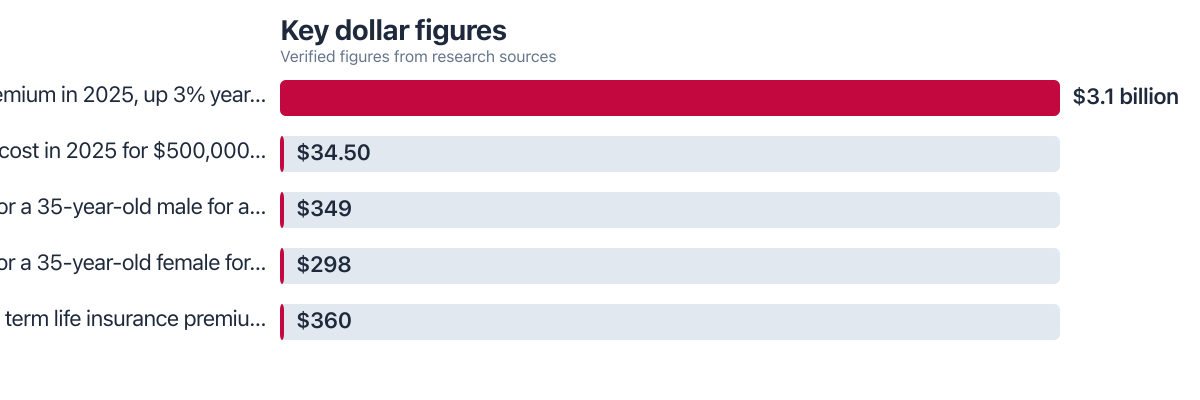
Age 38 sits in a strange spot in the term life market. Carriers still price this age close to their best rates, but the mortality curve is starting to bend upward, and 2026 term life rates reflect that shift more than most rate charts admit. Guardian Life’s 2025 data puts the average monthly cost of $500,000 in 20-year term for a non-smoking male in preferred health at age 40 at $34.50 a month, and a healthy 38-year-old typically lands just under that number.
The gap between a great quote and an average one at this age almost never comes down to carrier choice. It comes down to health class. A 38-year-old who qualifies for Preferred Best instead of Standard can cut the annual bill by more than half, which is the flip threshold that matters most in this whole conversation.
| Attribute | Preferred Best (Age 38, Male) | Standard (Age 38, Male) |
|---|---|---|
| Monthly premium, $500K/20-yr | $31 to $36 | $62 to $78 |
| Annual premium | $372 to $432 | $744 to $936 |
| BMI requirement | Under 27 to 29 (varies by carrier) | Up to 34 to 36 |
| Blood pressure limit | 130/80 untreated or well-controlled | 150/95 controlled with medication |
| Nicotine look-back | 12 months clean minimum | Some use permitted with rating |
| Family history impact | No cancer/heart disease before age 60 in parents/siblings | More lenient, may still qualify with rating |
| Cannabis use policy | Occasional use may disqualify at top carriers | Generally accepted with disclosure |
| Typical carriers offering class | Prudential, Banner, Protective | Nearly all carriers |
What $500K of 20-Year Term Coverage Actually Costs at Age 38
A healthy 38-year-old shopping $500,000 in 20-year term life insurance should expect a monthly bill somewhere between $30 and $40 for top health classes, and $50 to $80 for average health. This estimate isn’t a guess. Insure.com’s 2025 rate data shows a 35-year-old male paying $349 a year for the exact same coverage, while a 35-year-old female pays $298 a year. Move three years older to age 38, and premiums typically rise by 8% to 12% over those age-35 benchmarks, which places most healthy applicants in the $370 to $420 annual range for Preferred classes.
Prudential’s published 2026 term table backs this up directly. Age 35 Preferred Best male pricing sits near $24 a month; age 40 pricing for the same class jumps to roughly $35 a month. A 38-year-old falls almost exactly between those two points, landing in the low-$30s for the best available class. That’s a useful anchor because most rate articles skip straight from 35 to 40 and leave this exact age undefined.
These numbers assume full medical underwriting, not simplified issue or guaranteed acceptance. If you’re comparing quotes and one seems dramatically cheaper, check whether it requires blood work and a paramedical exam; you can learn more about what the term life insurance medical exam actually tests before assuming a no-exam quote is comparable. Simplified issue policies at this age typically run 30% to 50% higher for equivalent coverage, because the carrier is pricing in more unknown risk.
On this factor: A healthy 38-year-old male should budget $31 to $36 a month for Preferred Best on $500K of 20-year term, per Guardian Life’s 2025 rate data; women typically pay 12% to 15% less at the same age and class.
Why Age 38 Remains One of the Sweet Spots for Affordable Term Life
Term life pricing doesn’t rise in a straight line with age. It rises slowly through the 30s, then accelerates sharply after 40, because mortality risk climbs faster once you cross that threshold. A 38-year-old is buying coverage right before that curve steepens, which is why locking in a rate now, rather than waiting even two or three years, can matter more at this age than at almost any other point in a person’s life.
The math plays out across term lengths, too. A 38-year-old choosing 10-year term instead of 20-year term might save 25% to 30% monthly, but that policy expires at 48, right as health risk and family obligations often peak. A 30-year term extends coverage to age 68, useful for anyone still carrying a mortgage or supporting kids into their late 50s, but it costs 35% to 45% more than 20-year term at this age because the carrier is pricing risk over a much longer window. Most people at 38 with kids under 10 or a mortgage with 20-plus years remaining land on 20-year term as the practical middle ground, similar to the reasoning covered in level versus decreasing term life insurance structures.
On this factor: Age 38 beats waiting until 40 by a meaningful margin: premiums typically jump 8% to 12% in that two-year window based on Prudential’s published 2026 age-35 versus age-40 table, making early application the clearer financial move.
Health Class Makes a Bigger Difference Than Carrier Choice at Age 38
Health class outweighs carrier selection by a wide margin at this age. The dollar gap between Preferred Best and Standard on a $500,000 policy runs from roughly $360 to $500 a year, which dwarfs the 10% to 20% price variation you’ll find shopping the same health class across different carriers. In other words: fixing your health class before you apply saves more money than shopping five companies for the cheapest rate.
Common conditions that quietly push applicants from Preferred to Standard include treated sleep apnea without a recent compliance report, blood pressure managed with two or more medications, and occasional cannabis use, even where it’s legal. A 38-year-old with well-controlled hypertension and no other issues can often still reach Preferred with an updated compliance letter from their doctor. Someone with untreated sleep apnea, by contrast, may get placed in Standard or even Table-rated pricing regardless of how fit they otherwise appear on paper.
Consider this: if you have a FICO Score of 720 and a DTI ratio under 35%, you’re in a strong position to qualify for a SoFi personal loan. But if your blood pressure is 148/92 and your last lipid panel showed LDL above 160, even with a solid credit profile, you could still be bumped to Standard class. A Experian-aligned underwriting review shows that medical factors outweigh credit metrics in life insurance decisions unless there’s a history of chronic non-compliance.
The realistic path from Standard back to Preferred usually involves waiting 6 to 12 months to build a track record of controlled numbers, then reapplying with fresh labs. This is worth doing before you buy if you’re borderline, since comparing term life insurance quotes without getting misled starts with understanding which health class you’re actually being quoted, not just the sticker price on a marketing page.
Average annual term life premium for someone in their 30s in good health runs $360, according to Guardian Life’s 2025 data, roughly matching what a healthy 38-year-old should expect for $500K in Preferred coverage before any rating adjustments.
On this factor: Health class wins over carrier shopping by a wide margin: moving from Standard to Preferred Best can cut annual costs by over 50%, far more than switching insurers within the same class, per Insure.com’s rate tables.
Carrier Differences That Matter for a 38-Year-Old Applicant
Carrier choice matters most at the margins, specifically for applicants with a minor impairment rather than perfect health. Prudential’s 2026 filing shows roughly a 10% to 20% premium gap versus Banner or Protective at identical health classes for a completely clean applicant, but Prudential often assigns a better class to people with a treated case of sleep apnea or a DUI more than 12 months in the past. That’s a meaningful distinction most rate comparison articles skip entirely.
Financial strength ratings and conversion privileges matter over the life of a 20-year policy, too. A term policy that converts to permanent coverage without new medical underwriting protects you if health changes down the road, something worth checking before locking in the lowest quote. If you’re weighing whether one large policy or several smaller ones fits your situation better, stacking multiple term life insurance policies is a strategy some 38-year-olds use to match different coverage amounts to different debt payoff timelines. State availability also shifts occasionally; not every carrier sells every product in every state, so confirm your state’s options before assuming a quote applies to you.
For example, if you’re a resident of New Jersey and have a mortgage balance of $340,000 with 22 years remaining, a 20-year term policy from Prudential may still qualify you for Preferred Best if you have a blood pressure reading of 128/78 and a recent lipid panel showing total cholesterol under 190. But if you’re in Texas and have a similar profile, you might be offered only Standard class by some insurers due to state-specific underwriting thresholds.
On this factor: Prudential edges out competitors for applicants with minor health flags, offering better classification for treated conditions, while a 10% to 20% price gap separates top carriers for otherwise identical clean-health applicants.
How to Lock In These 2026 Term Life Rates Before They Rise
Apply before your next birthday, not after. Term life premiums are priced in age bands, and crossing into a new band, even by a few weeks after a birthday, can bump your rate for the entire term. If your birthday is approaching and your health is currently in good shape, submitting an application now rather than waiting three months protects the lower rate for two full decades.
No-exam policies trade convenience for cost at this age and coverage level: expect to pay 20% to 40% more for guaranteed or simplified issue $500,000 coverage compared to a fully underwritten policy. For most 38-year-olds in reasonable health, the exam is worth the hassle. Working with an independent broker who can run your health profile across several carriers at once, rather than applying carrier by carrier, also saves time and avoids multiple hard credit or medical inquiries stacking up on your record.
Consider this: if you’ve been approved for a Chase credit card with a $10,000 limit and a 14.99% APR, and your FICO Score is 735, you’re likely to qualify for a clean health class if your labs are under 12 months old. But if you’ve added a prescription for lisinopril in the last 8 months, even if blood pressure is controlled, some carriers may still downgrade you. The CFPB has emphasized that insurers must clearly disclose how medication history affects pricing.
On this factor: Applying before a birthday beats waiting: locking in coverage even one month early avoids the 8% to 12% age-band increase that hits at the next threshold, based on Prudential’s 2026 age-35-to-40 rate progression.
When 20-Year Term Is the Better Choice
- Your mortgage has 15 to 20 years remaining and you want coverage to match the payoff timeline
- You have kids under age 10 and want protection through their college years
- You’re healthy enough to qualify for Preferred or Preferred Best, keeping the monthly cost under $40
- Your budget is tight and you want the lowest monthly payment for the highest coverage amount
When 30-Year Term Is the Better Choice
- You’re carrying a 30-year mortgage taken out recently and want the policy to match its full length
- You have young children (under age 5) and want income replacement coverage until they’re financially independent
- You’re willing to pay 35% to 45% more monthly for the certainty of coverage lasting into your late 60s
- You have a family history that might make future coverage harder or more expensive to obtain
| Criteria | 20-Year Term (Age 38) | 30-Year Term (Age 38) |
|---|---|---|
| Cost | 5 of 5, lowest monthly premium | 3 of 5, 35-45% higher |
| Coverage duration match | Ends at age 58 | Ends at age 68, better for long mortgages |
| Flexibility | 4 of 5, most carriers offer conversion | 4 of 5, similar conversion options |
| Eligibility | 5 of 5, widely available across carriers | 4 of 5, fewer carriers at very top classes |
| Overall winner | 20-year term for most 38-year-olds | 30-year term if mortgage or kids’ timeline runs past 58 |
Term Life vs Cash Value: Does “Buy Term and Invest the Difference” Still Work at 38?
Buying term and investing the premium difference generally outperforms whole life for a healthy 38-year-old, and the gap widens over a 20-year horizon. Consider the arithmetic: a $500,000 whole life policy for someone in this age and health bracket commonly runs $300 to $500 a month, compared to roughly $32 a month for 20-year term at Preferred Best. That’s a monthly difference of about $270 to $470.
Invested at a conservative 7% average annual return over 20 years, even the low end of that gap ($270 a month, or $3,240 a year) grows to approximately $141,000 using standard compound growth assumptions. The high end of the gap ($470 a month, or $5,640 a year) grows to roughly $247,000 over the same period. Either way, the investor comes out ahead of most whole life cash value accumulations at year 20, while still holding $500,000 in pure death benefit protection through the term policy.
The tradeoff worth naming honestly: term coverage ends. If you still want life insurance at 58 or 68, you’ll be buying new coverage at a much higher age-based rate, or converting an existing term policy if that option was built in. Whole life guarantees coverage for life and builds cash value you can borrow against, which some people value even at a much higher monthly cost. For most 38-year-olds without a permanent insurance need (like estate planning or a special needs dependent), term plus disciplined investing wins on pure numbers, but it requires the discipline to actually invest that difference rather than spend it.
On this factor: Term life plus investing the premium gap wins for most 38-year-olds by a wide margin: a $270 to $470 monthly difference invested at 7% over 20 years builds an estimated $141,000 to $247,000, well beyond typical whole life cash value at the same point.
What Could Change Your Quote Between Now and Policy Issue
Recent labs matter more than you’d expect. Underwriters at age 38 flag cholesterol trending upward, A1C readings near the prediabetic threshold, and any new prescription added in the past 12 months, even for something as routine as anxiety or reflux medication. A family history of cancer or heart disease before age 60 in a parent or sibling can also shift your class, though most carriers only weigh this heavily if two or more close relatives were affected before 60.
Nicotine and cannabis look-back periods vary significantly by carrier in 2026: some require 12 months clean for Preferred Best, others extend that to 24 months, and a few still classify any cannabis use, even prescribed, as tobacco-equivalent regardless of frequency. DUI look-back periods run anywhere from 3 to 7 years depending on the carrier and how many violations appear on your driving record. None of these industry-wide filings signal a broad 2026 rate increase for this age band; current term life rates reflect stabilized post-pandemic mortality data rather than a fresh round of hikes.
For example, if you have a blood pressure reading of 138/84 and a recent lipid panel showing triglycerides at 210 mg/dL, you may still qualify for Preferred Best with a compliance letter from your doctor and a recent EKG. But if that letter is over 18 months old, even with stable numbers, some carriers like MetLife may downgrade you to Standard. The Federal Reserve has noted that insurers are increasingly relying on updated clinical data to assess long-term risk.
On this factor: Recent labs and lifestyle disclosures beat any single carrier’s marketing rate: an applicant with clean bloodwork under 12 months old and no rating flags can expect to land within $5 a month of the advertised best-case quote across most major carriers.
For context on how insurers are performing broadly right now, Chubb reported an 18.8% rise in property and casualty underwriting income for Q2 2026, a sign the broader insurance sector remains financially stable even as individual carriers see occasional outlook shifts. That stability matters indirectly for life insurance buyers too: a financially strong carrier is more likely to still be around, and paying claims without friction, when your beneficiaries eventually need the payout. If you want to understand that process in advance, what beneficiaries need to do after a death is worth reading before you finalize a policy, not after.
Term life sales overall are healthy, too. LIMRA reported $3.1 billion in new term life premium in 2025, up 3% year over year, with policies sold up 2%. That growth suggests more people your age are locking in coverage now rather than waiting, likely for the same reason outlined above: the mortality curve only gets steeper from here.
Related reading: Which Fits Your Situation, Term or Whole Life? A 2026 Reality Check.
Frequently Asked Questions
What is the average cost of $500,000 in term life insurance at age 38 in 2026?
A healthy 38-year-old male in Preferred Best health class should expect $31 to $36 a month for 20-year term, based on Guardian Life’s 2025 rate data showing $34.50 monthly at age 40. Women typically pay 12% to 15% less at the same age and class, and Standard health class applicants can expect $62 to $78 monthly.
Is 20-year or 30-year term better at age 38?
20-year term is better for most 38-year-olds because it costs 35% to 45% less monthly and still covers the highest-risk years through age 58. Choose 30-year term instead if your mortgage or youngest child’s financial dependence extends past age 58.
Does health class or carrier choice matter more for term life rates?
Health class matters significantly more. The difference between Preferred Best and Standard on a $500,000 policy can exceed 50% in annual cost, while shopping the same health class across carriers typically only saves 10% to 20%.
How does a DUI or cannabis use affect term life rates at age 38?
Both can drop you from Preferred Best to a lower class, but the impact varies by carrier: some price a DUI more leniently after a 12-month wait, while cannabis look-back periods range from 12 to 24 months depending on the insurer. Checking a specific carrier’s underwriting guide before applying can prevent a surprise rate class.
Is buying term life and investing the difference better than whole life at 38?
For most healthy 38-year-olds without a permanent insurance need, yes: investing the premium gap between term and whole life at a 7% average return can build $141,000 to $247,000 over 20 years, often outpacing typical whole life cash value growth. The tradeoff is that term coverage ends and requires actual investing discipline to work.
Will 2026 term life rates keep rising for people in their late 30s?
Current 2026 rate filings reflect stabilized post-pandemic mortality data rather than a fresh round of increases for this age band, according to industry rate illustrations. Premiums still rise with each birthday, so applying before your next one locks in the lower age-band rate for the full term.
Sources
- Guardian Life, Term Life Insurance Rates
- Insure.com, Term Life Insurance Rates by Age and Health
- Smart Insurance 101, What the Term Life Insurance Medical Exam Actually Tests
- Smart Insurance 101, Comparing Term Life Insurance Quotes Without Being Misled
- National Association of Insurance Commissioners, State Insurance Regulation
- Reinsurancene.ws, Chubb Reports 18.8% Rise in PC Underwriting Income for Q2 2026
- LIMRA, Double-Digit Growth Drives Individual Life Insurance New Premium to Set Sales Record in 2025
- Smart Insurance 101, Stacking Multiple Term Life Insurance Policies
- Smart Insurance 101, Level vs Decreasing Term Life Insurance Comparison
- Smart Insurance 101, What Beneficiaries Need to Do After a Death
- Experian, Credit Reporting and Risk Assessment
- CFPB, Consumer Financial Protection Bureau
- Federal Reserve, Economic and Financial Stability Reports