Fact-checked by the Smart Insurance 101 editorial team
The Verdict
Rideshare driver auto insurance structured correctly means stacking a rideshare endorsement on your personal policy as the baseline. It is worth doing if your insurer offers one and you drive more than occasionally. Skip the endorsement only if your insurer does not offer it in your state, in that case, a commercial or standalone rideshare policy is the right alternative, not leaving the gap open.
The single factor that determines whether you are actually covered as a rideshare driver is whether your insurance recognizes the three phases of TNC (transportation network company) activity. Most personal policies do not. According to the Insurance Information Institute, a standard personal auto policy generally provides no coverage from the moment a driver logs into a rideshare app until the passenger exits and the transaction closes, a window that can represent the majority of a driver’s time on the road. That is the gap that rideshare driver auto insurance is designed to close.
Getting this wrong has real consequences: denied claims, policy cancellation for undisclosed commercial use, and out-of-pocket costs that can run into tens of thousands of dollars after a single accident. The structure you choose now determines your exposure every time you go online.
| Factor | Reasons to Get Proper Rideshare Coverage | Reasons Drivers Skip It |
|---|---|---|
| Phase 1 Liability Gap | TNC offers only $25K property damage / $100K bodily injury while waiting for a ride request, far below full-trip limits | Drivers assume the TNC policy covers everything from app-on onward |
| Physical Damage Deductible | TNC collision deductibles reach $2,500; an endorsement can bridge the $2,000 gap vs. a $500 personal deductible | Drivers believe the TNC’s contingent coverage is equivalent to their own policy |
| UM/UIM Protection | Endorsements extend your personal uninsured/underinsured motorist limits into Phase 1, where TNC coverage is thinnest | UM/UIM gaps are invisible until an uninsured driver causes an accident |
| Policy Cancellation Risk | Disclosing rideshare use prevents claim denial and mid-term cancellation for material misrepresentation | Fear that disclosure will trigger a rate increase or cancellation |
| Cost of Endorsement | Rideshare endorsements typically add $15–$30/month, far less than a standalone commercial policy | Any added premium feels like reduced earnings per trip |
| Delivery App Use | Many endorsements now cover DoorDash, Uber Eats, and similar platforms under the same rider | Drivers assume delivery driving is categorically different from passenger TNC work |
Key Takeaways
- Your personal auto policy almost certainly excludes rideshare activity, confirm this in writing with your insurer before your first trip.
- A rideshare endorsement makes sense if your insurer offers one in your state and the added cost is under $40/month for comparable coverage.
- Your personal liability limits should meet or exceed TNC Phase 2/3 levels, at minimum $100,000 per person / $300,000 per occurrence, so the endorsement actually improves your position.
- Choose collision and comprehensive deductibles of $500 or lower on your personal policy to limit exposure during the TNC’s $2,500-deductible contingent coverage periods.
- Add UM/UIM limits of at least $100,000 per person to protect yourself during Phase 1, when TNC liability coverage is minimal and your personal policy has been switched off.
- If you drive for both a passenger TNC and a delivery platform, verify explicitly that your endorsement or commercial policy covers both use types.
- Review your coverage annually, state regulations and TNC policy terms change, and what was adequate in 2023 may leave gaps in 2025.
Why Your Personal Auto Policy Probably Won’t Cover Rideshare Driving
Here’s the thing: the business-use exclusion in a standard personal auto policy is not a technicality, it is a fundamental limitation that applies the moment you turn on the app. The National Association of Insurance Commissioners (NAIC) confirms that personal auto policies typically exclude coverage for livery or commercial use in ridesharing, and that states have enacted laws based on the TNC Model Bill to establish minimum liability coverage requirements across different ride periods precisely because of this gap.
The practical consequence: if you are in an at-fault accident during Phase 1 (app on, waiting for a request) and your insurer discovers you were ridesharing without disclosure, your claim can be denied in full. Beyond the single claim, insurers can cancel or non-renew your policy for material misrepresentation. That leaves you scrambling for new coverage with a cancellation on your record, which drives up your future premiums significantly. The Texas Department of Insurance puts it plainly: most personal auto policies do not cover ride-sharing use, and drivers should notify their insurer before starting.
Notification is the first structural decision. Make it before your first trip, not after a claim.
The Three Phases of Rideshare Coverage, and Where the Gaps Actually Are
Three distinct coverage periods exist in every TNC relationship, and the risk is not evenly distributed across them. Phase 1 is by far the most dangerous gap for drivers: the app is on, you are available for requests, but no trip has been accepted. During this period, Uber’s contingent liability coverage offers only $25,000 in property damage and $100,000 in bodily injury per person, a fraction of the $1 million in combined liability that activates once a trip is accepted in Phases 2 and 3.
Physical damage coverage follows a different logic. In Phases 2 and 3, both Uber and Lyft offer contingent collision and comprehensive, but only if you already carry those coverages on your personal policy. And the TNC deductible is often $2,500. If your personal collision deductible is $500, the TNC’s coverage still leaves you personally responsible for a $2,000 gap on any at-fault accident while you have a passenger in the car.
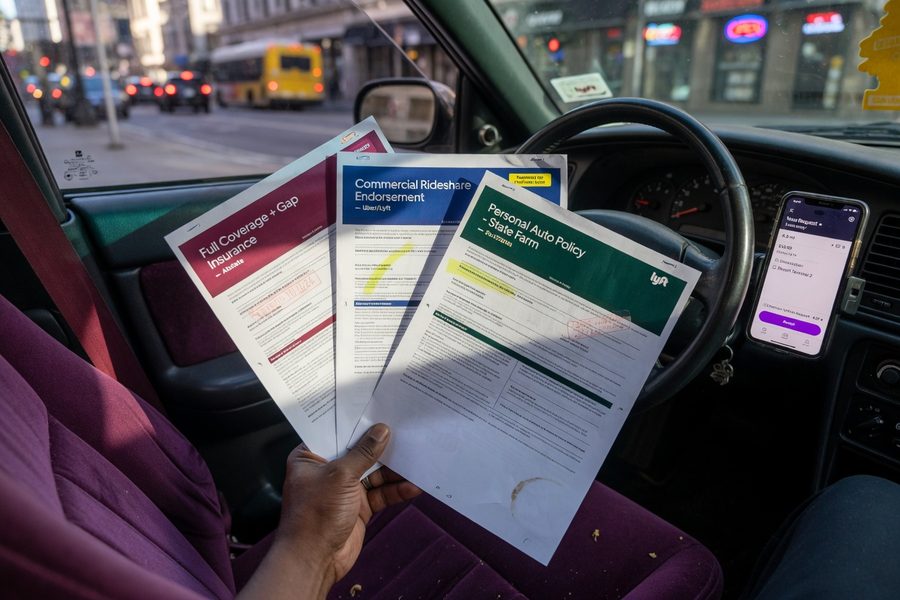
Once you log off, coverage shifts entirely back to your personal policy. The Insurance Information Institute describes these as three distinct periods with no automatic continuity between them. An endorsement or standalone rideshare policy is the mechanism that creates continuity, without one, you move between coverage frameworks with no bridge.
What Uber and Lyft Actually Provide, and Where It Falls Short
TNC coverage is real, but conditional on circumstances most drivers do not fully understand. Uber and Lyft both provide the $1 million combined liability during Phases 2 and 3, which sounds substantial. The problem surfaces when you examine UM/UIM (uninsured/underinsured motorist) coverage and physical damage in detail.
Research from the R Street Institute (2024) found that 96% of uninsured motorist claims in Uber’s California business settled below $100,000 when that was the available limit, but when the limit was $1 million, only 56% of claims settled below $100,000. Higher limits shift the settlement curve upward, meaning TNC UM/UIM at $1 million does not simply add a safety buffer; it changes how claims resolve. Separately, UM/UIM claims involving TNC drivers are 45% more likely to be attorney-represented than personal auto claims, according to the same R Street analysis. Attorney involvement typically increases settlement amounts and litigation costs.
The deductible mechanics deserve a concrete example. Say you carry a $500 personal collision deductible and Uber’s contingent coverage applies a $2,500 deductible to an at-fault accident during a trip. Your vehicle sustains $8,000 in damage. The TNC’s contingent coverage pays $5,500 ($8,000 minus $2,500). You absorb the remaining $2,500. With a rideshare endorsement that bridges your $500 personal deductible to the TNC’s $2,500 deductible, the endorsement covers the $2,000 middle layer, you pay only your $500 deductible. Over a single year with one at-fault accident, that $2,000 difference is the endorsement’s entire value proposition in one scenario.
Insurance costs also flow in the other direction. According to the Insurance Information Institute, 10% of the average rider fare goes toward insurance costs for rideshare trips. TNCs are absorbing significant expense, but that does not mean their coverage is structured for your benefit as a driver rather than for their liability exposure.
Rideshare Endorsements: The Most Practical Gap-Filler
A rideshare endorsement extends your existing personal auto policy, liability, collision, and comprehensive, across all three TNC phases, including Phase 1. For most part-time drivers, this is the most cost-effective structure. Endorsements typically add $15 to $30 per month to your premium, compared to a standalone commercial or livery policy that can cost two to three times more annually.
Here’s the thing: not every insurer offers rideshare endorsements in every state, and the coverage terms vary meaningfully. State Farm, GEICO, Allstate, Erie, and several regional carriers offer endorsements in most states. The New York State Department of Financial Services requires that TNC driver insurance recognize TNC activity specifically, with minimum limits including $75,000/$150,000/$25,000 during Phase 1. An endorsement that meets those thresholds satisfies state law while extending your personal coverage continuously.
One limitation worth naming directly: endorsements match your personal policy’s limits. If your underlying liability limit is low, say, $50,000/$100,000, the endorsement does not automatically upgrade it to TNC-level amounts. You need to set your personal policy limits high enough that extending them into rideshare periods actually provides adequate protection. Review these numbers before assuming the endorsement does the full job. For a broader understanding of how liability exposure works in practice, liability claims are becoming more expensive across the board, and rideshare drivers are not insulated from that trend.
On delivery platforms: many endorsements now explicitly cover gig delivery work through DoorDash, Instacart, or Uber Eats under the same rider. Confirm this in writing with your insurer. The Oregon Division of Financial Regulation advises drivers who use any TNC to review their insurer’s specific commercial or endorsement options, because compensation-based driving of any kind triggers the business-use exclusion in personal policies.
Who Should and Who Should Not
Good candidates
Most drivers who go online with Uber, Lyft, or a delivery TNC more than a few times a month fall into this group.
- Part-time rideshare drivers who want to close Phase 1 gaps without paying for a full commercial policy, a rideshare endorsement at $15–$30/month is the right call.
- Drivers who already carry collision and comprehensive on their personal vehicle and want the deductible bridge to cover the TNC’s $2,500 gap.
- Drivers in states with specific TNC insurance mandates (New York, California, Texas) where non-compliance carries regulatory risk on top of coverage gaps.
- Anyone who drives for both a passenger TNC and a delivery app, a single endorsement that covers both is cleaner and cheaper than patching each separately.
- High-mileage rideshare drivers who want continuous, consistent liability limits across all three phases rather than relying on TNC coverage to activate mid-trip.
Who should skip it
A standard rideshare endorsement is not the right fit for every driver situation.
- Full-time drivers in states where insurers do not offer endorsements, a livery or commercial auto policy is the correct alternative, not an unendorsed personal policy.
- Drivers whose insurer will cancel the policy upon disclosure of rideshare use, in that case, shopping for an insurer that offers endorsements is step one, not adding a rider to an unwilling carrier.
- Drivers who operate a vehicle they do not own, an endorsement on a personal policy generally does not extend to non-owned vehicles used for commercial purposes.
- Anyone who drove for months without disclosing TNC activity and fears a retroactive cancellation, get legal and insurance advice before disclosing, not after a claim.
Frequently Asked Questions
Does my personal car insurance cover me while driving for Uber or Lyft?
No, a standard personal auto policy excludes commercial use, including ridesharing. The exclusion applies from the moment you activate the TNC app, not just while you have a passenger. Without a rideshare endorsement or commercial policy, any claim during an app-on period is subject to denial.
What is the coverage gap during Phase 1 rideshare driving?
Phase 1 is when the app is on but no trip request has been accepted. During this window, TNC liability coverage drops to roughly $25,000 in property damage and $100,000 in bodily injury, a fraction of the $1 million that activates once you accept a trip. Your personal policy is off, and the TNC’s reduced limits may not cover a serious accident. A rideshare endorsement fills this gap by extending your personal policy continuously.
How much does a rideshare insurance endorsement cost?
Endorsements typically add $15 to $30 per month to your existing premium, though the range varies by insurer, state, and your driving record. That is significantly less than a standalone commercial auto policy, which can cost two to three times more annually for similar protection.
Will my insurer cancel my policy if I tell them I drive for Uber?
Some insurers will non-renew or cancel if they do not offer rideshare endorsements, but most major carriers now accommodate rideshare disclosure without cancellation. The greater risk is not disclosing: if you have an accident and the insurer discovers undisclosed commercial use, they can deny the claim and cancel retroactively. Disclosure first, then shop if your insurer does not have an option.
Does rideshare insurance cover delivery driving for DoorDash or Uber Eats?
Many rideshare endorsements now extend to delivery platforms, but this is not universal. You must confirm with your insurer in writing that the endorsement covers app-on delivery driving specifically. Some policies treat passenger TNC use and delivery use as separate categories requiring separate riders.
Should I get a commercial auto policy instead of a rideshare endorsement?
A commercial or livery policy makes sense if you drive full-time, if your state does not allow endorsements, or if your insurer will not add a rideshare rider. For most part-time drivers, the endorsement is sufficient and meaningfully cheaper. If you are unsure which applies to your situation, comparing quotes across both policy types side by side is the clearest way to see the cost-coverage trade-off. You can also review the fundamentals of auto insurance coverage to make sure your base policy is structured correctly before adding a rideshare layer.
Sources
- National Association of Insurance Commissioners (NAIC), Commercial Ride-Sharing Insurance
- Insurance Information Institute (Triple-I), Ride-Sharing and Insurance Q&A
- New York State Department of Financial Services, TNC Ride-Sharing Insurance FAQs
- Texas Department of Insurance, Ride-Sharing Insurance Tips
- Oregon Division of Financial Regulation, Sharing Economy Insurance Guidance
- R Street Institute (2024), Transportation Network Company Insurance: Problems and Solutions
- Insurance Information Institute Blog, Uber Joins Effort to Drive Legal System Reform


