
Fact-checked by the Smart Insurance 101 editorial team
A finished basement adds serious square footage to a home. It also introduces a new category of financial exposure that most standard homeowners insurance policies were never designed to handle. Roughly 1.5 percent of insured homes file a water damage or freezing claim each year, and the average payout on those claims reached $15,400 between 2019 and 2023, according to the Insurance Information Institute. For a homeowner with a homeowners insurance finished basement, that average payout often understates the real cost because finished surfaces, built-ins, and stored belongings push repair bills higher, fast.
Water damage is the second most common claim type after wind and hail. Yet many insurers still treat a finished lower level as a secondary space, applying coverage limits and exclusions that don’t line up with what the homeowner actually spent on drywall, flooring, and furnishings. The gap between what a policy pays and what a rebuild actually costs is widest in the basement. When the water comes from the wrong direction, a backed-up sewer line or ground seepage rather than a burst supply pipe, the claim can be denied outright. That denial doesn’t just mean a wet carpet. It can mean a $20,000 out-of-pocket restoration on a room the policy said was covered.
Updating a policy after a basement renovation is not a one-call formality. It’s a series of specific decisions about coverage type, limits, endorsements, and documentation. This article walks through exactly what those decisions are, what they cost, and when they protect you. You’ll see which endorsements are non-negotiable, how to talk to your agent so nothing gets overlooked, and what numbers to put in writing before the first drop of water ever appears.
Key Takeaways
- The average water damage claim costs $15,400, and finished basement losses routinely exceed that because finishes and contents drive up restoration bills.
- Standard homeowners policies exclude sewer backups and groundwater intrusion; a water backup endorsement is the single most important add-on for finished basements.
- Failing to notify your insurer after a basement renovation can leave you underinsured, triggering proportional claim reductions on a total loss.
- NFIP flood policies severely limit coverage for finished basement improvements, drywall, flooring, and built-ins are largely excluded.
- Documenting contractor bids, square footage, and permit records before a loss occurs makes the claims process faster and harder to dispute.
- A finished basement increases dwelling coverage needs by $30 to $60 per square foot depending on finishes, adding roughly $120 to $350 annually in premium for most homes.
In This Guide
- Why Finishing a Basement Triggers an Insurance Review
- What Standard Policies Actually Cover in a Basement
- The Must-Have Water Backup and Sewer Endorsement
- Flood Insurance Realities for Finished Basements
- Permits, Contractors, and Coverage Traps
- Personal Property and Contents in a Finished Basement
- How to Update Your Policy: Practical Steps and Conversations
- Anticipating and Managing Premium Changes
Why Finishing a Basement Triggers an Insurance Review
A basement renovation changes two numbers on your policy at once. The first is dwelling coverage, also called Coverage A: the amount it would cost to rebuild your home from the foundation up. The second is personal property coverage, or Coverage C, which covers belongings like furniture, electronics, and exercise equipment. When you finish 800 square feet of previously unfinished space, you’re adding somewhere between $24,000 and $48,000 in rebuildable value, assuming $30 to $60 per square foot for mid-range finishes. Your policy’s dwelling limit probably hasn’t changed since you bought the house, and it doesn’t know you added a home theater.
The risk calculation shifts, too. Unfinished basements experience water leaks and the damage stays contained to concrete and exposed joists. Finished basements turn the same leak into drywall replacement, flooring removal, mold remediation, and furniture loss. Insurers know this. The Insurance Information Institute reports that water damage and freezing claims are among the most frequent and severe categories, and finished basements concentrate that risk in one part of the house. When you notify your insurer post-renovation, you’re telling them the cost of a worst-day scenario just went up.
1.5% of insured homes file a water damage or freezing claim in a given five-year window, with an average severity of $15,400 per claim. Finished basements consistently produce claims above that average.
Consider what underinsurance looks like in practice. Say your home’s dwelling coverage is $300,000, but post-renovation the true rebuild cost is $350,000. If a fire destroys the whole house, some policies with a coinsurance clause will reduce your payout proportionally. You’d receive roughly 86% of the claim, $300,000 instead of the $350,000 needed, even if the loss is a covered peril. That $50,000 gap isn’t theoretical. It’s the cost of not making one phone call.
The liability side matters, too. A finished basement often becomes a gathering space: kids’ playroom, guest suite, home gym. More foot traffic means more slip-and-fall exposure. If your liability coverage hasn’t kept pace with how you use your home, a single injury claim can exceed standard limits fast. Updating your policy after a basement renovation isn’t just about water. It’s about recognizing that the room’s function has changed and the insurance should match.
What Standard Policies Actually Cover in a Basement
Standard homeowners policies draw a bright line through water damage: the source of the water determines everything. The Texas Department of Insurance explains that most policies cover sudden and accidental water damage from a burst pipe, a broken washer hose, or a toilet overflow. The Wisconsin Office of the Commissioner of Insurance frames it plainly: water coming from the top down is covered. Water coming from the bottom up is not.
That distinction hits finished basements harder than any other room. A supply line ruptures inside a wall? Covered. A sump pump fails during a storm and sewage backs up through the floor drain? Not covered unless you’ve added a specific endorsement. Groundwater seeping through the foundation after heavy rain? The flood exclusion applies, no standard policy touches it. Most finished-basement water claims involve the second or third scenario, which is exactly why so many homeowners are stunned when the adjuster says no.
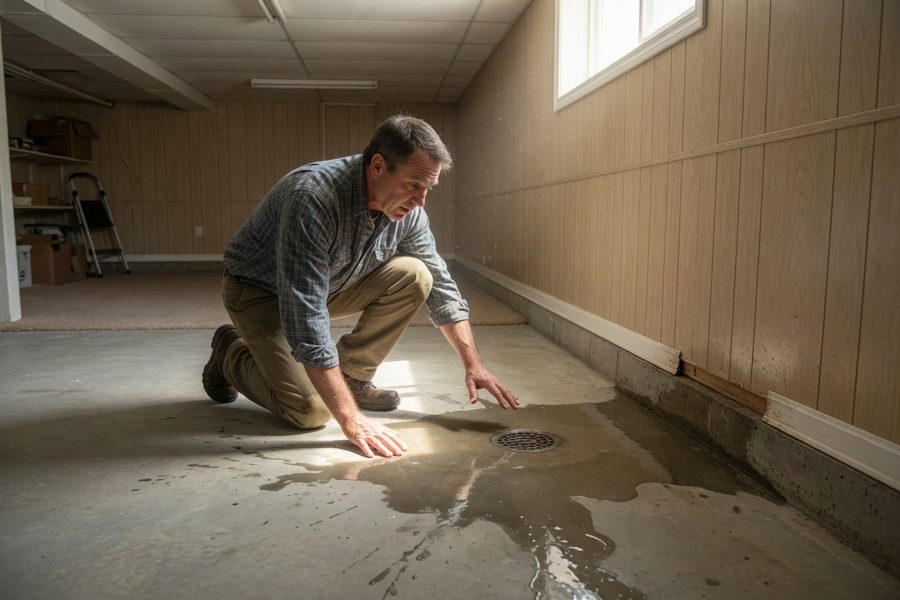
Coverage for structural finishes also varies within a policy. Dwelling coverage typically extends to attached features like drywall, flooring, and permanent lighting in a finished basement, but only for covered perils. If a fire damages the basement, you’re likely fully covered. If a backed-up sewer line soaks the same drywall, you’re not, unless you’ve purchased the endorsement. Personal property stored in the basement gets its own set of sublimits, which are addressed separately below.
Gradual leaks and seepage are almost never covered by standard homeowners policies. If water has been entering slowly over weeks or months and you didn’t catch it, the resulting mold and rot damage will likely fall entirely on you.
The Must-Have Water Backup and Sewer Endorsement
The water backup endorsement is not optional for a finished basement. It is the single piece of paper that stands between you and a five-figure out-of-pocket loss when a sump pump fails or a municipal sewer line backs up. Standard policies exclude damage from water that reverses course through drains, sump pits, and sewer lines. The endorsement fills that gap, extending coverage to drywall, carpet, baseboards, and built-in cabinetry that would otherwise have zero protection against the most common basement water peril.
Costs for this endorsement are modest relative to the exposure. Most insurers charge between $50 and $150 annually for $10,000 to $25,000 in water backup coverage, though limits can go higher. A homeowner who spent $35,000 finishing a basement should aim for a limit that covers full restoration, including tear-out, drying, and rebuild, not just surface cleaning. If your carrier caps the endorsement at $10,000, shop around. Some competitors offer $50,000 or more, and the premium difference is often under $100 per year.
| Coverage Limit | Typical Annual Premium | What It Restores |
|---|---|---|
| $10,000 | $50–$75 | Minor backup: tile floor, baseboard section, drying |
| $25,000 | $75–$125 | Moderate backup: drywall replacement, carpet, basic finishes |
| $50,000 | $100–$175 | Major backup: full gut and rebuild of finished space |
What the endorsement does not cover is equally important. Water backup coverage applies to internal drain and sump failures. It does not cover surface water, groundwater, or overland flooding. If a river overflows and water enters through a window well, that’s a flood claim, not a backup claim. The distinction is rigid; insurers will not blur it, and neither should your planning.
Confirm with your agent whether the water backup endorsement covers the cost of tear-out and debris removal, not just replacement materials. Without that provision, you could be left with a soggy, stripped room and no budget to finish the rebuild.
The frequency data backs up the urgency. Finished basements file water backup claims at a higher rate than any other part of the house, simply because the finishes turn a manageable cleanup into a structural restoration. Sump pumps fail during power outages, check valves stick, municipal systems overload during heavy rain. None of these events are floods in the legal or insurance sense, but all of them destroy drywall and flooring at the same speed. A solid homeowners insurance foundation is where coverage starts; endorsements are where it actually works.
Comparing Limits Across Carriers
Not all water backup endorsements are built alike. Some carriers bundle backup coverage with other water-related protections at a discount. Others sell it strictly a la carte with sublimits that cap well below the actual cost of basement restoration. When comparing quotes, request the endorsement’s exact sublimit, its deductible structure, and whether it includes coverage for the sump pump itself. A $750 deductible on a $15,000 backup claim leaves you writing a check that could have been avoided with the right policy design.
Flood Insurance Realities for Finished Basements
Flood insurance is a separate product, and for finished basements, it’s a deeply limited one. The National Flood Insurance Program (NFIP), administered by FEMA, explicitly restricts what it covers below grade. Building coverage extends to furnaces, water heaters, electrical panels, and foundation walls. It does not cover finished drywall, flooring, built-in shelving, or personal property stored in a finished basement. If you’ve turned your lower level into a guest suite with a bathroom and wet bar, an NFIP flood policy will pay to replace the water heater, and stop there.
The average NFIP claim payout across all water damage claims sits around $66,000, but that figure reflects whole-house flood losses, not basement-limited claims where the policy explicitly excludes the most expensive finishes. A homeowner with $40,000 in basement improvements may receive $5,000 to $8,000 from an NFIP policy after a flood, covering mechanicals and cleanup. The drywall, carpet, and cabinets come out of pocket.
Private flood insurers increasingly offer supplemental policies that cover finished basement improvements at higher limits than NFIP allows. Premiums are higher, often $500 to $1,200 annually depending on flood zone, but the coverage gap narrows considerably.
Whether you need flood insurance at all depends on your flood zone. Homes in designated Special Flood Hazard Areas with federally backed mortgages, loans backed by Fannie Mae, Freddie Mac, or FHA, must carry it. Homes outside those zones have no mandate, but finished basements in low-to-moderate-risk areas still flood; roughly 25% of NFIP claims come from properties outside high-risk zones. For a homeowner who just spent $50,000 on a basement renovation, a flood policy with a known coverage limit is a math problem, not a panic button. Run the numbers against the premium and decide whether the mechanicals-only payout justifies the cost.
Permits, Contractors, and Coverage Traps
Unpermitted work is a coverage landmine most homeowners don’t see until a claim is already open. Insurers routinely ask for permit records during a major loss investigation. If the finished basement was built without permits, or if the electrical and plumbing work was never inspected, the carrier may argue that the construction doesn’t meet code and reduce or deny the claim. The policy’s language around “ordinance or law” coverage comes into play here: if the work wasn’t legal to begin with, the insurer has a defensible reason to walk away.
Pulling permits adds cost and time during a renovation, and plenty of contractors will offer to skip the process to save both. That savings evaporates the moment an adjuster flags the omission. Homeowners who paid $30,000 for an unpermitted basement finish and then suffer a $25,000 water backup loss can find themselves with no coverage for the very room they just built. This is a standard exclusion tied to code compliance, not a rare edge case.
Contractor credentials matter, too. If you hire an unlicensed contractor and faulty workmanship causes a water loss, say, a poorly connected drain line under the basement bathroom, your insurer may cover the resulting water damage but then subrogate against the contractor. If that contractor has no license, no bond, and no assets, you’re the one holding the bill for the deductible and any uncovered portion. Verify a contractor’s license, insurance, and bonding before they start framing walls. State contractor licensing boards, which in most states fall under a Department of Consumer Affairs or similar agency, maintain public lookup tools for exactly this purpose.
Some policies include an exclusion for damage caused by “faulty, inadequate, or defective” workmanship. If a basement flood originates from a contractor’s error and the work wasn’t permitted, the insurer may deny the entire resulting water damage claim, not just the repair to the faulty pipe.
Personal Property and Contents in a Finished Basement
Personal property coverage in a basement is not the same as coverage in the main living areas. Most homeowners insurance policies include a sublimit for contents stored in below-grade spaces, and it’s often much lower than the overall personal property limit. A policy with $100,000 in total contents coverage might cap basement-stored items at $10,000 or $20,000. Homeowners who move a home office, a home theater system, or a full gym into a finished basement can exceed that sublimit without realizing it.
To get specific numbers, pull up your policy’s declarations page and look for the “personal property” or “contents” section. Find the sublimit labeled “property in basements” or “below-grade contents.” Compare that figure against what you actually have down there: furniture, electronics, exercise equipment, stored seasonal items, area rugs. If the gap is wide, talk to your agent about raising the sublimit or scheduling high-value items separately through a personal articles floater. Scheduling an item removes it from the sublimit and gives it its own coverage amount, often with no deductible.
| Item Category | Typical Basement Sublimit | Better Approach |
|---|---|---|
| Electronics (TV, audio) | $2,500–$5,000 aggregate | Schedule individually or raise sublimit |
| Furniture | $5,000–$10,000 aggregate | Increase personal property limit overall |
| Exercise equipment | Typically included in aggregate | Schedule high-value machines separately |
Loss of use coverage, Additional Living Expenses (ALE), also gets murky with finished basements. If a covered water loss makes the basement uninhabitable and that space was a primary bedroom or rental unit, you may qualify for hotel or temporary housing reimbursement while repairs are underway. But if the basement is a recreational space and the rest of the house remains livable, ALE coverage usually won’t kick in. The trigger is habitability, not inconvenience. Clarify this with your agent before a loss; the answer will shape whether you need to build a contingency fund for displacement costs.

How to Update Your Policy: Practical Steps and Conversations
Call your agent as soon as the drywall is hung and the flooring is in, don’t wait until the basement is fully furnished and you’ve hosted three gatherings. The conversation should cover raising your dwelling coverage (Coverage A) to reflect the new finished square footage, adding or increasing a water backup endorsement, and reviewing personal property sublimits for below-grade contents.
Come to that call with numbers. Provide the new finished square footage and a brief description of finishes: drywall, flooring type, bathroom fixtures, wet bar if applicable. If you have contractor invoices or a bid sheet, have those ready. Photos of the completed space help, too, your agent can forward them to the underwriter to support a higher coverage limit. The more documentation you provide at the outset, the less likely you’ll face a dispute at claim time.
While reviewing the water backup endorsement limit, compare it directly against your actual rebuild cost. If you finished the basement for $40,000 and the endorsement tops out at $10,000, you’ve identified a $30,000 exposure. Either raise the endorsement or switch carriers. While you’re at it, confirm that the endorsement covers tear-out, debris removal, and mold remediation triggered by the backup. Not all endorsements include those line items; some carriers treat them as separate sublimits.
Ask your agent to run a replacement cost estimator specifically for the finished basement. Most agents use software like 360Value or CoreLogic RCT that can isolate below-grade finished square footage, giving you a coverage number backed by data rather than guesswork.
Timing the update matters. If you wait until after a loss to disclose the renovation, the insurer can argue misrepresentation and adjust the claim downward. If you update the policy mid-renovation, confirm whether the new limits and endorsements take effect immediately or at the next renewal. Some carriers will endorse the policy mid-term; others require the changes to align with the renewal cycle. Know which one applies so you’re not exposed during the gap.
Finally, review your homeowners insurance for savings opportunities that might offset the premium increase. A finished basement often comes with upgraded electrical, new plumbing, and added security features, all of which can qualify for discounts that partially offset the higher dwelling coverage cost.
Anticipating and Managing Premium Changes
Finishing a basement will raise your premium. The increase reflects two things: a higher dwelling coverage limit and a higher risk profile. On average, adding $30,000 to $50,000 in dwelling coverage increases annual premiums by roughly $120 to $350, depending on your location, carrier, and claims history. The water backup endorsement adds another $50 to $175 on top of that. All told, a homeowner should budget an extra $200 to $500 per year after a basement renovation, less than $42 a month on the high end.
That increase is not spread evenly across carriers. Some insurers price finished basement risk more aggressively than others, particularly in regions with high water tables or aging municipal sewer systems. Shopping the policy at renewal can surface a carrier that charges $180 for the same coverage another quotes at $400. Submit identical coverage specifications to each insurer so the comparison is apples-to-apples: same dwelling limit, same water backup sublimit, same personal property structure.
| Premium Driver | Estimated Annual Cost | Negotiation Lever |
|---|---|---|
| Higher dwelling coverage (add $40K) | $120–$280 | Shop carriers; ask for reconstruction cost review |
| Water backup endorsement ($25K limit) | $75–$125 | Bundle with other endorsements; compare sublimits |
| Increased personal property | $30–$80 | Schedule high-value items vs. raising blanket limit |
Offsets That Reduce the Net Increase
Bundling home and auto with the same carrier typically saves 10% to 15% on the home policy, which can absorb most of the basement-related increase. Installing a water leak detection system with an automatic shutoff, brands like Moen Flo or Phyn, can earn a premium credit from some carriers, usually $30 to $80 annually. Upgrading the sump pump to a model with a battery backup can also trigger a discount, though the credit is smaller. Before accepting the first renewal quote, run through all three options with your agent.
Also consider raising your deductible. Moving from $1,000 to $2,500 can reduce the premium by 10% to 20%, which often covers the cost of the new endorsements. The tradeoff is that you’ll pay more out of pocket on a claim, so the math only works if you have the savings to cover the higher deductible comfortably. For a finished basement where claims tend to be larger anyway, a higher deductible paired with solid coverage limits is often the right balance.
Real-World Example: The Half-Finished Basement That Cost Double
Consider an illustrative example: a homeowner in suburban Chicago finishes 700 square feet of basement for $38,000, adding a bathroom, luxury vinyl plank flooring, and drywall throughout. The renovation is complete in May. The homeowner intends to call their insurer but puts it off. In August, a heavy storm overloads the municipal sewer system. Water backs up through the floor drain, soaking the flooring, wicking into the drywall, and ruining a sectional sofa and entertainment center.
The homeowner files a claim. The standard policy covers the burst-pipe scenarios but excludes sewer backups, no water backup endorsement was ever added. The claim is denied for the finishes. The homeowner pays $31,000 out of pocket for tear-out, mold remediation, drywall replacement, and new flooring. The personal property loss adds another $6,000 for the sofa and electronics, partially covered under a general contents limit but reduced by a basement sublimit of $5,000.
Had the homeowner updated the policy immediately after the renovation, raising dwelling coverage, adding a $50,000 water backup endorsement ($140 annual premium), and increasing the basement contents sublimit to $15,000, the out-of-pocket cost after a $1,000 deductible would have been $1,000 instead of $34,000. The annual premium increase for all updates was roughly $310. That’s the difference between a policy that matches the house and one that doesn’t.
Your Action Plan
-
Notify your insurer the week the renovation is complete
Call your agent as soon as drywall and flooring are installed. Provide finished square footage, description of finishes, and total project cost. Waiting until the next renewal or until a loss occurs creates a coverage gap that the insurer can use to reduce or deny a claim.
-
Raise dwelling coverage to reflect the new rebuild cost
Have your agent run a replacement cost estimator that includes the finished basement. Increase Coverage A so it matches the estimator’s output. A shortfall here means proportional claim reduction on a total loss.
-
Add or increase a water backup and sewer endorsement
Match the endorsement limit to the full cost of restoring the finished space, tear-out, materials, and labor. A $10,000 endorsement on a $40,000 basement leaves an unacceptable gap. Expect to pay $75 to $175 annually for adequate coverage.
-
Review the basement contents sublimit and adjust it upward
Inventory everything stored in the basement: furniture, electronics, exercise equipment, seasonal items. Compare the total value against your policy’s below-grade sublimit. If the gap exceeds $5,000, raise the sublimit or schedule high-value items individually.
-
Confirm permit and contractor documentation is on file
Keep copies of all permits, inspection sign-offs, and contractor license and insurance certificates. These documents are your defense against a claim denial based on code compliance or faulty workmanship exclusions.
-
Evaluate flood insurance, even outside a high-risk zone
If your area has any flood history, price an NFIP policy and a private flood option. Accept that finished basement coverage under NFIP is extremely limited and budget accordingly. Private policies may fill that gap at a higher premium.
-
Shop the updated policy across at least three carriers
Submit identical coverage specifications to multiple insurers. A $400 annual difference for the same protection is common. Include the water backup endorsement and raised contents sublimit in every quote request.
-
Install leak detection and a battery-backup sump pump
These hardware upgrades can earn premium credits and, more importantly, prevent the loss from happening at all. A sump pump with a battery backup costs $250 to $500 installed and can stop a $20,000 backup claim before it starts.
Related reading: homeowners policy really protecting roof.
Related reading: general insurance policy doesn’t cover.
Frequently Asked Questions
Does standard homeowners insurance cover water damage in a finished basement?
Standard policies cover sudden and accidental water damage from internal sources like burst pipes, broken appliance hoses, and toilet overflows. They exclude damage from sewer backups, sump pump failures, groundwater seepage, and overland flooding. A finished basement needs a water backup endorsement to cover the most common sources of water damage.
How much does a water backup endorsement cost?
Most insurers charge between $50 and $175 annually for coverage limits from $10,000 to $50,000. The exact premium depends on your location, the coverage limit you select, and the carrier’s pricing for water-related risks. Higher limits cost more but close the gap between what the policy pays and what full restoration actually requires.
Will my premium go up if I tell my insurer I finished the basement?
Yes. Expect an increase of roughly $120 to $350 per year from a higher dwelling coverage limit, plus $50 to $175 for a water backup endorsement. The total annual increase typically falls between $200 and $500. That increase buys coverage that matches the actual value of your home and protects against the most likely basement loss scenario.
What happens if I don’t tell my insurer about the finished basement?
Your policy’s dwelling coverage will not reflect the added value, leaving you underinsured. On a total loss, a coinsurance clause could reduce your payout proportionally. On a basement-specific water claim, the insurer may investigate whether the renovation complied with code and permits; unpermitted work can trigger a denial. The safest course is to disclose the renovation immediately after completion.
Does flood insurance cover a finished basement?
NFIP flood insurance covers mechanical systems, furnace, water heater, electrical panels, in a basement. It excludes finished improvements like drywall and flooring, as well as most personal property stored below grade. Private flood policies may offer broader coverage for finished spaces but at a higher premium, generally $500 to $1,200 annually.
Are my belongings in the finished basement fully covered?
Not automatically. Most homeowners policies include a sublimit for personal property stored in basements, often $5,000 to $10,000 regardless of the overall contents limit. If you have furniture, electronics, or exercise equipment exceeding that amount, raise the sublimit or schedule high-value items individually through a personal articles floater.
Does unpermitted basement work void my insurance?
It can. If a loss originates from or is worsened by unpermitted construction, the insurer may deny the claim based on code compliance exclusions. Insurers routinely request permit records during claim investigations. Permits and inspections protect your coverage as much as they protect the construction quality.
Will my policy cover temporary housing if the finished basement is damaged?
Additional Living Expenses coverage applies only if the home becomes uninhabitable. A damaged basement that serves as a primary bedroom or rental unit may trigger ALE. A recreational basement that leaves the main living areas functional will not. Confirm the habitability standard with your agent so you know when displacement costs are covered.
Sources
- Insurance Information Institute, Facts + Statistics: Homeowners and Renters Insurance
- Insurance Information Institute, How to Protect Your Home From Water Damage
- FEMA, Flood Insurance
- Texas Department of Insurance, When Are Water Damage and Mold Covered by Insurance?
- Wisconsin Office of the Commissioner of Insurance, Water Damage and Your Insurance
- Insurify, Water Damage Statistics
- Smart Insurance 101, Homeowners Insurance Guide: A Beginner’s Overview
- Smart Insurance 101, Liability Insurance: Why Lawsuits Are Quietly Getting More Expensive
- Smart Insurance 101, How to Save Money on Your Homeowners Insurance
- Smart Insurance 101–8 Reasons You Need Home Insurance
- Smart Insurance 101, Important Homeowners Insurance Policies You Should Know
- Smart Insurance 101, Are You Covered for Anything That Can Happen to Your Home and Belongings?


