
Reviewed by the Smart Insurance 101 Editorial Team
Our Take
For most cruise travelers, a third-party policy with at least $250,000 in medical evacuation coverage and a missed-port benefit of $250–$500 per stop beats both cruise-line insurance and generic travel policies. Ship-to-shore evacuations can exceed $250,000 out of pocket, and two missed ports can return more than the entire premium. The case against it: third-party cruise insurance costs 4% to 10% of your trip total, and travelers with fully refundable bookings or weekend itineraries may never trigger enough benefits to break even.
The cruise industry is racing toward a record year. AAA projects 21.7 million Americans will take an ocean cruise in 2026, and with that volume comes more itinerary disruptions, more onboard medical events, and more travelers stunned to learn their standard insurance coverage falls short the moment they leave port. The best travel insurance for cruise vacations addresses risks that simply do not exist on land, and that most general travel policies never touch.
This article is for cruisers who want to know exactly what coverage gaps exist, which benefits actually pay out, and where the value breaks. I will walk through the specific numbers that make the recommendation work, and name the scenarios where it does not.
Key Takeaways
- 10% of cruise ship medical cases are emergencies or require urgent care, according to the CDC’s 2025 data, and ship infirmaries are not equipped for serious intervention.
- Uninsured medical evacuation from a cruise ship can exceed $250,000, per Squaremouth’s industry analysis, a cost most travelers never anticipate.
- Roughly 95% of onboard illnesses or injuries are treated ship-side, but the CDC confirms the remaining 5% require evacuation or shoreside care, the exact scenario where coverage limits matter most.
- Comprehensive cruise insurance costs 4% to 10% of total trip expenses, based on Squaremouth’s 2026 rate data, and missed-port payouts alone can recover that cost after one or two skipped stops.
- In our experience, cruise-line insurance almost never matches third-party medical and evacuation limits, the convenience is real, but the coverage gap is wider than most travelers assume.
Why Standard Travel Insurance Fails Cruise Travelers
Standard travel insurance is built for land. It covers flight delays, lost luggage, hotel cancellations, the friction points of air and ground travel. A cruise introduces a different risk profile entirely, and most generic policies ignore it.
The fundamental problem is jurisdiction. Once a ship enters international waters, U.S. health insurance, including Medicare, typically provides zero coverage. The ship’s infirmary operates as a cash-based facility. If you need advanced care, the evacuation is coordinated through a foreign port, often at a cost that dwarfs what domestic medical transport costs. A basic travel policy with $50,000 in emergency medical coverage might cover a land ambulance and an ER visit in Cancun. It will not cover a helicopter evacuation from a ship 200 miles offshore.
Then there is the itinerary problem. Cruises visit multiple ports. Weather, mechanical failure, or a medical diversion can scrub a scheduled stop with no warning. The cruise line refunds port fees, usually $15 to $30 per person, and nothing else. If you booked independent excursions, you eat the loss. Standard trip insurance does not recognize a missed port as a covered event unless the entire trip is delayed or cancelled.
What I see in practice: The single most common complaint I hear from first-time cruisers is some version of “I paid for insurance and it covered nothing.” In nearly every case, they bought a policy that excluded missed-port benefits and capped medical evacuation at $50,000 or less, adequate for a resort vacation, dangerously thin for a ship at sea.
Cruise-specific policies close these gaps by design. They treat missed ports as standalone claim events. They carry medical evacuation limits of $250,000, $500,000, or even $1 million. And they recognize that a cruise is not just a trip, it is a floating sequence of destinations, each with its own financial exposure.
The Coverages That Make the Best Travel Insurance for Cruise Vacations
Not every cruise insurance benefit deserves equal attention. Three coverages matter more than everything else combined: medical evacuation limits, missed-port reimbursement, and onboard medical coverage with a pre-existing condition waiver. Everything else, trip cancellation, baggage delay, travel assistance hotlines, is secondary. Those are standard in any competent travel policy. The best travel insurance for cruise vacations distinguishes itself on the marine-specific benefits.
Medical evacuation is the non-negotiable starting point. The CDC reports that roughly 5% of onboard acute cases cannot be managed in the ship infirmary and require shoreside care or evacuation. Squaremouth puts the uninsured cost of a ship-to-shore evacuation at more than $250,000. A policy with a $50,000 limit leaves a six-figure gap. The right number is $250,000 minimum, $500,000 preferred, and several top plans now offer $1 million.
Missed-port coverage works differently than most travelers expect. It is not reimbursement for the port fees you lost. It is a fixed cash payment, typically $250 to $750 per missed stop, that triggers when the ship skips a scheduled port for a covered reason like weather, mechanical issues, or a natural disaster. You do not need to prove a financial loss. You file a claim with proof that the port was missed, and the insurer pays the flat amount. This is where the economics of cruise insurance get interesting.
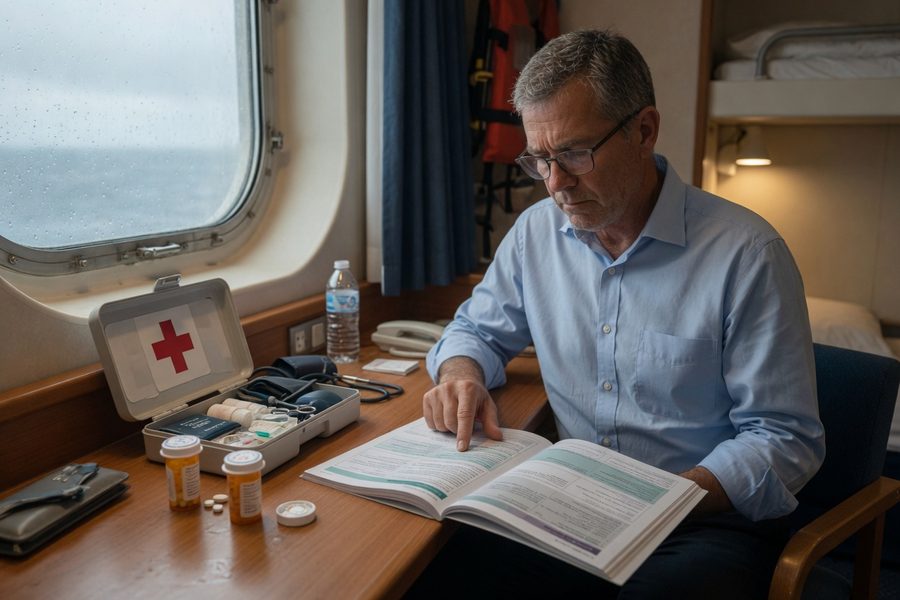
Medical Coverage at Sea: What the Ship Can and Cannot Handle
Ship infirmaries are equipped for stabilization, not treatment. According to the CDC, about 95% of onboard medical cases are managed without evacuation, but that statistic masks a critical detail. “Managed” often means the ship’s doctor stabilizes a passenger with a cardiac event or a fracture and then arranges evacuation at the next port. The infirmary handles seasickness, minor lacerations, and upper respiratory infections. It does not perform surgery. It does not have an ICU. If a passenger needs a ventilator or a CT scan, they are leaving the ship.
This is why primary medical coverage matters. Some cruise insurance policies provide secondary coverage only, meaning they pay after your regular health insurance. But since most U.S. health plans provide zero coverage in international waters, secondary coverage effectively leaves you filing two claims, one of which will be denied, while the insurer waits for the primary denial before processing yours. Primary medical coverage pays first, with no requirement to involve your health insurer. It is a cleaner process, and it is standard in the best third-party cruise plans.
The Pre-Existing Condition Window
Cruise travelers over 50 should pay especially close attention here. Most cruise insurance policies exclude pre-existing conditions unless you purchase within a specific window after your initial trip deposit, typically 14 to 21 days, though some plans extend this to 30 days. Miss the window, and a cardiac event tied to a documented heart condition becomes a denied claim. This is not cruise-line specific; it is standard across the industry, and it is the reason to buy insurance the same week you book your cruise.
Where this gets tricky: The pre-existing condition clock starts on the date of your first trip payment, not the sail date. I have seen travelers book a cruise 18 months out, wait until final payment to buy insurance, and then discover their hypertension is excluded. The 14-to-21-day window is absolute with most carriers.
How Missed Ports Coverage Actually Pays Out
Missed-port coverage is the benefit that makes cruise insurance worth the premium for most travelers. The math is straightforward. A comprehensive cruise policy for a $5,000 trip costs 4% to 10% of the trip total, or roughly $200 to $500. One missed port with a $500 per-person benefit covers the entire premium. Two missed ports, common on weeklong Caribbean itineraries during hurricane season, and the policy has more than paid for itself before you factor in any medical coverage.
The payout structure varies by plan. Tin Leg Cruise pays $500 per missed port per person. Travel Guard Preferred caps missed-port benefits at $250. Berkshire Hathaway WaveCare includes itinerary change coverage that can reimburse unused excursion costs in addition to a fixed missed-port payment. The fixed-amount benefit is the simpler claim: you submit documentation from the cruise line confirming the port was skipped, and the insurer sends payment. No receipts required. The itinerary-change reimbursement requires proof of non-refundable excursion costs and pays actual losses.
Cruise lines themselves refund only port fees and taxes, typically $15 to $30, plus any excursions booked directly through the line. Independent excursions, private tour guides, and non-refundable activity deposits are your loss. A cruise insurance policy with $500 in missed-port benefits transforms an itinerary disruption from a financial loss into a net gain. That is not marketing language. It is the arithmetic of fixed-amount benefits.
| Plan | Missed Port Benefit | Medical Evacuation Limit | Pre-Existing Waiver Window |
|---|---|---|---|
| Tin Leg Cruise | $500 per person per port | $500,000 | 15 days |
| Berkshire Hathaway WaveCare | $500 per person per port + excursion reimbursement | $1,000,000 | 21 days |
| Travel Guard Preferred | $250 per person per port | $500,000 | 15 days |
| IMG iTravelInsured Choice Cruise | $750 per person per port | $500,000 | 21 days |
One detail worth underlining: most missed-port benefits only trigger for specific covered reasons. Weather, mechanical breakdown, and natural disasters are standard. A schedule change for commercial reasons, the cruise line decides to swap one port for another because of docking conflicts, is typically excluded. Read the covered-reason list in the policy certificate. If it does not specify “missed port of call” as a named benefit with its own trigger language, it is not the right policy.
Onboard Medical: The Numbers That Should Worry You
The CDC’s data draws a sharp line between what cruise ship infirmaries can and cannot do. 10% of all conditions reported to cruise medical centers are emergencies or require urgent care. The other 90% are routine, seasickness, sunburn, minor infections. But that 10% represents thousands of passengers annually, and for them, the difference between a $500 policy premium and a $250,000 evacuation bill is everything.
The worked example: a 65-year-old couple on a 10-night Mediterranean cruise books a $7,000 trip. A third-party policy from Tin Leg Cruise costs roughly $420 at 6% of the trip total. On day six, the ship diverts for a medical emergency involving one passenger, their port call in Santorini is skipped. The missed-port benefit pays $500 per person, or $1,000 total. The policy has already returned more than double its cost, and the medical coverage has not even been touched.
The Top Cruise Insurance Plans for 2026
After comparing quotes across multiple aggregators, four plans consistently surface as the strongest cruise-specific options for 2026. Each of these includes missed-port benefits, high medical evacuation limits, and primary medical coverage. The differences come down to benefit caps, pre-existing condition windows, and pricing for older travelers.
Berkshire Hathaway WaveCare carries the highest evacuation limit at $1 million and includes both fixed missed-port payments and excursion reimbursement. It is priced at the higher end of the 4% to 10% range but becomes cost-competitive for expensive itineraries where the evacuation exposure justifies the premium.
Tin Leg Cruise is the mid-market standout, $500 per missed port, $500,000 in evacuation coverage, and a 15-day pre-existing condition window. For a typical seven-night Caribbean cruise in the $3,000 to $5,000 range, it hits the coverage-to-cost sweet spot.
IMG iTravelInsured Choice Cruise offers the highest per-port missed-port benefit at $750 per person. If your itinerary includes multiple tender ports, destinations where weather frequently prevents docking, that higher per-port payout adds up fast.
Travel Guard Preferred caps missed-port benefits at $250 but includes strong trip interruption coverage and is widely available through comparison sites like Squaremouth and InsureMyTrip. It works best for travelers more concerned about trip cancellation than itinerary disruption.

Third-Party vs. Cruise Line Insurance: The Gap Is Wider Than You Think
Cruise line insurance is convenient. You check a box during booking, the cost is added to your invoice, and you move on. The coverage is typically underwritten by a major carrier, Nationwide, AIG, or Allianz, so the brand name provides comfort. But the benefit structure is almost always thinner. Cruise line policies routinely cap medical evacuation at $50,000 or $100,000. They rarely include missed-port benefits. And pre-existing condition waivers are uncommon or come with restrictions that third-party plans do not impose.
The price difference is not dramatic. Cruise line insurance often costs 5% to 8% of the trip total, comparable to third-party plans. But the coverage is narrower for the same money. The best travel insurance for cruise vacations nearly always comes from a third-party insurer that builds cruise-specific benefits into the policy architecture, not from a cruise line that tacks insurance onto a booking flow.
One exception: some premium cruise lines, including certain Viking and Regent Seven Seas policies, bundle evacuation coverage with higher limits into their travel protection. If your cruise line’s policy includes $250,000 or more in evacuation coverage and a missed-port benefit, it may be sufficient. But verify the certificate wording. Do not rely on the marketing summary.
Where This Recommendation Falls Short
The strongest counterargument against buying comprehensive third-party cruise insurance is this: most cruises go exactly as planned. Ships hit their ports. Nobody gets seriously ill. The policy premium, $300, $500, sometimes $700 for a longer sailing, becomes a sunk cost with zero return. For travelers who cruise frequently and have never filed a claim, the cumulative premiums across multiple sailings can exceed $2,000 or $3,000 over a few years with nothing to show for it. That is not a flaw in the product; it is the nature of insurance. But it is a real tradeoff, and it is the reason some experienced cruisers self-insure.
There is a specific profile of traveler who should skip cruise-specific insurance. If you book fully refundable fares, carry an annual medical evacuation membership like Medjet Horizon or Global Rescue, and travel with a health insurance plan that includes international coverage with evacuation riders, the incremental benefit of a cruise policy shrinks considerably. The draw of a missed-port payout, nice to have, but not covering a catastrophic exposure, may not justify the added cost.
The risk of self-insuring is the evacuation exposure. A $250,000 helicopter transport is not theoretical. It happens. The 5% of onboard cases that require evacuation or shoreside care represent real people, and while the absolute probability for any single traveler is low, the financial consequence is severe enough that for most, the insurance premium is rational. But “most” is not “all.” If your net worth can absorb a six-figure medical bill without material damage, you may be better served by an evacuation-only policy paired with trip cancellation coverage from a premium credit card.
The catch with missed-port payouts: they are small relative to the trip cost for high-end cruises. A $500 per-port benefit on a $15,000 Antarctic expedition is trivial. The evacuation limit matters far more. On an expensive sailing, prioritize medical and evacuation limits over itinerary benefits. The per-port payout is the icing, not the cake.
How We Sourced This
This article draws on 2025 cruise ship medical data from the CDC’s Yellow Book, 2026 cruise passenger projections from AAA, and 2026 premium-rate ranges and evacuation cost estimates from Squaremouth. Policy-specific missed-port benefit amounts and pre-existing condition waiver windows were pulled from current plan certificates available through Squaremouth and InsureMyTrip. Coverage comparisons between third-party and cruise-line policies are based on publicly available benefit summaries from major cruise lines and insurers. All figures were last verified in July 2026.
Frequently Asked Questions
Does travel insurance cover missed ports on a cruise?
Only if the policy explicitly includes a missed-port or itinerary-change benefit. Standard travel insurance policies do not recognize a missed port as a covered event. Cruise-specific plans from carriers like Tin Leg, Berkshire Hathaway, and IMG pay a fixed amount, typically $250 to $750 per missed port, when the ship skips a scheduled stop for a covered reason like weather or mechanical failure.
How much does cruise travel insurance cost?
Cruise travel insurance typically costs 4% to 10% of your total insured trip expenses, according to Squaremouth’s 2026 data. A $5,000 cruise would carry a premium of roughly $200 to $500. The exact percentage depends on your age, trip cost, itinerary, and the specific benefits included in the policy.
What happens if I need medical care on a cruise ship?
Ship infirmaries can stabilize most conditions, approximately 95% of cases are managed onboard, per the CDC. But the infirmary is not a hospital. For serious conditions like cardiac events, fractures requiring surgery, or respiratory failure, the ship will arrange evacuation to the nearest appropriate shoreside facility. Without insurance, that evacuation can cost over $250,000 out of pocket.
Is cruise line insurance better than third-party insurance?
In most cases, no. Cruise line insurance is convenient but typically carries lower medical evacuation limits, often $50,000 to $100,000, and rarely includes missed-port benefits. Third-party cruise-specific policies consistently offer higher evacuation limits, broader medical coverage, and the missed-port payouts that make the premium worthwhile. If your cruise line’s policy includes $250,000 or more in evacuation coverage, it may be adequate, but verify the certificate wording.
Does cruise insurance cover itinerary changes due to weather?
Yes, for covered weather events. If a hurricane, tropical storm, or severe weather forces the ship to alter its route or skip ports, a cruise-specific policy with missed-port or itinerary-change benefits will pay. The fixed-amount missed-port benefit requires only proof that the port was skipped. Itinerary-change reimbursement for unused excursions typically requires receipts and proof of non-refundable costs.
Can I get coverage for pre-existing conditions on a cruise?
Yes, but only if you purchase the policy within the waiver window, usually 14 to 21 days after your initial trip deposit. Most cruise insurance policies exclude pre-existing conditions by default. The waiver removes that exclusion if you buy early and meet the policy’s other eligibility requirements. Waiting until final payment to buy insurance almost always means losing pre-existing condition coverage.
When should I buy cruise travel insurance?
Within 14 to 21 days of your first trip payment. This triggers the pre-existing condition waiver on most policies and locks in coverage for trip cancellation due to unforeseen illness or injury. Buying early also ensures you are covered if a hurricane or other event threatens your sailing before final payment. You cannot buy coverage after a storm is named and expect it to apply.
Sources
- CDC Yellow Book, Cruise Ship Travel: Medical Care and Evacuation Data
- Squaremouth, Cruise Travel Insurance: Evacuation Costs and Premium Ranges
- AAA, 2026 Cruise Forecast: 21.7 Million Americans Projected
- InsureMyTrip, Cruise Insurance Plan Comparisons and Benefit Details
- Travel Guard, Preferred Plan Benefit Summary: Missed Port Coverage