
Fact-checked by the Smart Insurance 101 editorial team
Quick Answer
If convicted of DUI, you’ll typically need an SR-22 filing for 3 years, costing an average of $1,204 annually in premiums, plus a $15–$25 one-time filing fee. The SR-22 is a certificate proving you carry minimum liability coverage; any lapse triggers immediate license suspension.
An SR-22 insurance DUI filing is not a separate insurance policy, it’s a state-mandated certificate your insurer submits to the DMV to prove you meet minimum liability requirements after a DUI conviction. Here’s the thing: the real cost isn’t the filing fee; it’s the premium hike. Drivers convicted of DUI pay an average of $1,204 per year, according to WalletHub’s 2024 analysis.
The stakes are high, many states restart the clock if your coverage lapses, and Alaska requires up to life for repeat offenses. In this article, you’ll learn exactly how long you must carry SR-22, what it costs, and the steps to get licensed again without costly missteps.
Key Takeaways
- The average annual premium for SR-22 insurance after a DUI is $1,204 (WalletHub, 2024).
- DUI-related rate hikes can reach a maximum of 103% above a driver’s previous premium (WalletHub, 2024).
- The SR-22 filing fee itself typically costs only $15 to $25 one‑time, paid to the insurer (WalletHub, 2024).
- Most states require 3 years of continuous SR-22 coverage after a DUI, but Texas requires 2 years and Alaska extends to life for repeat offenses (Texas DPS; Alaska DMV).
- Any lapse in coverage triggers automatic DMV notification and license suspension, often resetting the SR-22 clock entirely (Colorado DMV).
In This Guide
SR-22 Insurance DUI: What It Is and Why You Need It
An SR-22 is a financial responsibility certificate your auto insurer files with the Department of Motor Vehicles to prove you carry at least the state’s minimum liability insurance. After a DUI conviction, nearly every state requires this filing before you can reinstate a suspended or revoked license. Colorado DMV explicitly states: “Drivers may be required to file an SR-22 when reinstating from DUI‑related suspensions or revocations.”
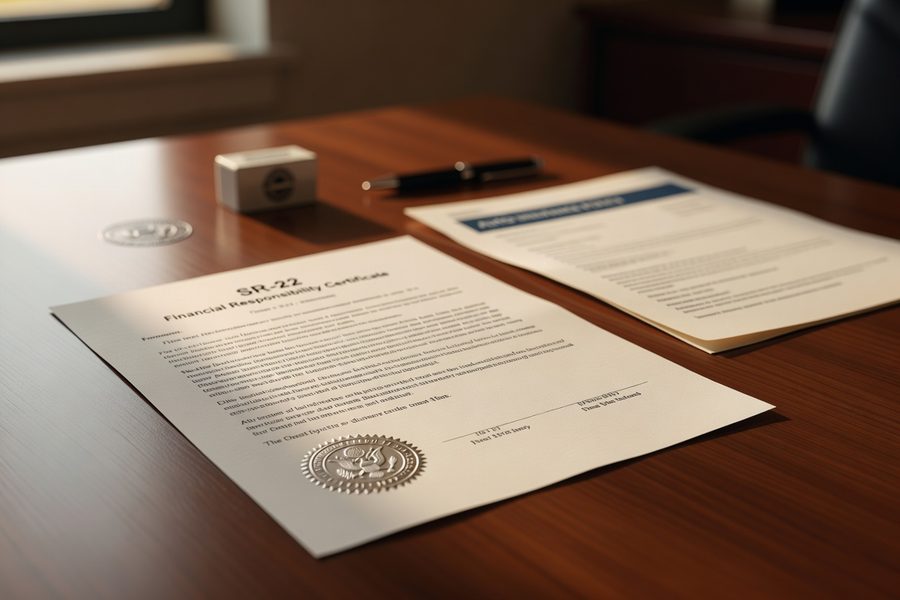
It doesn’t replace your auto policy. You still need standard car insurance coverage; the SR-22 simply attaches to it. An SR-22 can be required for any vehicle you drive, and your insurer must notify the DMV immediately if the policy cancels, resulting in a fresh license suspension.
SR-22 vs. Insurance: Clearing Up the Confusion
The common mix‑up comes from calling it “SR‑22 insurance.” You’re not buying a new product; you’re adding a filing to an existing or new high‑risk auto policy. The form itself, known as an SR‑22 in most states, proves you meet minimum liability limits. Your insurer charges a modest filing fee and then reports your coverage status to the state. That’s the full scope of it. The state then knows in real time that you’re meeting your financial responsibility obligation after a DUI.
Some states, notably Florida and Virginia, require an FR‑44 instead of an SR‑22 after a DUI. An FR‑44 demands higher liability limits: often double the state’s standard minimum, which pushes premiums even higher.
How Long Do You Have to Keep an SR-22 After a DUI?
Most states mandate 3 years of uninterrupted SR‑22 coverage after a DUI, but the start date matters. Some count from the conviction date; others from the date you become eligible for reinstatement. The look‑back and clock‑reset rules vary so widely that a single slip‑up can add years to your requirement. Below is a snapshot of the most common, and most extreme, scenarios.
| State | SR‑22 Duration | Start of Clock |
|---|---|---|
| Texas | 2 years | Date of conviction requiring SR‑22 |
| Nebraska | 3 years | Date eligible for reinstatement |
| Alaska (1st DUI) | 5 years | End date of revocation |
| Alaska (2nd DUI) | 10 years | End date of revocation |
| Alaska (3rd DUI) | 20 years | End date of revocation |
| Alaska (4th DUI) | Life | End date of revocation |
Texas DPS keeps it straightforward: 2 years from the most recent conviction. In Nebraska, the 3‑year window starts when you become eligible for reinstatement, not the date of the court order. And Alaska stretches the requirement dramatically for repeat offenses: five years for a first, ten for a second, twenty for a third, and life for a fourth. Vermont, meanwhile, runs the 3‑year clock from the date of the event that triggered the requirement.
Why the Start Date Changes Everything
If the clock doesn’t start until you’re eligible for reinstatement, months spent completing suspension requirements don’t count toward your SR‑22 term. A driver in Nebraska could wait out a 6‑month hard suspension, pay fines, and then face a fresh 3‑year SR‑22 obligation. That’s a real difference from Texas, where the expiration date is locked to the conviction date and doesn’t shift.
The average U.S. driver pays $1,204 per year for SR‑22‑related auto insurance after a DUI, a premium that compounds over the full filing period.
How Much Does SR-22 Insurance Cost After a DUI?
The filing fee itself is negligible: typically $15 to $25, paid once when your insurer submits the form. The real budget breaker is the premium increase. WalletHub found that a DUI can drive annual rates up by a maximum of


