Fact-checked by the Smart Insurance 101 editorial team
Quick Answer
Car insurance for college students costs an average of $7,146 per year on a solo policy for an 18-year-old, but staying on a parent’s policy cuts that to roughly $4,079 annually. Students who qualify for good-student or distant-student discounts can reduce that figure further, often by 15–25%.
Car insurance for college students is expensive by default. Insurers price young drivers as high-risk because statistical claims data backs that up, not because they are being arbitrary. According to insurance.com’s 2025 rate analysis, an 18-year-old buying a solo full-coverage policy pays an average of $7,146 per year, while the same student added to a parent’s policy pays about $4,079. That $3,067 annual gap is the single most important number any college student should know before making a coverage decision.
The gap between what you pay and what you could pay is often significant, and the strategies to close it are straightforward. This guide covers when to stay on a family policy, which discounts are worth pursuing, how to handle out-of-state school situations, and where most students leave money on the table.
Key Takeaways
- An 18-year-old on a solo policy pays an average of $7,146 per year, compared to $4,079 when added to a parent’s full-coverage policy (insurance.com, 2025).
- By age 21, the cost of staying on a parent’s policy drops to roughly $3,030 per year, a $1,049 decrease from the 18-year-old rate (insurance.com, 2025).
- Adding a teenage driver can increase a family’s auto coverage by 50 to 100 percent, depending on the student’s age and driving history (Insurance Information Institute, 2025).
- State Farm’s good-student discount reaches up to 25% off for qualifying GPAs, among the highest offered by any major carrier in the U.S.
- Distant-student discounts typically apply when school is at least 100 miles from home and the car stays with the parents, directly reducing the usage-based risk insurers price into premiums.
In This Guide
- Why College Students Face Higher Car Insurance Rates
- Should You Stay on Your Parents’ Policy or Get Your Own?
- Student-Specific Discounts That Actually Save Money
- Choosing the Right Coverage Levels Without Overpaying
- What Happens to Your Coverage When You Go to School Out of State?
- Smart Shopping Strategies to Find the Best Rates
Why College Students Face Higher Car Insurance Rates
Age and inexperience are the two largest rating factors working against college students. Insurers use actuarial data showing that drivers under 25, particularly those under 21, have significantly higher crash rates than older drivers. That risk gets priced into every premium, regardless of how careful any individual student claims to be.
What the Numbers Actually Look Like
According to Forbes Advisor’s rate data, the average annual cost of car insurance for an 18-year-old driver is $6,779. That figure shifts depending on the state, vehicle, and coverage tier, but the direction is consistent: young drivers pay a steep premium. CNBC Select’s 2025 analysis puts the average at $3,996 per year for an 18-year-old on a parent’s policy, which aligns closely with other independent estimates.
Location compounds the problem. A student attending school in an urban area with heavy traffic and higher theft rates will pay more than one in a rural college town, even with identical driving records. If school is in a different state, that state’s minimum coverage requirements and local risk factors apply, which can push rates up or down unpredictably. The Texas Department of Insurance advises students to let their agent know when attending school in a different city or state, since the change in location may raise or lower the premium.
Adding a teenage driver to a family auto policy can increase total premiums by 50 to 100 percent, according to the Insurance Information Institute. For context, if a family currently pays $1,800 per year, that addition could push the bill to $2,700–$3,600.
Should You Stay on Your Parents’ Policy or Get Your Own?
For most college students, staying on a parent’s policy is the cheaper option by a wide margin. The math is clear: an 18-year-old pays an average of $7,146 annually on a solo policy versus $4,079 on a family policy, a difference of $3,067 per year, or roughly $255.58 per month. Over four years of college, that gap compounds to more than $12,000.
When Getting Your Own Policy Makes Sense
The calculus changes in specific situations. If you own the vehicle in your name, or if you live permanently at an address other than your parents’ home, most insurers require a separate policy anyway.
Students should also get their own, separate policy if they permanently live elsewhere (not in a parent’s home), particularly if they have a vehicle titled in their own name.
The Wisconsin Office of the Commissioner of Insurance makes this explicit: if you own your vehicle, you need your own individual policy, and auto insurance is mandatory. Driving a parent-owned car at school is a different situation, typically still covered under the family policy, but ownership changes the requirement entirely.
Students with thin credit files or no established credit history face an additional wrinkle. Most states allow insurers to use credit-based insurance scores when setting premiums. A student with no credit history often receives a neutral or unfavorable score by default, which can push an independent policy even higher than the averages shown above. Staying on a parent’s established policy sidesteps that problem entirely, since the parent’s credit profile anchors the rate.

By age 21, the average cost of being on a parent’s full-coverage policy drops to $3,030 per year, down from $4,079 at age 18. That $1,049 annual decrease happens automatically as a student ages, without any action required.
Student-Specific Discounts That Actually Save Money
Two discounts stand out as genuinely valuable for college students: the good-student discount and the distant-student discount. Most major carriers offer both, but the qualifying criteria and savings percentages vary enough that it is worth asking specifically about each one.
Good-Student and Distant-Student Discounts Compared
The good-student discount is the more widely known of the two. State Farm’s version reaches up to 25% off for students with a B average or better, one of the highest percentages among major U.S. carriers. GEICO, Allstate, and Progressive offer similar programs, typically in the 8–15% range, with GPA thresholds that usually require at least a 3.0 on a 4.0 scale. Students need to provide a transcript or report card annually to keep the discount active.
The distant-student discount is less understood but equally useful. It applies when a student leaves the car at home and attends school at least 100 miles away. The insurer reduces the premium because the student is no longer a regular driver of the vehicle. Savings typically range from 10 to 30% on the student’s portion of the policy, depending on the carrier. One firm condition: if the car comes to campus, the discount disappears. If your student is going to school far from home without a car, this is one of the easiest discounts to claim.
According to Ron Hettler, President of Hettler Insurance Agency, the distant-student discount can decrease rates by more than $1,000 annually, depending on the student’s age and driving record.
Choosing the Right Coverage Levels Without Overpaying
Minimum liability coverage is cheaper upfront, but it creates real financial exposure for college students who get into a serious accident. State minimums are often too low to cover the actual cost of injuries or vehicle damage in a significant crash.
Full Coverage vs. Liability-Only: The Trade-Off
If the student drives an older car worth less than $4,000, dropping collision and comprehensive coverage may make sense. The standard rule of thumb: if the annual cost of collision plus comprehensive exceeds 10% of the car’s actual cash value, the coverage is probably not worth the cost. For a car worth $3,000, that threshold is $300 per year. Many students pay more than that, and the insurer will never pay out more than the car’s market value anyway.
Higher deductibles are one of the most effective ways to lower monthly premiums without eliminating coverage. Raising a deductible from $500 to $1,000 typically reduces the collision premium by 10–15%. That trade-off is worth it only if the student has enough savings to cover the deductible out of pocket in an emergency. Usage-based insurance programs, offered by companies like Progressive (Snapshot) and Allstate (Drivewise), are another option worth considering for low-mileage students who drive safely. These programs track driving behavior and can generate meaningful discounts for responsible drivers. They are not ideal for students who drive late at night frequently, since hard-braking and late-night driving events can increase rather than decrease rates.
| Coverage Scenario | Average Annual Cost (Age 18) | Best For |
|---|---|---|
| Solo Full Coverage Policy | $7,146 | Students owning their own car |
| Added to Parent’s Full Coverage | $4,079 | Most college students with a parent’s policy |
| Added to Parent’s Policy (Age 21) | $3,030 | Junior/senior students on family policy |
| Distant-Student Discount Applied | ~$2,856–$3,670 | Students 100+ miles away, car stays home |
| Good-Student Discount (25% off) | ~$3,059 | Students with 3.0+ GPA on parent’s policy |
Note: Distant-student and good-student discount estimates are calculated using the $4,079 base figure and applying a 10–30% and 25% reduction, respectively. Individual rates vary by carrier, state, and driver profile.
What Happens to Your Coverage When You Go to School Out of State?
Your existing policy does not automatically adjust when you cross state lines. Most auto policies follow the car and driver across states for temporary trips, but a permanent change of location for school purposes is a different matter.
Updating Your Policy for a New State
The Oregon Division of Financial Regulation notes that students covered under a parent’s policy should be aware that driving a car at school may change rates due to the new location and vehicle use. Similarly, the North Dakota Insurance Department recommends checking with your agent about existing policy terms and the rates specific to the college’s city and state before making any decisions.
The Virginia State Corporation Commission adds a practical step most families miss: confirm that state’s minimum coverage requirements before arriving. Some states require higher liability limits than others. A policy that meets your home state’s minimums may be legally insufficient at your school’s location if the student registers the vehicle there.
International or non-U.S. resident students often face additional barriers: some insurers require a U.S. driver’s license history of at least one year before issuing a policy, and foreign driving records are rarely accepted. These students may need to start with a non-standard carrier at higher rates, or remain on a co-signer’s policy if eligible.
Smart Shopping Strategies to Find the Best Rates
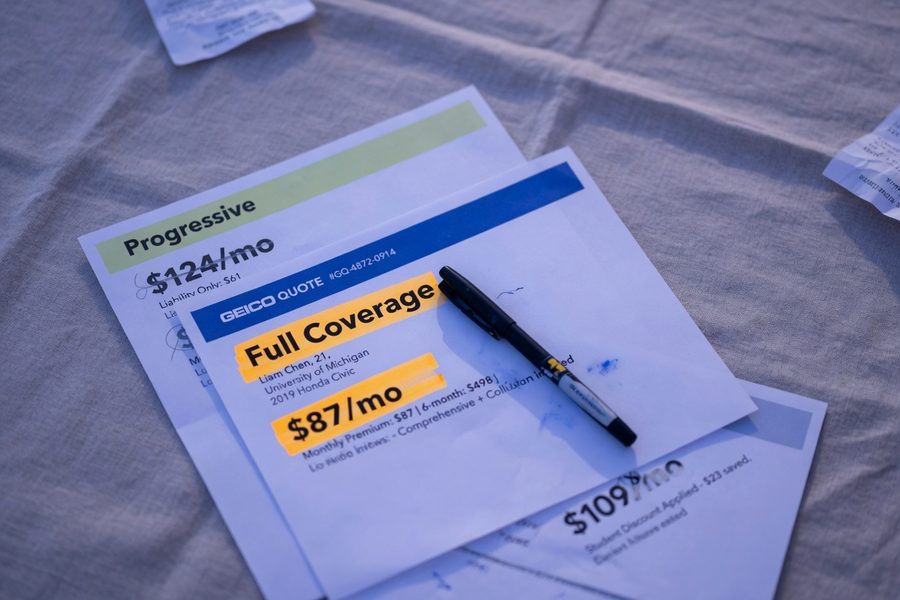
Shopping multiple carriers is the single most effective action a college student can take. GEICO consistently ranks as a low-cost option for young drivers on parents’ policies across multiple independent 2025 comparisons, often undercutting competitors by $50 or more per month. But “often cheapest” is not the same as “always cheapest.” State Farm, Erie, and USAA (for military families) frequently compete closely depending on the student’s state and profile.
Practical Steps to Compare Quotes Effectively
Our step-by-step guide to car insurance quote comparison walks through the full process, but the short version is: get at least three quotes for the exact same coverage levels, use both direct insurer websites and an independent broker, and request quotes for both adding to a parent’s policy and getting a standalone policy so you have real numbers to compare.
“Make sure you shop around with multiple carriers to get the best rates and coverages.”
Bundling is another underused strategy. If a student rents an apartment off campus, adding renters insurance alongside their auto policy from the same carrier typically generates a multi-policy discount of 5–15%. Renters insurance itself costs around $15–$20 per month on average, and the auto discount can offset part or all of that cost. It is also worth checking whether the family’s homeowners policy already covers the student’s belongings at school, which could make standalone renters insurance redundant. Our piece on ways to reduce your auto insurance costs covers additional tactics that apply directly to young drivers.
“We always recommend working with a qualified agent to ensure your policy is appropriate for your insurance needs.”
Before finalizing any policy, ask specifically about the good-student discount and provide a current transcript. Many insurers will not apply the discount automatically; you have to request it and submit proof. The same applies to the distant-student discount: notify your insurer each semester the car stays home.
One honest caveat: working with an independent agent adds a layer of guidance, but agents are compensated by carriers, which creates a potential conflict of interest. Cross-check any recommendation against direct quotes from at least one or two insurers you contact yourself. The guidance from understanding how car insurance quotes are calculated can help you evaluate whether an agent’s suggestion reflects your actual risk profile or a carrier’s payout incentive.
For students thinking through coverage decisions beyond auto, choices made now about deductibles, coverage gaps, or lapses can affect future premium history. If you are also sorting out health coverage options as a student, our overview of the different types of insurance and how each works provides a useful grounding.
Frequently Asked Questions
Can a college student stay on their parents’ car insurance policy?
Yes, in most cases. If the student’s primary residence is still the parents’ home and they drive a parent-owned vehicle, coverage under the family policy typically continues. Once the student owns their own car or establishes a permanent address elsewhere, a separate policy is usually required.
Does going to school in another state affect my car insurance?
It can, and often does. Insurers price premiums partly based on where the vehicle is garaged, and a new state may have different minimum coverage requirements. Notify your insurer or agent before the move, not after. Rates may go up or down depending on the school’s location.
What GPA do you need for a good-student car insurance discount?
Most carriers require a 3.0 GPA (B average) on a 4.0 scale. Some accept rank-in-class standing as an alternative. You will need to submit a current transcript or report card each year to keep the discount active, and you need to request it proactively since it is rarely applied automatically.
Is it cheaper for a college student to get their own car insurance policy?
No, not for most students. An 18-year-old purchasing a solo policy pays an average of $7,146 per year, compared to $4,079 when added to a parent’s policy, a gap of over $3,000 annually. An independent policy makes financial sense only when the student owns the car outright or lives permanently outside the family home.
What is a distant-student discount and how does it work?
A distant-student discount reduces premiums when a college student attends school at least 100 miles from home without taking the car. Because the student is no longer a regular driver of the insured vehicle, the insurer lowers the risk classification and adjusts the rate accordingly. The discount is removed if the car relocates to campus, even temporarily.
Sources
- insurance.com, Car Insurance for College Students (2025)
- Insurance Information Institute, Auto Insurance for Teen and College Students (2025)
- Forbes Advisor, Average Cost of Car Insurance (2025)
- CNBC Select, Best Car Insurance for College Students (2025)
- ValuePenguin, Should I Take My College Student Off My Auto Insurance Policy?
- Texas Department of Insurance, College Insurance Tips
- Oregon Division of Financial Regulation, Insurance Tips for College Students
- North Dakota Insurance Department, College Students and Insurance